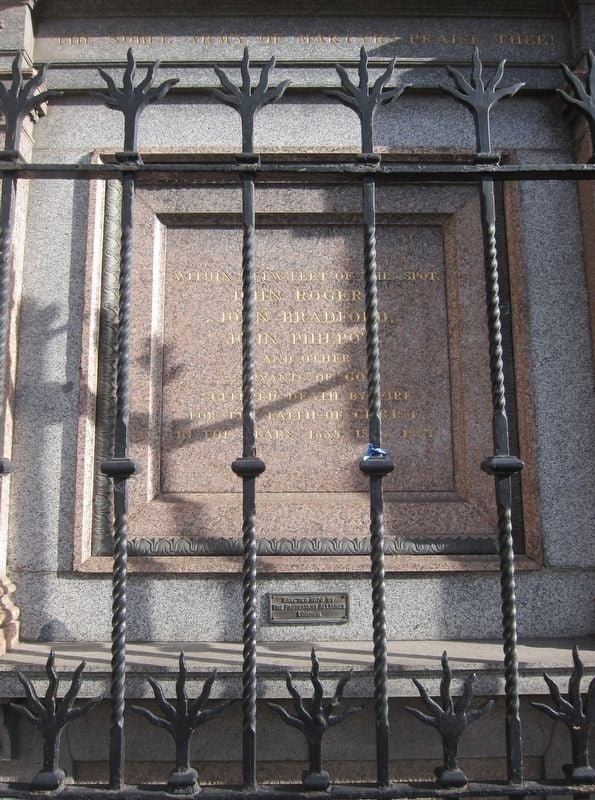
Inscription
Within a few feet of this spot,
John Rogers,
John Bradford,
John Philpot,
and other servants of God,
suffered death by fire
for the faith of Christ,
in the years 1555, 1556, 1557.
_____
The Marian Persecutions represent one of the most dramatic and tragic chapters in the history of the English Reformation. During the reign of Mary I of England, hundreds of Protestants were executed for refusing to return to Roman Catholic doctrine. These individuals later became known as the English Marian Martyrs.
Mary I came to the English throne in 1553 following the death of her half-brother, the Protestant king Edward VI of England. Determined to restore Catholicism in England, Mary reversed many of the Protestant reforms that had taken place during the previous decades. Her government reinstated laws against heresy, making it possible to prosecute and execute those who rejected Catholic teachings.
Between 1555 and 1558, approximately 280 men and women were burned at the stake for their Protestant beliefs. These executions took place in cities and towns across England, including London, Oxford, and Canterbury. Among the most well-known martyrs were church leaders such as Hugh Latimer, Nicholas Ridley, and Thomas Cranmer.
Many ordinary believers were also executed, including artisans, farmers, and women who refused to abandon their Protestant faith. The burnings were intended to discourage resistance to the restoration of Catholic authority. Instead, they often produced sympathy for the victims and strengthened the resolve of Protestant supporters.
The memory of the Marian Martyrs was preserved in great detail by the English writer John Foxe in his famous book Acts and Monuments, commonly known as Foxe’s Book of Martyrs. The book described the trials and executions of many Protestant believers and became one of the most widely read works in Elizabethan England.
When Elizabeth I succeeded Mary in 1558, the persecution ended and Protestantism was gradually reestablished as the dominant form of Christianity in England.
The legacy of the English Marian Martyrs has endured for centuries. Their willingness to die rather than abandon their convictions became a powerful symbol of Protestant faithfulness. Churches, memorials, and historical writings continue to remember their sacrifices, reminding later generations of the intense struggles that accompanied the establishment of Protestantism in England.
_____
Image Source/Credit:
• Andrew Ruppenstein of Lamorinda, California, HMDB.org
Related
Sorry, no records were found. Please adjust your search criteria and try again.
Sorry, unable to load the Maps API.