
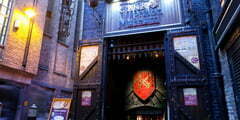
The Clink Prison Museum stands on the south bank of the River Thames in London, preserving the memory of one of England’s oldest and most notorious prisons. Though the original prison no longer survives, the museum marks the site of the medieval Clink Prison and offers insight into centuries of law, punishment, and daily life in the capital.
The history of the Clink dates back to at least the twelfth century, when it was established under the authority of the Bishop of Winchester. The bishops owned land in the Southwark area, which lay just outside the jurisdiction of the City of London. This location made it a convenient place for institutions that did not fit easily within the city’s stricter regulations, including prisons, theaters, and various trades. The Clink Prison was used to hold a wide range of inmates, from debtors and vagrants to religious dissenters and political offenders.
Unlike modern prisons, the Clink was not primarily designed for rehabilitation. Conditions were harsh, and prisoners were often required to pay for their own food, bedding, and even release. Those who could afford better treatment might secure improved conditions, while the poor endured severe hardship. Over time, the prison gained a reputation for corruption, as jailers were known to exploit inmates for profit.
The Clink was particularly associated with the religious conflicts of the sixteenth and seventeenth centuries. During the English Reformation and the periods that followed, individuals who resisted the religious policies of the crown were sometimes imprisoned there. Both Catholics and Protestant dissenters found themselves confined within its walls at different times, reflecting the shifting nature of religious authority in England. The prison thus became a symbol of the tensions between conscience and control during a formative period in English history.
The original Clink Prison was eventually destroyed in 1780 during the Gordon Riots, a wave of anti-Catholic protests that led to widespread unrest in London. After its destruction, the site was not rebuilt as a prison, and the institution passed into history. However, its legacy endured, even entering the English language through the phrase “to be thrown in the clink,” meaning to be imprisoned.
The modern Clink Prison Museum was established to bring this history to life for contemporary audiences. Through exhibits, reconstructions, and artifacts, the museum recreates aspects of prison life, allowing visitors to experience something of what inmates might have faced. Displays include replicas of torture devices, information about medieval law enforcement, and accounts of notable prisoners. While some elements are designed to engage and even entertain visitors, the museum also aims to educate by presenting the realities of historical punishment and justice.
The impact of the Clink Museum lies in its ability to connect the present with the past. It provides a tangible link to a period when the systems of law and punishment were very different from those of today. By exploring the history of the Clink, visitors gain a deeper understanding of how ideas about justice, authority, and human rights have evolved over time.
In addition, the museum contributes to the preservation of Southwark’s rich historical identity. The area, once known for its liberties and contrasts with the City of London, remains a place where layers of history can still be discovered. The Clink Museum serves as one of the key sites through which that history is interpreted.
Today, the Clink Prison Museum stands not only as a reminder of a notorious institution but also as a reflection on the broader development of society. It invites visitors to consider how far systems of justice have come—and how the past continues to shape the present.
♦ _____ ♦
On London’s Clink Street, the Clink Museum stands at the ruins of this infamous prison, where John Greenwood, Henry Barrow, and Francis Johnson (of the “Ancient Church”), along with Henry Jacob, and John Lathrop (forerunners of Particular Baptists), all suffered incarceration, during 1587-1634.
Copyrighted and used by permission from David Beale, Baptist History in England and America: Personalities, Positions, and Practices
_____
Image Source/Credit:
• Admin. “Clink Prison Museum London | UK School Trips.” UK School Trips, 4 Nov. 2024 (www.ukschooltrips.co.uk/clink-prison-museum-london)
Related
Sorry, no records were found. Please adjust your search criteria and try again.
Sorry, unable to load the Maps API.