
Watch Douglas Whitley as Spurgeon:
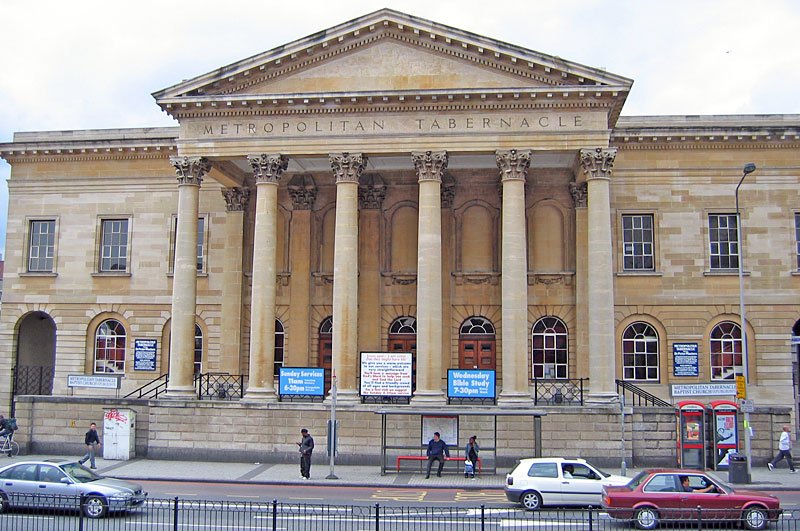
The Metropolitan Tabernacle in London is one of the most influential Baptist churches in the history of English Nonconformity. Closely associated with the ministry of Charles Haddon Spurgeon, it became a center of evangelical preaching in the nineteenth century and remains an active congregation today.
The origins of the Metropolitan Tabernacle trace back to the early eighteenth century. A Baptist congregation was established at New Park Street Chapel in 1650, making it one of the oldest Baptist churches in London. Over time, the congregation grew and moved locations to accommodate increasing numbers of worshippers. By the nineteenth century, it had settled at New Park Street, where it became a significant center of Baptist life.
The turning point in the church’s history came in 1854, when Charles Haddon Spurgeon, then only 19 years old, was called as pastor. Spurgeon’s preaching quickly attracted large crowds due to his powerful oratory, clear theological message, and strong emphasis on personal conversion. The New Park Street Chapel soon became too small to accommodate the growing congregation, and plans were made for a larger building.
In 1861, the Metropolitan Tabernacle was opened at Elephant and Castle, designed to seat approximately 5,000 people. At the time, it was one of the largest independent church buildings in the world. The structure reflected both the ambition of the congregation and the extraordinary popularity of Spurgeon’s ministry. Services were often filled to capacity, with visitors coming from across London and beyond to hear him preach.
Spurgeon’s ministry at the Tabernacle was marked by a strong commitment to biblical preaching, evangelism, and social concern. He emphasized the authority of Scripture and the necessity of personal faith in Christ. His sermons were widely published and distributed, making him one of the most influential Christian voices of the nineteenth century. Through his work, the Metropolitan Tabernacle became a center not only of worship but also of theological education and missionary support.
The church also played an important role in broader Baptist and evangelical movements. It supported missionary efforts through organizations such as the Baptist Missionary Society and was involved in various charitable and educational initiatives in London. Spurgeon himself established the Pastors’ College, which trained ministers for evangelical service.
After Spurgeon’s death in 1892, the church continued its ministry under successive pastors, though it faced challenges typical of large urban congregations in the modern era. In 1898, the original building was destroyed by fire. However, the congregation rebuilt on the same site, and the present Metropolitan Tabernacle was opened in 1900. The new structure maintained the spirit of the original, with a large auditorium designed for preaching and congregational worship.
Throughout the twentieth and twenty-first centuries, the Metropolitan Tabernacle has remained a center of Reformed Baptist worship. While no longer attracting the vast crowds of Spurgeon’s day, it continues to serve a committed congregation and maintains a strong emphasis on preaching and doctrinal teaching.
The impact of the Metropolitan Tabernacle lies in its association with one of the most influential preachers in Christian history and its role in shaping evangelical Baptist identity. It stands as a symbol of nineteenth-century revivalism, urban ministry, and global missionary vision.
Today, the Metropolitan Tabernacle remains both a living church and a historic landmark. It continues to reflect the legacy of its past while carrying forward its commitment to biblical preaching and Christian service in the heart of London.
_____
Image Source/Credit (in order):
• Oast House Archive / Metropolitan Tabernacle, Elephant & Castle, London
Related
Sorry, no records were found. Please adjust your search criteria and try again.
Sorry, unable to load the Maps API.