
Jerry Root at the Bunhill Fields Burial Grounds:
I’m sitting here in a famous London cemetery called Bunhill Fields. If you were an Anglican, you could be buried in an Anglican cemetery. But if you weren’t an Anglican, you had to be buried in a non-conformist cemetery. And this is one where there were many interesting people in both theological and literary history who were not Anglicans, but they made an impact on their world.
To my right is the grave of John Bunyan, who wrote Pilgrim’s Progress. Beyond his grave is John Owen, the great Puritan divine. And to my left is the grave of William Blake, the famous poet. If you’re a C.S. Lewis fan like I am, William Blake wrote a poem called The Marriage of Heaven and Hell. C.S. Lewis said, Behind me is the grave of Susanna Wesley, John and Charles Wesley’s mother. And beyond them, almost at the edge of the cemetery, is the grave of John Gill, the famous theologian who wrote this massive theological work. They called it Gill’s Body of Divinity. And a short distance from him is the grave of John Rippon. Many of you know the hymn that he wrote, How Firm a Foundation, Ye Saints of the Lord, is Laid for Your Faith in His Wonderful Word.
Those two men were significant because John Gill pastored a church called New Park Street Church here in London for 50 years. He died, and they hired a young guy in his early 20s, John Rippon, to pastor that church. He pastors it for 50 years. He dies, and they hire a young guy 19 years old to pastor that church.
Can you imagine? And that guy was such a great preacher, they ended up changing the name of the church to the Metropolitan Tabernacle pulpit, and that was C.H. Spurgeon. 150 years, three pastors in 150 years. Of course, after Spurgeon died, they needed to hire a famous person. They were looking for a star rather than a young person like they had before, and consequently the church has never been quite as big a deal as it was under Spurgeon. They’ve had some good moments in their history, but it’s not been quite the same. Just behind us, Isaac Watts, the great hymn writer. His remains are buried back there. Bun Hill Fields, across the street from John Wesley’s London home.
Welcome to Bunhill Cemetery, which is just across the street from the Wesley Chapel here in London. And here we find the grave of the great John Bunyan. I want you to notice this relief. Do you see this burden of sin? that he describes so well in Pilgrim’s Progress. In that book, he talks about the temptations that we face. He speaks also about the dangers of the Christian life, but he always holds before him the heavenly city to which we are going. Now, the good news is that Bunyan experienced the blessing of God and the forgiveness of God. And that, of course, is a relief actually on the other side, where the burden of sin is gone, It, of course, was taken, as it were, and thrown into the grave of Christ, the empty tomb.
And what you see there is the cross. So let’s remember. When we read Pilgrim’s Progress, this was written by a man who was in jail for 12 years, and he used that time very wisely. We’re still reading Pilgrim’s Progress today, and even as we stand here, we remember the impact of this man. I like to repeat this over and over again. God never shows us the good that we do. Bunyan had no idea. that hundreds of years later, his book would be read with appreciation, and that we would be rejoicing in the fact that he taught us so much about the burden of sin, the dangers of temptation, all the way to the heavenly city. Thanks for watching, and you have a good day.
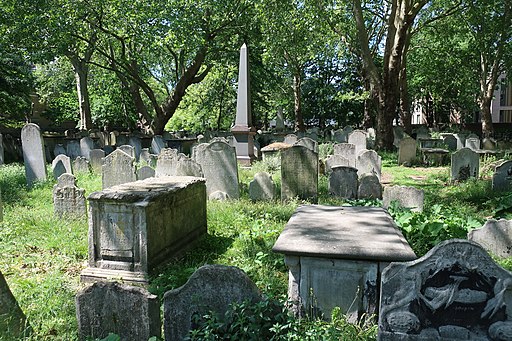
Bunhill Fields is one of the most historically significant burial grounds in London, particularly associated with Protestant Nonconformists. Located just outside the old boundaries of the City of London, Bunhill Fields became a resting place for those who stood outside the established Church of England and sought freedom of conscience in matters of faith.
The origins of Bunhill Fields as a burial ground date back to the seventeenth century. Before it became formally recognized, the area had been used during times of crisis, including the Great Plague of London, as a place for emergency burials. By 1665, the site was more systematically used for interments, and in 1669 it was officially designated as a nonconformist burial ground. This was a significant development at a time when religious dissenters often faced restrictions in both life and death, including limitations on where they could be buried.
Over the next two centuries, Bunhill Fields became the principal cemetery for Nonconformists in London. It served a wide range of Protestant groups who did not conform to the practices of the established church, including Baptists, Independents, Presbyterians, and Quakers. The burial ground thus reflects the diversity of dissenting religious life in England and the gradual expansion of religious toleration following legislation such as the Toleration Act of 1689.
Among those buried at Bunhill Fields are some of the most influential figures in English religious and literary history. John Bunyan, the famed Baptist preacher and author, is perhaps the most closely associated with the site; his grave remains a place of interest for visitors. Also interred there is Daniel Defoe, whose writings helped shape early English literature. Another notable figure is Isaac Watts, often called the “father of English hymnody,” whose hymns have been sung for generations.
The presence of these and many other figures underscores the intellectual and spiritual contributions of Nonconformists to English society. Bunhill Fields is not merely a cemetery; it is a record in stone of a movement that valued religious liberty, personal conviction, and the authority of Scripture. The individuals buried there were often leaders, thinkers, and writers who influenced both church life and broader culture.
By the nineteenth century, the burial ground had become full, and it was closed to new interments in 1854. Despite this, its historical importance continued to be recognized. Efforts were made to preserve the site, and it eventually came under the care of local authorities. Today, Bunhill Fields is maintained as a public garden and heritage site, offering a quiet space for reflection amid the surrounding urban environment.
Visitors to Bunhill Fields can walk among the gravestones and monuments, many of which bear inscriptions that provide insight into the beliefs and lives of those buried there. The layout of the ground, with its mixture of simple markers and more elaborate memorials, reflects both the humility and the significance of the people it commemorates.
The impact of Bunhill Fields lies in its enduring testimony to the history of religious dissent in England. It stands as a reminder of a time when freedom of worship was not taken for granted and when individuals often faced hardship for their convictions. At the same time, it celebrates the contributions of those who helped shape the religious, literary, and cultural life of the nation.
In this way, Bunhill Fields continues to speak across the centuries. It preserves the memory of a community defined by faith and principle, and it offers a place where the past can be encountered in a direct and meaningful way.
♦ _____ ♦
Bunhill Fields, at 38 City Road, was the Burying Ground for Dissenters. Here stand the tombs of key players in Baptist history: John Rippon, Joseph Ivimey, John Gill, and John Bunyan. Important Baptists whose tombstones here have been destroyed over time include Henry Jessey, Hanserd Knollys, William Kiffin, and Vavasor Powell. See also the tombstones of notable non-Baptists, such as Daniel Defoe, author of Robinson Crusoe, Isaac Watts, “Father of English Hymnody,” and Susanna Wesley, mother of nineteen children, of whom the most eminent were John and Charles. Just across the road from Bunhill Fields is the Wesley House.
Copyrighted and used by permission from David Beale, Baptist History in England and America: Personalities, Positions, and Practices
Learn more about William Kiffin in this interview with Dr. David Saxon on VCY.tv
_____
Image Source/Credit:
• GrindtXX, CC BY-SA 4.0 <https://creativecommons.org/licenses/by-sa/4.0>, via Wikimedia Commons
Related
Sorry, no records were found. Please adjust your search criteria and try again.
Sorry, unable to load the Maps API.