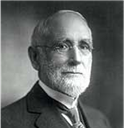
Lyman Stewart (1840–1923) was an American oilman, businessman, and Christian philanthropist whose wealth and convictions helped shape the rise of early twentieth-century fundamentalism. Best known as co-founder of the Union Oil Company of California, Stewart used his fortune not only to build one of the major energy enterprises of the American West, but also to fund religious initiatives that left a lasting imprint on evangelical Christianity.
Stewart was born on August 22, 1840, in Coatesville, Pennsylvania, into a modest farming family. His early life was marked by hard work and limited formal education, but he demonstrated a strong practical intelligence and entrepreneurial drive. Like many ambitious young men of his era, he moved west in search of opportunity, eventually settling in California during a period of rapid economic growth following the Gold Rush.
In the late nineteenth century, Stewart entered the emerging oil industry, which was beginning to transform the American economy. In 1890, he co-founded the Union Oil Company of California (commonly known as Union Oil or “Unocal”) alongside businessman Thomas Bard. The company played a key role in developing oil production in California, particularly in the Santa Paula region, where early wells helped establish the state as a significant center of petroleum production.
Under Stewart’s leadership, Union Oil expanded rapidly. He served as president of the company and was instrumental in shaping its early corporate structure and business strategy. The company’s success brought Stewart substantial wealth, but he was not primarily driven by financial gain. Instead, he saw business as a means of providing stability and opportunity while also enabling him to support causes he considered spiritually important.
Stewart was a committed evangelical Christian, and his faith became increasingly central to his identity as he grew older. He was particularly concerned with what he perceived as the growing influence of theological liberalism within Protestant churches. In response, he became one of the most important financial supporters of the early fundamentalist movement.
One of Stewart’s most significant contributions was his support for the publication of The Fundamentals, a series of essays published between 1910 and 1915 that defended core doctrines of conservative Protestant Christianity. These essays were distributed widely to pastors, missionaries, and Christian workers throughout the United States and abroad. Stewart provided much of the funding for this project, which helped define the theological boundaries of what would come to be known as “fundamentalism.”
The influence of The Fundamentals was far-reaching. The essays addressed topics such as biblical authority, the deity of Christ, the virgin birth, and the reality of miracles. By promoting these ideas, Stewart and his collaborators sought to reinforce traditional Christian beliefs at a time when higher criticism and modernist theology were gaining ground in academic and ecclesiastical settings.
In addition to his support for theological publications, Stewart also contributed to missionary efforts and Christian educational initiatives. He believed strongly in the importance of evangelism and the spread of the gospel, both in the United States and overseas. His philanthropy reflected a consistent desire to use his resources for what he viewed as eternal rather than temporal purposes.
Stewart’s legacy is closely tied to that of his brother and business partner, Milton Stewart, who shared both his commercial interests and his religious convictions. Together, the Stewart brothers were among the most influential lay supporters of conservative Protestantism in the early twentieth century. Their financial backing helped sustain institutions and movements that might otherwise have struggled to survive during periods of theological conflict.
Beyond his religious influence, Stewart’s impact on the oil industry also deserves recognition. Union Oil became a major player in the development of California’s petroleum resources and contributed to the broader growth of the American energy sector. The company’s success helped shape the economic landscape of the western United States during a time of rapid industrial expansion.
Lyman Stewart died on September 28, 1923, leaving behind both a business empire and a significant religious legacy. His fortune continued to support Christian causes after his death, ensuring that his influence extended beyond his lifetime.
In historical perspective, Stewart represents a distinctive type of American figure: the industrial entrepreneur whose wealth was deeply intertwined with religious conviction. His life illustrates how economic success in the modern industrial era could be leveraged to shape cultural and theological movements.
Today, his legacy is most clearly seen in the enduring impact of early fundamentalism and the institutions it helped inspire. While he is less widely known than some of the religious leaders he supported, his financial backing played a crucial role in enabling their work. In this sense, Lyman Stewart’s influence continues to echo in the ongoing story of American evangelical Christianity.
_____
Image Source/Credit:
• Wikipedia contributors. “Lyman Stewart.” Wikipedia, 26 Jan. 2025 (en.wikipedia.org/wiki/Lyman_Stewart)
Related
Sorry, no records were found. Please adjust your search criteria and try again.
Sorry, unable to load the Maps API.