
Thomas Hooker stands among the most influential early Puritan leaders in colonial New England. A gifted preacher, theological thinker, and community organizer, Hooker played a foundational role in the development of democratic ideas in America and in the founding of the colony of Connecticut. His life reflects the broader story of Puritan migration, religious reform, and the shaping of early American political thought.
Born in 1586 in Leicestershire, England, Hooker was educated at Emmanuel College, Cambridge, a training ground for many Puritan ministers. From early in his career, he became known for his powerful preaching and strong convictions regarding church reform. Like many Puritans, he believed that the Church of England retained too many elements of Roman Catholic practice and needed further purification according to Scripture. These beliefs eventually brought him into conflict with ecclesiastical authorities.
By the 1630s, as pressure on nonconforming ministers increased under Archbishop William Laud, Hooker fled England for the more tolerant environment of the Dutch Republic, settling briefly in Holland. However, like many of his contemporaries, he soon concluded that a more permanent solution lay in the New World, where Puritans sought to establish communities grounded in their religious principles. In 1633, Hooker emigrated to Massachusetts Bay Colony, where he became pastor in Cambridge (then called Newtowne).
In Massachusetts, Hooker quickly gained prominence as a preacher of unusual clarity and force. His sermons emphasized the immediacy of God’s grace and the importance of personal faith, themes that resonated deeply with his congregations. However, Hooker also became increasingly concerned with the colony’s restrictive political structure, particularly the limited franchise, which restricted voting rights to church members approved by the colony’s leadership.
Hooker’s most significant contribution came through his disagreement with the leadership of Massachusetts Bay, especially over questions of political authority and the nature of consent. In a famous sermon delivered in 1638 before the General Court, Hooker articulated a revolutionary idea for his time: that “the foundation of authority is laid in the free consent of the people.” While the exact wording is often paraphrased in later sources, the essence of his argument is well documented. This principle would later be seen as a precursor to democratic thought in America.
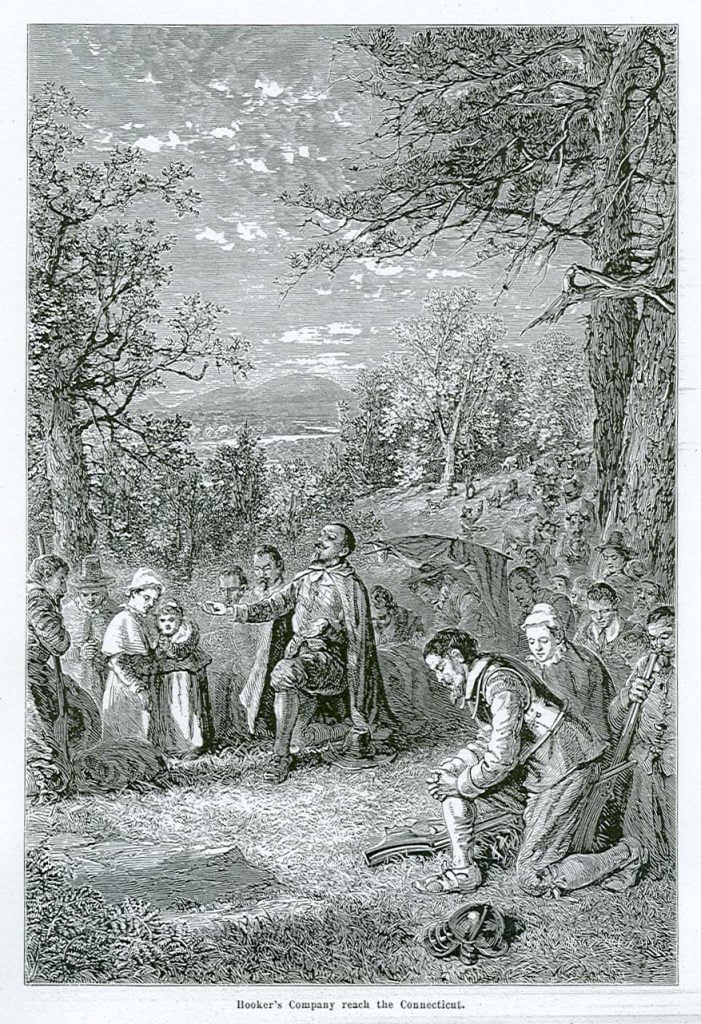
Shortly after this period of tension, Hooker led a group of followers out of Massachusetts and into the Connecticut River Valley. In 1636, they established the settlement of Hartford, forming the basis of the Connecticut Colony. Unlike Massachusetts, the Connecticut settlements developed a more inclusive political framework. This was formalized in 1639 with the adoption of the Fundamental Orders of Connecticut, often regarded by historians as one of the first written constitutions in the Western tradition. Hooker’s influence on this development was significant, even if indirect.
Religiously, Hooker remained committed to Puritan orthodoxy, but he also emphasized the importance of spiritual assurance and pastoral care. His theology balanced strict moral expectations with a strong emphasis on God’s mercy. This combination helped shape the pastoral identity of early New England churches and influenced later generations of ministers.
Hooker’s legacy is most often discussed in terms of political thought. His advocacy for consent and participatory governance contributed to the intellectual foundations of American democracy. While he did not propose modern democratic systems, his insistence that legitimate authority required the agreement of the governed represented a significant departure from prevailing European political models.
He also left a lasting institutional legacy. The colony he helped found became one of the original thirteen states, and its early political structures influenced later constitutional development in America. Connecticut’s emphasis on written agreements, local governance, and community consent can be traced in part to Hooker’s leadership and ideas.
Hooker died in 1647 in Hartford, but his influence continued long after his passing. Later historians and political thinkers, particularly in the eighteenth and nineteenth centuries, often cited him as a key figure in the development of American democratic principles. While modern scholarship tends to place his ideas within the broader context of Puritan political thought, his role as a catalyst remains widely acknowledged.
In conclusion, Thomas Hooker was more than a preacher; he was a formative voice in the early shaping of American society. His sermons challenged assumptions about authority, his leadership helped establish a new colony, and his ideas contributed to emerging concepts of self-government. Through his ministry and migration, Hooker left a legacy that bridged theology and politics, shaping the identity of early New England and influencing the development of American democratic ideals.
_____
Image Source/Credit:
• Public domain, via Wikimedia Commons
Related
Sorry, no records were found. Please adjust your search criteria and try again.
Sorry, unable to load the Maps API.