
From the National Park System:
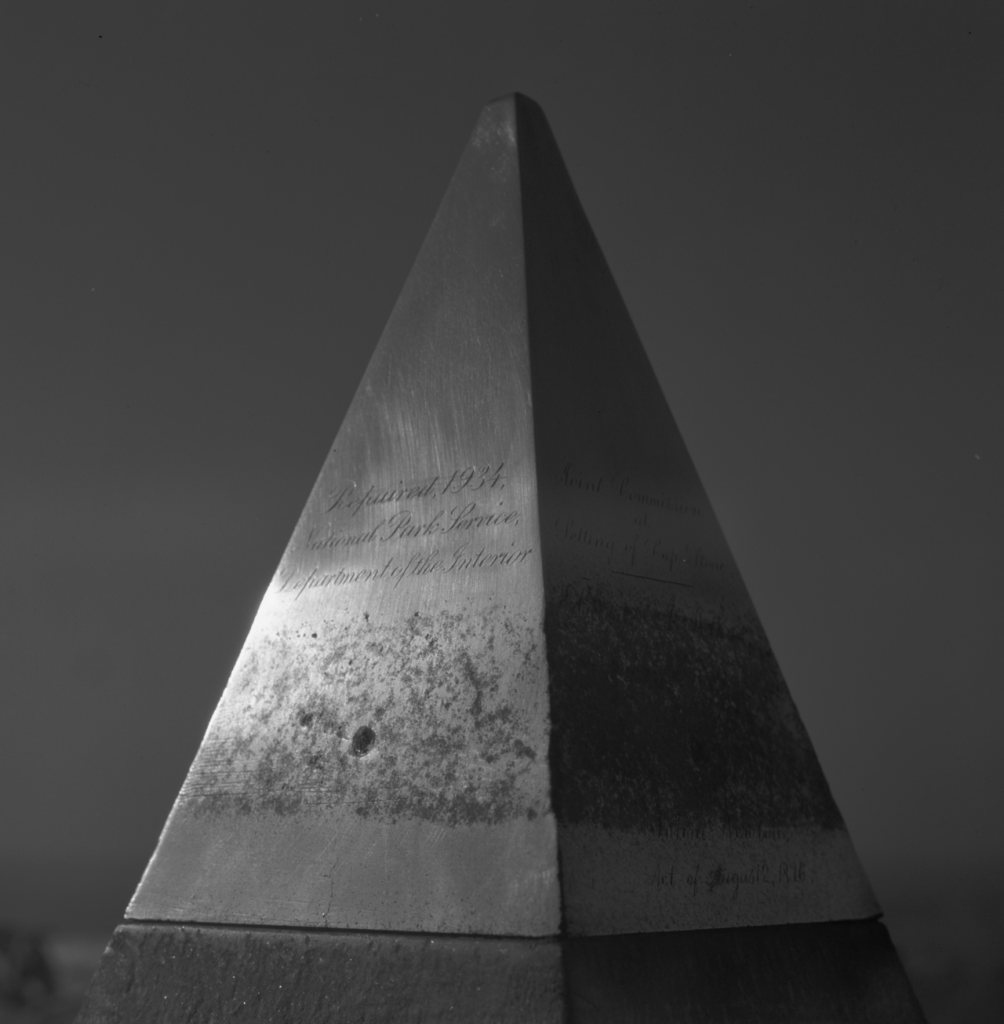
470 feet above the ground, the builders began angling buttresses inward to support the 300-ton marble pyramidion at the top of the monument. Supported by the buttresses, the angled walls of the pyramidion, anchored by mortice and tenon joints, climbed inward beginning at 500 feet above ground. On a breezy December 6, 1884, Lt. Col. Casey supervised as the 3,300-pound capstone was brought out through one of the windows, hoisted to the scaffolding at the dizzying tip of the monument, and set in place. Casey then placed the 8.9-inch aluminum tip atop the capstone to the cheers of the crowd below. The Washington Monument was complete, and it had surpassed the Cologne Cathedral to be the tallest building in the world at 555 feet, 5.125 inches. Inscribed on the aluminum cap, notable names and dates in the monument’s construction are recalled, and on the east face, facing the rising sun, the Latin words “Laus Deo,” which translate to, “Praise be to God.”
The Washington Monument was dedicated on a chilly February 21, 1885, one day before George Washington’s birthday (which fell on a Sunday that year). After the completion of the iron staircase in the monument’s interior, the Washington Monument was first accessible to the public in 1886, closed much of 1887 until it could be better protected from vandals, and reopened in 1888 with a public elevator. Visitors making the ascent could view commemorative stones inset in the walls from various individuals, civic groups, cities, states, and countries from around the world, the tokens of appreciation of Washington’s admirers and, in many cases, the donors that contributed to the construction of the Monument in its privately-financed phase. Today there are 193 of these commemorative stones.
By 1934 when the aluminum cap was repaired, the inscription was illegible.
Related
Sorry, no records were found. Please adjust your search criteria and try again.
Sorry, unable to load the Maps API.