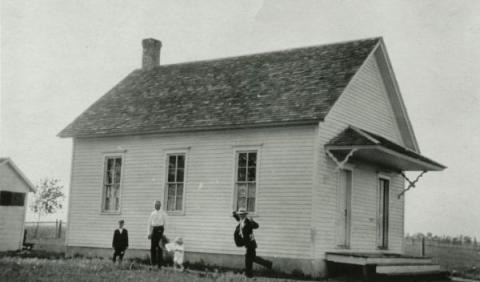
Clearview School in Iowa represents a small but meaningful piece of the early life and environment that helped shape one of America’s most famous evangelists, Billy Sunday. Though the school itself was a typical rural one-room schoolhouse, its connection to Sunday reflects the broader story of how modest beginnings and local institutions contributed to the development of influential figures in American religious history.
Billy Sunday (1862–1935) was born in Iowa during a time when the state was still largely rural and agricultural. His early life was marked by hardship. His father, a Union soldier, died shortly after the Civil War, leaving the family in difficult circumstances. As a result, Sunday spent part of his youth in an orphanage, but he also experienced the rhythms of rural life in Iowa, where small schools like Clearview played a central role in community life.
Clearview School was typical of late nineteenth-century rural education in the Midwest. As a one-room schoolhouse, it brought together children of different ages under the instruction of a single teacher. Lessons included reading, writing, arithmetic, and moral instruction, often rooted in Christian principles. These schools emphasized discipline, responsibility, and character—values that would later be reflected in Sunday’s preaching and public persona.
The connection between Clearview School and Billy Sunday lies in the formative environment it represents. While specific details of his attendance may be limited, the school stands as a symbol of the kind of education and community structure that shaped his early years. In such settings, children were taught not only academic subjects but also the importance of hard work and moral conduct, traits that became hallmarks of Sunday’s life.
As a young man, Sunday gained national attention as a professional baseball player. Known for his speed and agility, he played in the major leagues before experiencing a religious conversion that changed the course of his life. Leaving baseball behind, he devoted himself to Christian ministry, eventually becoming one of the most prominent evangelists of his time.
Sunday’s preaching style was energetic and direct, often incorporating vivid illustrations and physical movement that captured the attention of large audiences. Despite his later fame and the scale of his revival meetings, his message retained the straightforward, practical tone associated with rural America. He spoke in a way that ordinary people could understand, addressing issues such as personal morality, faith, and social reform.
The influence of environments like Clearview School can be seen in Sunday’s emphasis on discipline and moral clarity. His sermons frequently called for personal responsibility and a return to traditional values, reflecting the lessons commonly taught in rural schools and communities. His advocacy for temperance and his strong opposition to alcohol were consistent with the moral framework that shaped many Midwestern communities during his youth.
Clearview School also represents the broader cultural setting of Iowa in the late nineteenth century. It was a time when communities were closely knit, and institutions such as schools and churches played central roles in daily life. These environments fostered a sense of shared values and collective responsibility, which influenced individuals like Sunday as they grew and developed their convictions.
Today, the legacy of Clearview School in connection with Billy Sunday lies not in grand architecture or widespread recognition, but in its symbolic importance. It reminds us that the foundations of influential lives are often laid in simple, everyday settings. The discipline, education, and moral instruction associated with such schools helped prepare individuals to take on larger roles in society.
In conclusion, Clearview School in Iowa stands as a quiet but meaningful part of Billy Sunday’s story. It represents the kind of environment that shaped his character and informed his later ministry. Through this connection, the school serves as a reminder of the lasting impact of rural education and community life on the course of American history.
♦ _____ ♦
According to the Ames Historical Museum, Billy Sunday attended Clearview School, a one-room schoolhouse on the northwest corner of South Duff & Airport Road in Washington Township. At the time, Sunday was living with his maternal grandparents, the Cory’s.
_____
Image Source/Credit:
• Clearview School | Ames History Museum (ameshistory.org/content/clearview-school)
Related
Sorry, no records were found. Please adjust your search criteria and try again.
Sorry, unable to load the Maps API.