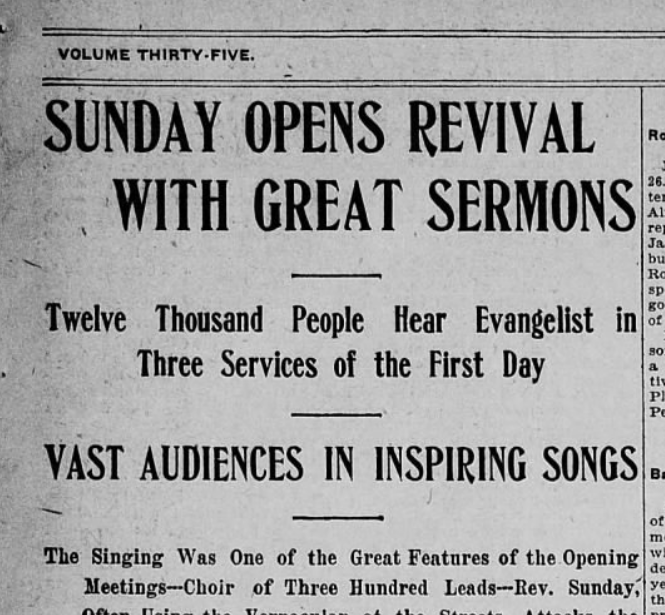
Billy Sunday (1862-1935) is regarded as the most prominent — and influential — evangelist of the early part of the 20th century. Born near Ames, he spent part of his youth in Marshalltown, then returned here in 1909, where he spoke to a packed tabernacle of his followers.
The tabernacle in Marshalltown in which Sunday did his preaching was located at Third Street and Main Street. One sermon was called “Booze Or Get On The Water Wagon.” That sermon was regarded as an influential factor in Marshalltown closing its saloons just two years later — years before Prohibition was passed nationally.
♦ _____ ♦
he 1909 revival campaign led by Billy Sunday in Marshalltown stands as a notable example of the evangelistic fervor that swept across small-town America in the early twentieth century. Though Sunday would later conduct massive campaigns in major cities, meetings like the one in Marshalltown reveal how his influence took root in local communities and helped shape the moral and religious climate of the era.
By 1909, Billy Sunday was already gaining recognition as a dynamic and unconventional preacher. A former professional baseball player, he brought energy and physicality to the pulpit that set him apart from more traditional ministers. His sermons were lively, direct, and often dramatic, filled with vivid language and forceful appeals. This approach resonated strongly with audiences, particularly in towns like Marshalltown, where people were eager for both spiritual renewal and a sense of shared purpose.
The crusade in Marshalltown was carefully organized, as was typical of Sunday’s campaigns. Local churches of various denominations cooperated in planning the event, setting aside differences to support a united effort. A large temporary tabernacle was often constructed for such meetings, capable of accommodating the crowds that Sunday attracted. These structures became central gathering places, where people from all walks of life came to hear the evangelist preach.
Each service followed a familiar pattern. There was music—often led by a choir and accompanied by spirited congregational singing—followed by testimonies and then Sunday’s sermon. His messages focused on personal repentance, moral responsibility, and the need for a clear decision of faith. He spoke plainly about issues such as alcohol, dishonesty, and social vice, urging listeners to adopt a disciplined and upright way of living.
In Marshalltown, as in many other locations, the response was significant. Large crowds attended the meetings, and many individuals came forward at the close of services to profess faith or renew their commitment to Christian living. These public responses were a hallmark of Sunday’s ministry, symbolizing a decisive turning point in a person’s life. For the community, the crusade created a sense of momentum, encouraging both personal change and collective reflection.
The campaign also had a broader social impact. Sunday was a strong advocate of the temperance movement, and his preaching often reinforced efforts to reduce or eliminate alcohol consumption. In towns like Marshalltown, this message found a receptive audience, contributing to ongoing discussions about public morality and social reform. The crusade thus extended beyond the walls of the tabernacle, influencing attitudes and behaviors within the wider community.
Another important aspect of the Marshalltown meetings was the cooperation among local churches. The campaign fostered a spirit of unity, as congregations worked together toward a common goal. This cooperation often continued after the crusade ended, strengthening relationships and encouraging ongoing joint efforts in ministry and outreach.
While it is difficult to measure the long-term results of any single revival, the 1909 campaign in Marshalltown clearly left a lasting impression. For many who attended, it was a memorable moment of spiritual awakening. For others, it reinforced values that shaped their daily lives in the years that followed.
In the broader context of Billy Sunday’s career, the Marshalltown crusade represents a period when his influence was expanding rapidly. It illustrates how his message, though simple and direct, spoke powerfully to the concerns of ordinary people. His ability to connect with audiences and to call for immediate action made his campaigns effective in both large cities and smaller towns.
The 1909 revival in Marshalltown remains a meaningful chapter in the history of American evangelism. It reflects a time when communities gathered in large numbers to consider matters of faith and conduct, and when a single voice, delivered with conviction and energy, could inspire widespread response.

Newspapers.com, Evening Times-Republican, January 2, 1909 (www.newspapers.com/article/evening-times-republican/195144515/)
_____
Image Source/Credit (in order):
• User, Super, et al. “Re-Digging the Wells of Revival: Dutch Sheets’ Visits to Cane Ridge and Wales.” Charisma News – Breaking News. Spiritual Perspective., 3 Oct. 2015 (charismanews.com/opinion/re-digging-the-wells-of-revival-dutch-sheets-visits-to-cane-ridge-and-wells)
• Newspapers.com, Evening Times-Republican, April 26, 1909 (www.newspapers.com/article/evening-times-republican/195141028/)