
New England’s First Fruits is one of the earliest printed documents in colonial American history, offering a rare and valuable glimpse into the spiritual and educational priorities of early New England settlers. Published in 1643 in London, this modest pamphlet was primarily intended to inform supporters in England about the progress of the Massachusetts Bay Colony, particularly in the areas of Christian missions and higher education.
The work is most closely associated with Harvard College, which had been founded just a few years earlier in 1636. At a time when the colony was still young and struggling for stability, the establishment of a college demonstrated the Puritans’ firm commitment to learning and the training of ministers. New England’s First Fruits celebrates this achievement, describing the college as a sign of God’s favor and a necessary institution for preserving sound doctrine and an educated clergy for future generations.
A significant portion of the pamphlet is devoted to explaining the purpose and early success of Harvard. It outlines the curriculum, which included classical languages such as Latin and Greek, as well as theology and logic. The document emphasizes discipline, moral instruction, and the formation of character, reflecting the Puritan belief that education should shape both the mind and the soul. The college is portrayed not merely as a place of academic learning, but as a training ground for godly leadership.
In addition to highlighting Harvard, New England’s First Fruits also gives attention to missionary efforts among Native Americans. It specifically references the work of John Eliot, who had begun preaching and teaching among indigenous communities. The pamphlet reports early conversions and expresses hope that Native Americans would be brought to Christian faith through instruction and literacy. This reflects a broader Puritan conviction that education and evangelism were closely linked, particularly through the ability to read Scripture.
The title itself—“First Fruits”—is drawn from biblical language, suggesting that these early accomplishments were only the beginning of a greater harvest to come. The pamphlet was written to encourage financial and spiritual support from English benefactors, who were seen as partners in the colonial mission. By presenting tangible results, such as the founding of a college and the beginnings of missionary work, the authors sought to demonstrate that their efforts were bearing fruit worthy of continued investment.
Historically, the pamphlet is significant not only for its content but also for its timing. It stands as one of the first promotional and informational publications about life in New England, bridging the Atlantic world and connecting the colony to its supporters abroad. It also reflects the deep seriousness with which the Puritans approached their calling, viewing education, ministry, and community-building as inseparable duties.
Today, New England’s First Fruits remains an important primary source for understanding the ideals that shaped early American society. It reveals a culture that placed a high value on learning, religious instruction, and the orderly development of institutions. While the world in which it was written has long since passed, the document endures as a testament to the foundational role of education and faith in the early history of New England.
♦ _____ ♦
From Wikipedia
New England’s First Fruits was a book published in London in 1643 about the early evangelization efforts by the Puritans in colonial New England in defense of criticisms from England that little evangelism was being pursued in New England.[1][2] It was the first publication to mention Harvard College.[3]
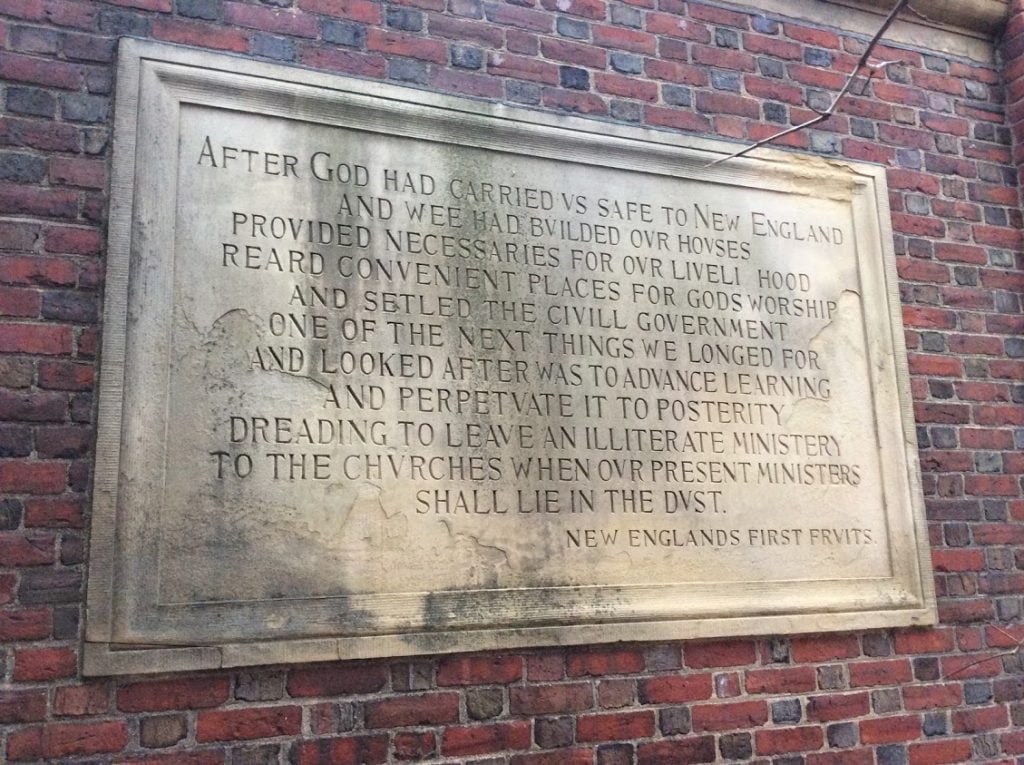
From the inscription (spelling modernized)
“After God had carried us safely to New England, and we had builded our houses, provided necessaries for our livelihood, reared convenient places for God’s worship, and settled the city government; one of the next things we longed for and looked after was to advance learning and perpetuate it to posterity; dreading to leave an illiterate ministry to the churches, when our present ministers shall lie in the dust.”
As mentioned in The Crimson
_____
Image Source/Credit:
• Photo by Randy Melchert
Related
Sorry, no records were found. Please adjust your search criteria and try again.
Sorry, unable to load the Maps API.