
Whither thou goest I will go
Where Thou lodgest I will Lodge
Thy people shall be my people
And thy God my God
-Ruth 1:16
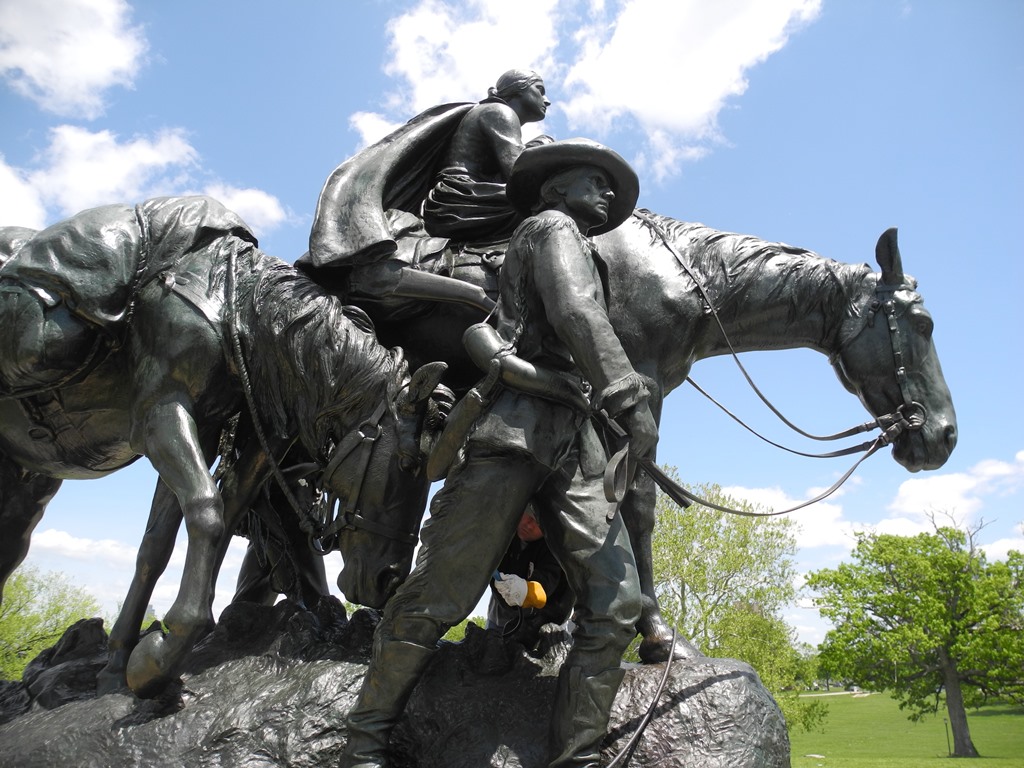
Presented to the people of Kansas City by Howard Vanderslice, the inscription reads: “To commemorate the Pioneer Mother who with unfaltering trust in God suffered the hardship of the unknown west to prepare for us a homeland of peace and plenty”.
♦ _____ ♦
The The Pioneer Mother stands as a moving tribute to the strength, endurance, and quiet heroism of women who helped settle the American West. Located in Golden Gate Park in San Francisco, the sculpture captures the spirit of sacrifice and perseverance that defined the pioneer experience.
Created by sculptor Charles Grafly and dedicated in 1915, The Pioneer Mother was unveiled during the Panama-Pacific International Exposition. This exposition celebrated the rebuilding of San Francisco following the devastating earthquake of 1906 and highlighted the city’s role as a gateway to the Pacific. Within this broader context, the statue honored not grand achievements or public victories, but the steady, often overlooked contributions of pioneer women.
The sculpture depicts a seated mother holding her infant child, with a young boy standing at her side. Her expression is calm yet resolute, reflecting both the burdens she carries and the strength with which she bears them. Unlike many monuments that emphasize action or triumph, The Pioneer Mother conveys endurance and quiet determination. The figure does not appear in motion; rather, she represents stability—the emotional and moral center of the family.
This portrayal speaks to the historical reality of pioneer life. As families moved westward during the nineteenth century, women faced immense challenges. They endured long and dangerous journeys, often under harsh conditions, and once settled, they took on a wide range of responsibilities. From raising children and managing households to assisting with farming and community life, their work was essential to the survival and success of early settlements.
The inclusion of the children in the sculpture reinforces this theme. The infant in the mother’s arms symbolizes the future, while the older child represents the next generation being guided and shaped. Together, they highlight the central role of the mother in nurturing both family and community. The composition suggests continuity and hope, even in the face of hardship.
Charles Grafly’s approach to the sculpture reflects the artistic trends of his time, combining realism with a sense of idealization. The figures are carefully detailed, yet they are also meant to represent broader qualities rather than specific individuals. The Pioneer Mother is not a portrait of one woman, but a symbol of many—an embodiment of courage, patience, and devotion.
Over the years, the statue has remained a place of reflection for visitors to Golden Gate Park. Its message continues to resonate, reminding viewers of the foundational role that families, and particularly mothers, have played in shaping communities. While the frontier era has long passed, the values represented by the sculpture—strength in adversity, commitment to others, and the importance of steady perseverance—remain relevant.
The Pioneer Mother also serves as a counterbalance to more dramatic narratives of the American West, which often focus on exploration, conflict, or individual achievement. By highlighting the quiet contributions of women, it offers a fuller and more balanced understanding of history. It acknowledges that the success of the frontier was not built solely on bold ventures, but also on the daily efforts of those who sustained life under challenging conditions.
In its simplicity and dignity, The Pioneer Mother endures as a meaningful tribute. It invites viewers to consider not only the past but also the enduring qualities that continue to shape families and communities. Through its enduring presence in Golden Gate Park, the sculpture honors a legacy that, though often uncelebrated, remains essential to the story of the American experience.
_____
Image Source/Credit:
• Proctormuseum. “Pioneer Mother – the Proctor Foundation.” The Proctor Foundation (theproctorfoundation.wordpress.com/tag/pioneer-mother)
Related
Sorry, no records were found. Please adjust your search criteria and try again.
Sorry, unable to load the Maps API.