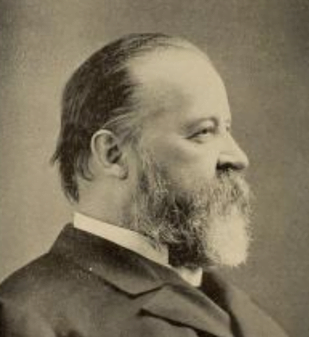
James H. Brookes (1830–1897) was a prominent pastor, author, and conference leader whose influence helped shape evangelical thought in the United States during the late nineteenth century. Known for his careful study of Scripture, strong doctrinal convictions, and leadership in the emerging prophetic movement, Brookes played a significant role in both the pulpit and the broader religious life of his era.
Born in Pulaski, Tennessee, Brookes was raised in a Presbyterian home that valued education and faith. He attended the University of Miami in Ohio and later studied theology at Princeton Theological Seminary, where he received a solid grounding in Reformed doctrine. His early ministry included pastoral service in several congregations, but it was his long tenure in St. Louis, Missouri, that brought him national recognition. In 1866, he became pastor of Walnut Street Presbyterian Church, a position he would hold for the remainder of his life.
Brookes quickly gained a reputation as a faithful expositor of the Bible. His preaching was marked by clarity, seriousness, and a firm commitment to the authority of Scripture. At a time when theological liberalism and higher criticism were beginning to influence American churches, Brookes stood firmly for what he understood to be the historic teachings of the Christian faith. He emphasized the importance of personal conversion, the necessity of sound doctrine, and the centrality of Christ in all preaching.
One of Brookes’s most enduring contributions was his leadership in the Bible conference movement. He was instrumental in organizing the Niagara Bible Conference, a gathering that brought together pastors, teachers, and laypeople for in-depth study of Scripture. These conferences, held annually from the 1870s into the 1890s, became a significant platform for the development and spread of premillennial theology. Brookes was a strong advocate of this viewpoint, which emphasized the imminent return of Christ and a literal interpretation of biblical prophecy.
Through his involvement in the Niagara movement, Brookes influenced a generation of evangelical leaders. The Niagara Bible Conference also produced a doctrinal statement, sometimes referred to as the Niagara Creed, which outlined key evangelical beliefs and served as a unifying expression of conservative theology during a time of growing division. Brookes’s role in shaping this statement reflected his commitment to doctrinal clarity and unity among like-minded believers.
In addition to his preaching and conference work, Brookes was a prolific writer. He authored numerous books and pamphlets on theological subjects, particularly prophecy and eschatology. His writings were widely read and helped to popularize premillennial interpretations of Scripture among American Protestants. He also served as editor of a religious periodical, further extending his influence beyond his local congregation.
Brookes maintained connections with other notable Christian leaders of his time, including Dwight L. Moody. While Moody was known for his evangelistic campaigns, Brookes contributed a more doctrinal and teaching-oriented emphasis. Together, figures like Brookes and Moody represented complementary aspects of the broader evangelical movement—one focused on outreach, the other on instruction and theological depth.
The impact of James H. Brookes can also be seen in the development of later movements within American Christianity. His emphasis on biblical inerrancy, prophetic study, and the importance of conferences for teaching would influence the rise of fundamentalism in the early twentieth century. Many of the themes he championed continued to resonate in Bible institutes, seminaries, and independent churches.
Yet, as with many influential figures, Brookes’s legacy is best understood within the context of his time. He ministered during a period of rapid social and intellectual change, and his firm stance on doctrine reflected a desire to preserve what he believed to be essential truths. His work contributed to both the strengthening of conservative evangelical identity and the shaping of ongoing theological discussions.
James H. Brookes died in 1897, leaving behind a legacy of faithful ministry and lasting influence. Remembered as a pastor who took Scripture seriously and sought to teach it clearly, he helped lay foundations that would guide many who followed. His life serves as an example of steady conviction, careful study, and a commitment to passing on the truths he held dear to future generations.
♦ _____ ♦
The Brookes Bible Institute nearby is named in his honor.
The Bellefontaine Cemetery is one of the few to have digitized its records and made them available for free online, with details on Brookes’ grave.
_____
Image Source/Credit:
• James Hall Brookes | Plymouth Brethren Archive (www.brethrenarchive.org/people/james-h-brookes)
Related
Sorry, no records were found. Please adjust your search criteria and try again.
Sorry, unable to load the Maps API.