
Hopewell Academy was one of the earliest and most influential educational institutions established by Baptists in colonial America. Founded in 1756 in Hopewell, the academy played a significant role in shaping both religious leadership and higher education in the colonies, leaving a legacy that extended far beyond its modest beginnings.
The academy was established under the leadership of Isaac Eaton, pastor of Hopewell Baptist Church. Eaton recognized the need for well-educated ministers within the growing Baptist movement. At the time, many Baptist preachers were self-taught, and there were few opportunities for formal education that aligned with Baptist beliefs. Eaton’s vision was to create a school that combined classical learning with theological training, preparing young men for ministry and leadership.
Hopewell Academy offered instruction in subjects typical of colonial education, including Latin, Greek, mathematics, and philosophy, alongside religious studies. This curriculum reflected the broader educational standards of the time while also emphasizing the importance of Scripture and doctrinal understanding. The academy was small and closely connected to the life of the church, with Eaton himself serving as both pastor and teacher.
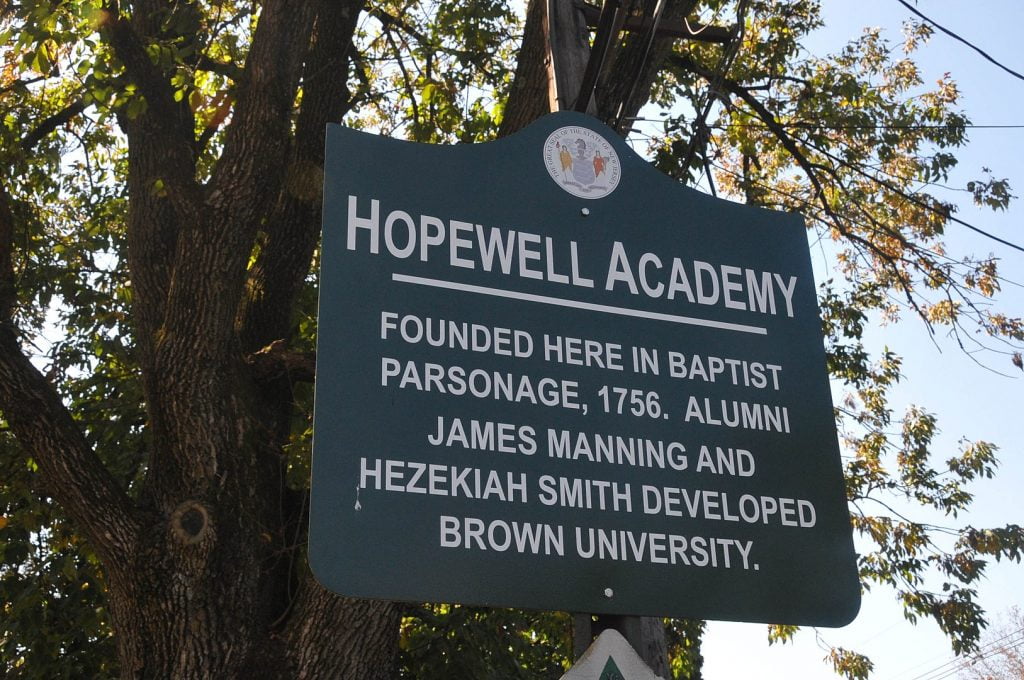
One of the most notable students associated with Hopewell Academy was James Manning. Manning would go on to become a key figure in the establishment of Brown University in 1764. As the first president of that institution, he carried forward the educational ideals he had encountered at Hopewell—namely, the integration of academic rigor with religious conviction. In this way, Hopewell Academy directly influenced the founding of one of America’s earliest colleges.
The academy must also be understood within the broader context of Baptist life in the eighteenth century. Baptists were often marginalized in colonial society, particularly in regions where established churches held political power. By creating their own educational institutions, Baptists sought to ensure that their ministers would be both intellectually capable and firmly grounded in their convictions. Hopewell Academy represented an important step in this effort, demonstrating that Baptists could contribute meaningfully to both religious and intellectual life.
The impact of the academy extended beyond the training of ministers. It helped foster a culture of learning within Baptist communities, encouraging the pursuit of knowledge as a means of better understanding faith and engaging with the world. This emphasis on education would become a defining feature of Baptist life in America, leading to the establishment of numerous colleges and seminaries in the years that followed.
Although Hopewell Academy itself did not continue indefinitely as a formal institution, its influence persisted through the individuals it trained and the ideas it promoted. The connection to Brown University is perhaps its most visible legacy, but its broader contribution lies in helping to establish a tradition of Baptist education that valued both intellect and devotion.
In many ways, the story of Hopewell Academy is a reminder of how significant institutions can grow from humble beginnings. What began as a small school in a rural New Jersey community became a seedbed for leadership and learning that would shape American religious and educational history.
Today, Hopewell Academy is remembered not for grand buildings or long institutional continuity, but for its lasting impact. Through its commitment to education, faith, and leadership, it helped lay the groundwork for a tradition that continues to influence both church and academy in the United States.
♦ _____ ♦
Hopewell Academy (est. 1756), a Latin grammar school, founded by Isaac Eaton, pastor at Hopewell Baptist, was the earliest Baptist academy in America. The building is now a private home, but a historical plaque stands near the street. The academy’s alumni included James Manning, founder of Brown University. Other alumni included the “Baptist Whitefield,” Hezekiah Smith, who was a classmate with Manning at Princeton and founding pastor of First Baptist at Haverhill, Massachusetts.
Copyrighted and used by permission from David Beale, Baptist History in England and America: Personalities, Positions, and Practices
_____
Image Source/Credit:
• Jerrye & Roy Klotz, MD, CC BY-SA 3.0 <https://creativecommons.org/licenses/by-sa/3.0>, via Wikimedia Commons
Related
Sorry, no records were found. Please adjust your search criteria and try again.
Sorry, unable to load the Maps API.