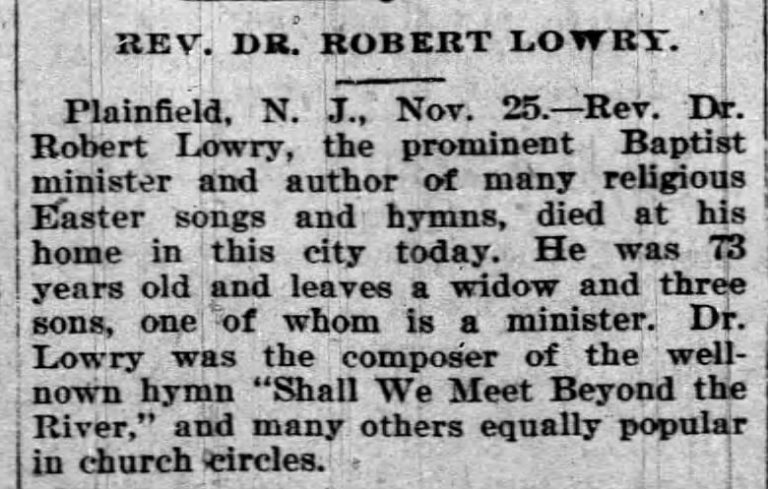
Robert Lowry
March 12, 1826 – November 25, 1899
Born in Philadelphia, Robert Lowry was converted at seventeen and received into the membership of the First Baptist Church of Philadelphia. Active in Christian service from his youth, he soon recognized the Lord’s call to the ministry. He entered school at Lewisburg, Pennsylvania—now Bucknell University—where he distinguished himself academically, graduating in 1854 as valedictorian of his class. Immediately thereafter, he began his lifelong labor as a Baptist pastor.
His pastorates were marked by faithfulness and steady growth. He served the West Chester Baptist Church in Pennsylvania (1854–1858), followed by the Bloomingdale Baptist Church in New York City (1859–1861). From 1861 to 1869 he ministered at the Hanson Place Baptist Church in Brooklyn, a period of fruitful influence. He later returned to Pennsylvania to shepherd the Lewisburg Baptist Church (1869–1875), and concluded his pastoral career at the Park Avenue Baptist Church in Plainfield, New Jersey (1875–1884).
Lowry was widely regarded as a successful and much-loved pastor. Possessing a brilliant mind and a deep knowledge of Scripture, he was an exceptional preacher—clear, earnest, and doctrinally sound. Though history remembers him chiefly for his hymns, he himself valued preaching above all. He once remarked, “I would rather preach a gospel sermon to an appreciative and receptive congregation than write a hymn.” That statement reveals his heart: music was never an end in itself, but a servant to the proclamation of truth.
Yet it was through sacred song that his influence spread far beyond the congregations he served. From early life he displayed a natural aptitude for music, and in time his hymns gained prominence not only across America but throughout the English-speaking world. He possessed the rare ability to write both text and tune, allowing him to wed doctrine and melody in a unified expression of faith.
Among his best-known hymns is “Shall We Gather at the River,” written during the difficult years of the Civil War. Its hopeful vision of believers gathered at the crystal river flowing from the throne of God offered comfort in days of grief and uncertainty. Equally beloved is “Christ Arose” (“Low in the Grave He Lay”), whose triumphant refrain proclaims:
Up from the grave He arose,
With a mighty triumph o’er His foes;
He arose a Victor from the dark domain,
And He lives forever with His saints to reign.
He arose! He arose!
Hallelujah! Christ arose!
Lowry also wrote “Nothing but the Blood of Jesus,” often regarded as a Baptist confession of faith set to music. Its straightforward testimony to redemption through Christ alone reflects the clarity of his theological convictions. His personal favorite hymn, “None but Jesus,” likewise centered on the sufficiency of the Savior.
While pastoring in Brooklyn, Lowry played an instrumental role in gathering the Flatbush Mission in 1865. This mission later became the Sixth Avenue Baptist Church. Among its constituting members were Charles and Annie Hawks. Mrs. Hawks wrote the cherished hymn “I Need Thee Every Hour,” and Lowry supplied the tune that has carried her words into countless churches.
In addition to his own hymns, Lowry composed music for other notable texts, including “Something for Thee,” “We’re Marching to Zion,” and “All the Way My Saviour Leads Me.” Through editorial work on hymnals and collaboration with fellow gospel writers, he helped shape the worship life of Baptist congregations during a formative era in American church history.
Without question, Robert Lowry is entitled to the double honor spoken of in Scripture for those who labor faithfully in word and doctrine. Still, it is his contribution to sacred music that secured his enduring reputation. His hymns are marked by scriptural imagery, doctrinal clarity, and a confident hope in Christ’s saving work—qualities that have allowed them to endure for generations.
A marker placed by the Baptist History Preservation Society on May 16, 2007, commemorates his connection to the Sixth Avenue Baptist Church in Brooklyn, located at the corner of Sixth Avenue and Lincoln Place. There his legacy is remembered not merely in stone, but in song.
As the Apostle exhorts in Ephesians, believers are to speak “in psalms and hymns and spiritual songs, singing and making melody in your heart to the Lord.” Few have aided the church in fulfilling that charge more faithfully than Robert Lowry, pastor and hymn writer, whose melodies continue to lift hearts heavenward.
Hymns by Robert Lowry in Great Hymns of the Faith:
#138 – Christ Arose
#212 – Nothing But the Blood
#510 – Shall We Gather at the River?
_____
Image Source/Credit (in order):
- Robert Lowry | Hymnary.org. hymnary.org/person/Lowry_Robert.
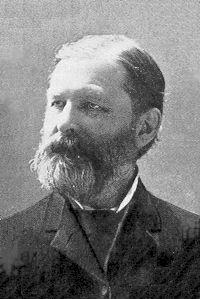
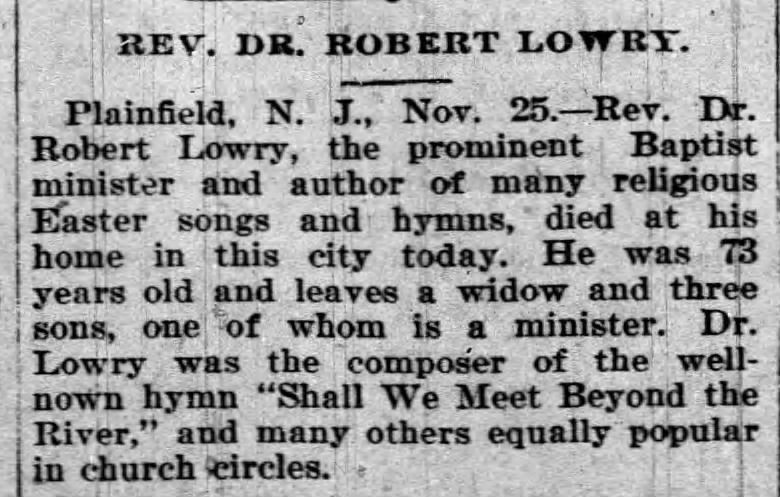
- Newspapers.com, Buffalo Post, November 25, 1899, https://www.newspapers.com/article/buffalo-post/191967661/
Related
Sorry, no records were found. Please adjust your search criteria and try again.
Sorry, unable to load the Maps API.