Our Christian Heritage

  • Browse/Search Sites
  • Map
  • OI Tour
  • Podcast
  • OCH TV
  • VCY
  • About

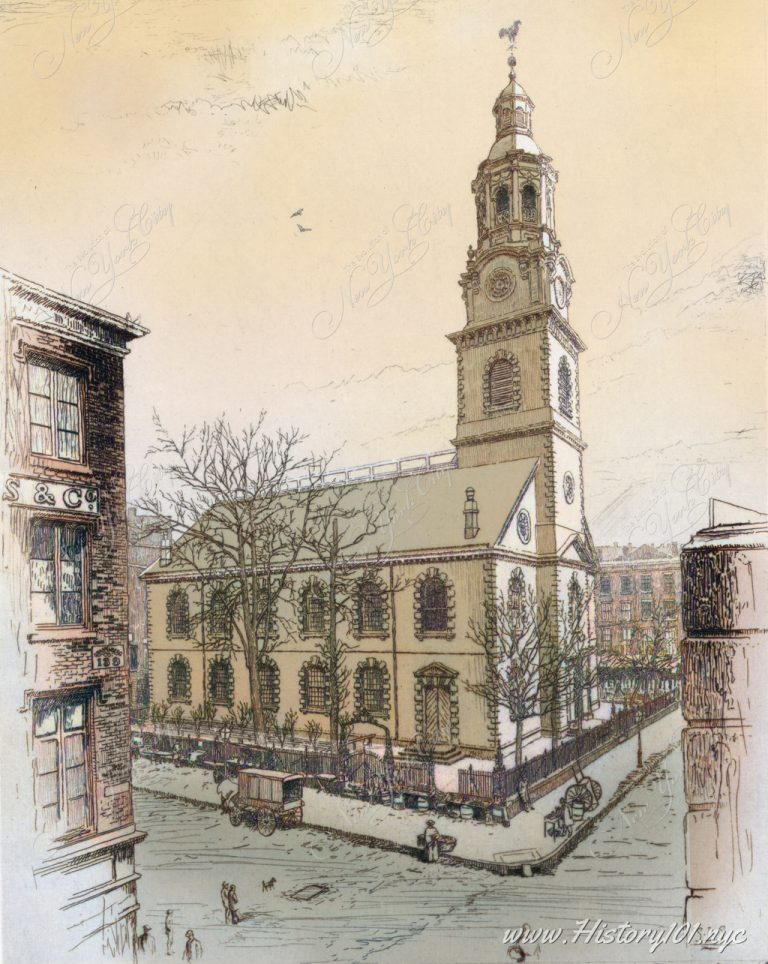
North Dutch Church

Get Directions
 
North Dutch Church 3052x3833 1 768x964
Previous Next
Place Category: SitePlace Tags: 1857–1858 Prayer Revival Fulton Street Prayer Meeting Jeremiah Lanphier Missionary New York City Prayer
 
  • Profile
  • Photos
  • Map
  • Reviews

The story of Jeremiah Lanphier and the North Dutch Church in New York City is closely tied to one of the most remarkable religious awakenings in American history, the 1857–1858 Prayer Revival. At a time of economic uncertainty and social anxiety, a quiet layman’s simple initiative helped spark a movement that spread across the United States and beyond. Lanphier’s life and the role of the North Dutch Church illustrate the enduring power of prayer, persistence, and ordinary individuals acting with conviction.

Jeremiah Lanphier (1809–1898) was not a minister or a prominent public figure. He worked as a businessman in New York City before becoming involved in lay missionary work for the North Dutch Church, a Reformed congregation located in the bustling commercial district of Lower Manhattan. The church itself was part of the Reformed Church in America and had a long history of serving the city’s population, particularly those engaged in trade and commerce.

In the mid-1850s, New York City was undergoing rapid growth and change. The pressures of urbanization, combined with economic instability, created an atmosphere of uncertainty. In response, the North Dutch Church appointed Lanphier as a lay missionary with the task of reaching out to businessmen in the area. His role involved visiting offices, distributing invitations, and encouraging individuals to attend church services or consider matters of faith.

Lanphier’s most significant contribution came in 1857 when he decided to organize a weekly prayer meeting specifically for businessmen. He distributed handbills inviting people to gather at noon on Wednesdays for a time of prayer. The first meeting, held at the North Dutch Church, was modest—only a handful of participants attended. However, Lanphier remained faithful to the effort, continuing to hold the meeting each week.

Gradually, attendance began to grow. Within a few weeks, the number of participants increased enough to require daily meetings instead of weekly ones. As word spread, similar gatherings began to appear in other parts of the city. The movement quickly expanded beyond New York, reaching cities across the United States. This surge of prayer meetings, often led by laypeople rather than clergy, became a defining feature of the 1857–1858 Prayer Revival.

The North Dutch Church played a central role as the birthplace of this movement. Its location in a busy commercial area made it accessible to workers and businessmen who could attend during their midday break. The church’s willingness to support Lanphier’s initiative demonstrated an openness to new forms of outreach and a recognition of the importance of lay involvement in spiritual life.

One of the most notable aspects of the revival was its simplicity. Meetings were typically informal, focused on prayer, brief testimonies, and the reading of Scripture. There were no elaborate programs or prominent speakers. This approach allowed the movement to spread easily, as it required minimal organization and could be adapted to different settings. It also emphasized the idea that spiritual renewal could arise from ordinary individuals rather than relying solely on formal leadership.

The impact of the revival was significant. It is estimated that tens of thousands of people were influenced by the movement, with many experiencing renewed interest in faith and church involvement. The revival also had a broader social effect, encouraging a sense of community and shared purpose during a time of economic difficulty. It demonstrated how collective action rooted in prayer could bring about both personal and communal change.

Jeremiah Lanphier’s legacy is closely tied to this movement. Though he never sought recognition, his initiative became the catalyst for a widespread spiritual awakening. His life serves as an example of how a single idea, faithfully pursued, can have far-reaching consequences. He continued his work with the North Dutch Church for many years, maintaining his commitment to outreach and prayer.

The North Dutch Church itself eventually declined and was demolished in the nineteenth century as the city evolved. Yet its historical significance remains, particularly in connection with the prayer revival that began within its walls. It stands as a reminder of the role that local congregations can play in shaping broader movements.

In conclusion, the story of Jeremiah Lanphier and the North Dutch Church highlights the power of simple faith and persistent effort. Together, they helped spark a movement that touched countless lives and demonstrated the potential of lay-led initiatives. Their legacy endures as a testament to the enduring influence of prayer and the capacity of ordinary individuals to effect meaningful change.

♦ _____ ♦


In 1857, the California gold rush was in decline. The railroad bubble peaked in July. Business failures began in August.

The fashionable churches were moving north, but Jeremiah Lanphier lived in the nonreligious lower part of the city. Lanphier never married, and had no formal schooling to prepare him for ministry, but he was commissioned as a lay missionary of North Dutch Church (torn down in 1860s)

He found his ministry in prayer, and started a prayer meeting on Wednesday, September 23, 1857 at the Fulton Street entrance to the church.

“Prayer meeting from 12 to 1 o’clock. Stop 5, 10 or 20 minutes, or the whole time, as your time admits.”

Nobody showed at noon, so he prayed by himself. By the end of the hour there were five others. Next week there were 20, and 40 the week after that. By October the meetings were daily, and by the end of March over ten thousand were meeting for prayer meetings on a daily basis. Even ships approaching New York were hit with conviction before they could land. Over one million were born again in two years. D.L. Moody was already saved but motivated by the spirit of prayer in the revival.

On the 150th anniversary, a statue was commissioned for outside the American Bible Society, and in 2015 it was moved to The King’s College.

_____
Image Source/Credit:
• “North Dutch Church – NYC in 1769.” History 101 NYC (www.history101.nyc/north-dutch-church-1769)

Related

North Dutch Church 3052x3833 1 768x964
Loading...
No Records Found

Sorry, no records were found. Please adjust your search criteria and try again.

Maps failed to load

Sorry, unable to load the Maps API.

Leave a Review Cancel reply

Your email address will not be published.
Select a rating

Previous
Next

Related

Find History Near Me
Loading...
No Records Found

Sorry, no records were found. Please adjust your search criteria and try again.

Maps failed to load

Sorry, unable to load the Maps API.

Address: 111 Fulton Street
New York
New York
10038
United States

Nearby Places:

swamp

Old Swamp Church

0.16 miles
No Reviews
Favorite
Frederick Muhlenberg, son of the “father of the Lutheran Church in North America,” Rev. Henry Melchior Muhlenberg, was the pastor of Christs Church, also known as the Old Swamp Church.   On July 2nd, 1776, Muhlenberg left the city. Following the Battle of Brooklyn Heights, sources say the church burned, likely during the Great Fire of New York City.   Read more...
Jeremiah Calvin Lanphier 1

Jeremiah Lanphier Statue

2.67 miles
No Reviews
Favorite
In 1857, the California gold rush was in decline. The railroad bubble peaked in July. Business failures began in August. The fashionable churches were moving north, but Jeremiah Lanphier lived in the nonreligious lower part of the city. Lanphier never married, and had no formal schooling to prepare him for ministry, but he was commissioned as a lay missionary of Read more...
Robert Lowry

Robert Lowry Monument

2.77 miles
No Reviews
Favorite
Robert Lowry March 12, 1826 – November 25, 1899 Born in Philadelphia, Robert Lowry was converted at seventeen and received into the membership of the First Baptist Church of Philadelphia. Active in Christian service from his youth, he soon recognized the Lord’s call to the ministry. He entered school at Lewisburg, Pennsylvania—now Bucknell University—where he distinguished himself academically, graduating in Read more...
chelsea methodist

Fanny Crosby – Conversion at Chelsea Methodist Episcopal Church

2.85 miles
No Reviews
Favorite
From Daytonian in Manhattan: Three blocks to the north, on Ninth Avenue between 33rd and 34th Street, the New York Asylum for the Blind had stood since 1831.  In 1839 it had taken in a 19-year old student, Franny J. Crosby, who quickly was recognized for her talent in writing poetry and hymns.  Fanny had been blinded by an incompetent physician at Read more...
Photo541021

Fanny Crosby – New York Institution for the Blind

3.04 miles
No Reviews
Favorite
Fanny Crosby remains one of the most beloved figures in American hymnody, and her life is closely tied to the New York Institution for the Blind, where she spent many formative years as both a student and a teacher. This institution played a crucial role in shaping her intellectual, spiritual, and creative development, ultimately helping to prepare her for a Read more...
View all

Browse By Topic

Adoniram Judson
Archaeology
Baptist History Preservation Society
Billy Sunday
Charles Spurgeon
Creation
David Beale’s Baptist History
David Livingstone
DL Moody
English Bible
Erwin Lutzer: Swastika & Cross
Erwin Lutzer: England
Fanny Crosby
George Whitefield
Great Hymns of the Faith
John Newton
Jonathan Edwards
Martin Luther
Missions
New Testament
Old Testament
Patrick Henry
Philip Bliss
Pilgrims
Presidents
Robert Sheffey
Wesleys
William Jennings Bryan
YWAM Heroes
100 Bible Verses That Made America

Recently Viewed History

Loading...

Change Location
Find awesome listings near you!