
Fanny Crosby remains one of the most beloved figures in American hymnody, and her life is closely tied to the New York Institution for the Blind, where she spent many formative years as both a student and a teacher. This institution played a crucial role in shaping her intellectual, spiritual, and creative development, ultimately helping to prepare her for a lifetime of remarkable influence.
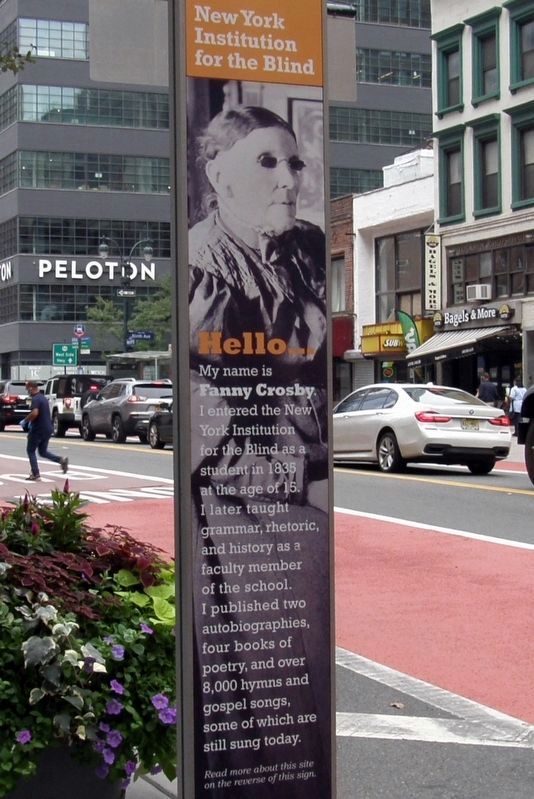
Born in 1820 in Brewster, New York, Fanny Crosby lost her sight at just six weeks old due to a medical error. Despite this early hardship, she was raised in a home that emphasized faith, resilience, and education. At a time when opportunities for the blind were limited, her admission to the New York Institution for the Blind at the age of fifteen marked a turning point in her life.
Founded in 1831, the New York Institution for the Blind was among the first schools in the United States dedicated to educating individuals with visual impairments. Its mission was both practical and progressive for its time: to equip students with academic knowledge, vocational skills, and cultural enrichment so they could live productive, independent lives. For Crosby, the institution became not only a place of learning but also a community that nurtured her gifts.
During her years as a student, Crosby quickly distinguished herself through her intellectual ability and remarkable memory. She developed a strong command of language, becoming particularly skilled in poetry and rhetoric. The school’s emphasis on memorization and oral expression suited her well, allowing her to excel despite the limitations imposed by her blindness. She also received musical training, which would later prove essential to her career as a hymn writer.
After completing her studies, Crosby remained at the institution as a teacher, serving there for more than a decade. In this role, she taught grammar, rhetoric, and history, while also mentoring younger students. Her presence as a successful blind educator offered a powerful example of what could be achieved through discipline and faith. She became a well-known figure within the school and even gained attention beyond it, occasionally reciting her poetry before public audiences, including prominent leaders of the day.
The environment of the New York Institution for the Blind had a lasting impact on Crosby’s worldview. It instilled in her a strong sense of purpose and a belief that physical limitations need not define a person’s contribution to society. The school’s blend of intellectual rigor and moral instruction reinforced her Christian faith, which would become the central theme of her later work.
Crosby eventually left the institution to pursue writing and mission work in New York City. Over the course of her lifetime, she wrote more than 8,000 hymns, including enduring favorites such as “Blessed Assurance” and “To God Be the Glory.” Her lyrics, often characterized by their clarity, warmth, and deep spiritual conviction, have been sung by millions around the world.
The connection between Crosby and the New York Institution for the Blind remains a significant chapter in American educational and religious history. The institution not only provided her with the tools she needed to succeed but also demonstrated the broader potential of education for people with disabilities at a time when such opportunities were rare.
In reflecting on her life, it becomes clear that Crosby’s years at the institution were foundational. They shaped her mind, strengthened her faith, and gave her the confidence to pursue a path that would influence generations. Her story, intertwined with the mission of the New York Institution for the Blind, stands as a testament to the enduring value of education, perseverance, and a life devoted to meaningful purpose.
Hymns by Fanny Crosby in Great Hymns of the Faith:
#106 – Tell Me the Story of Jesus
#148 – Will Jesus Find Us Watching?
#157 – What a Gathering!
#235 – Pass Me Not
#247 – Jesus Is Calling
#255 – Blessed Assurance
#258 – He Hideth My Soul
#296 – All the Way My Savior Leads Me
#304 – Savior, More Than Life to Me
#314 – I Am Thine, O Lord
#328 – Close to Thee
#345 – ‘Tis the Blessed Hour of Prayer
#351 – Near the Cross
#385 – Take the World, but Give Me Jesus
#411 – Victory Through Grace
#428 – To the Work!
#432 – Rescue the Perishing
#442 – Praise Him! Praise Him!
#449 – To God Be the Glory
#475 – Redeemed
#495 – Unsearchable Riches
#502 – My Savior First of All
#512 – Saved By Grace
_____
Image Source/Credit:
• New York Institute for the Blind Historical Marker. 4 May 2023 (www.hmdb.org/m.asp?m=157029)
Related
Sorry, no records were found. Please adjust your search criteria and try again.
Sorry, unable to load the Maps API.