
Newport Historical Society is one of the oldest historical organizations in the United States, dedicated to preserving and interpreting the rich past of Newport. Founded in 1854, the society has played a central role in safeguarding the city’s heritage, which spans colonial settlement, religious diversity, maritime trade, and the American Revolution.
Newport itself was established in 1639 by settlers seeking greater religious freedom than was available in neighboring Massachusetts. From its earliest years, the town became known for its spirit of tolerance and diversity. Quakers, Baptists, Anglicans, and members of the Jewish community all found a place in Newport, contributing to a unique cultural and religious landscape. The Newport Historical Society preserves records and artifacts that reflect this early commitment to liberty of conscience, which would later influence broader American principles of religious freedom.
The society’s headquarters are located in the Brick Market building, a prominent eighteenth-century structure in the heart of the city. Built in 1762, the building originally served as a marketplace and civic center. Today, it houses exhibitions that introduce visitors to Newport’s history, including its role as a major colonial port. The city’s location along the Atlantic coast made it a hub for trade, shipbuilding, and commerce, linking it to markets throughout the British Empire and beyond.
One of the key strengths of the Newport Historical Society is its extensive archival collection. The society maintains manuscripts, maps, photographs, and printed materials that document more than three centuries of local life. These records provide valuable insight into the economic, social, and political development of Newport, as well as the experiences of its diverse inhabitants.
The society also manages several historic properties, including colonial-era houses that have been preserved and opened to the public. These sites offer visitors a tangible connection to the past, illustrating how people lived and worked in different periods of the city’s history. Through guided tours and educational programs, the society helps bring these stories to life.
Newport played a significant role during the American Revolution, serving as a strategic location due to its harbor. The city was occupied by British forces for several years, and the surrounding area saw military activity involving both American and French troops. The Newport Historical Society preserves materials related to this period, helping to illuminate the local impact of the struggle for independence.
In addition to its focus on the colonial and revolutionary eras, the society also explores Newport’s later development. In the nineteenth century, the city became a fashionable summer resort for wealthy families, leading to the construction of grand estates along its coastline. While these “Gilded Age” mansions are often associated with Newport’s history, the society provides a broader perspective, emphasizing the experiences of ordinary residents as well as prominent figures.
Education is a central part of the society’s mission. Through exhibitions, lectures, and outreach programs, it engages both residents and visitors in the study of history. Its collections are also an important resource for researchers, genealogists, and students seeking to understand the past in greater depth.
The impact of the Newport Historical Society lies in its commitment to preserving the complexity of Newport’s story. By maintaining historical records and interpreting them for modern audiences, it ensures that the city’s heritage remains accessible and meaningful.
Today, the society continues to serve as a guardian of Newport’s past. Its work connects generations, offering insight into the events and ideas that have shaped not only a single city but also the broader American experience.
♦ _____ ♦
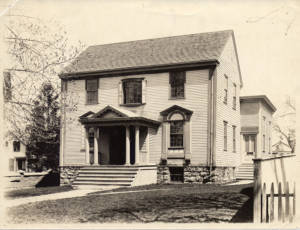
Newport Historical Society (NHS) houses the first Seventh-Day Baptist church in America. In 1671, Stephen Mumford led a small group of First Baptist to establish this church. In 1884, the NHS bought the Seventh-Day Baptists’ 1730 wooden chapel. In 1915, the NHS moved the elegant chapel from Barney Street to the rear of their headquarters, at 82 Touro Street. Here, the NHS encased the chapel in brick and incorporated it into their facility. More restoration took place in 2009. (See Chapter 12.).
Copyrighted and used by permission from David Beale, Baptist History in England and America: Personalities, Positions, and Practices
_____
Image Source/Credit:
• Wikipedia contributors. File:Sabbatarian Meeting House.jpg – Wikipedia (en.wikipedia.org/wiki/File:Sabbatarian_Meeting_House.jpg)
Related
Sorry, no records were found. Please adjust your search criteria and try again.
Sorry, unable to load the Maps API.