
The United Baptist Church in Newport stands among the oldest Baptist congregations in the United States, with roots reaching back to the mid-seventeenth century. Its history reflects not only the development of Baptist life in America but also the broader struggle for religious liberty that helped shape the nation’s identity.
The church traces its origins to the 1630s and 1640s, when dissenting settlers fled the rigid religious structure of the Massachusetts Bay Colony. Among them was John Clarke, a physician and minister who became the founding pastor. Clarke and his fellow believers sought the freedom to practice their faith according to conscience, without state interference. By 1644, their congregation had settled in Newport and established what is considered the first church building of any denomination in the Rhode Island colony.
From its earliest days, the church was deeply intertwined with the principle of religious liberty. Clarke himself traveled to England to secure a royal charter for Rhode Island, helping to guarantee freedoms that were rare in the seventeenth century. His efforts, alongside those of contemporaries like Roger Williams, contributed to a legacy of tolerance that would later influence American constitutional thought.
Like many early congregations, the church experienced division as theological differences arose. In 1656, a group separated to form what became known as the Second Baptist Church in Newport. Despite such divisions, these developments also demonstrated the vitality and independence of Baptist congregational life. Over time, the original church remained a center of influence, with notable leaders such as John Callender guiding it through the eighteenth century.
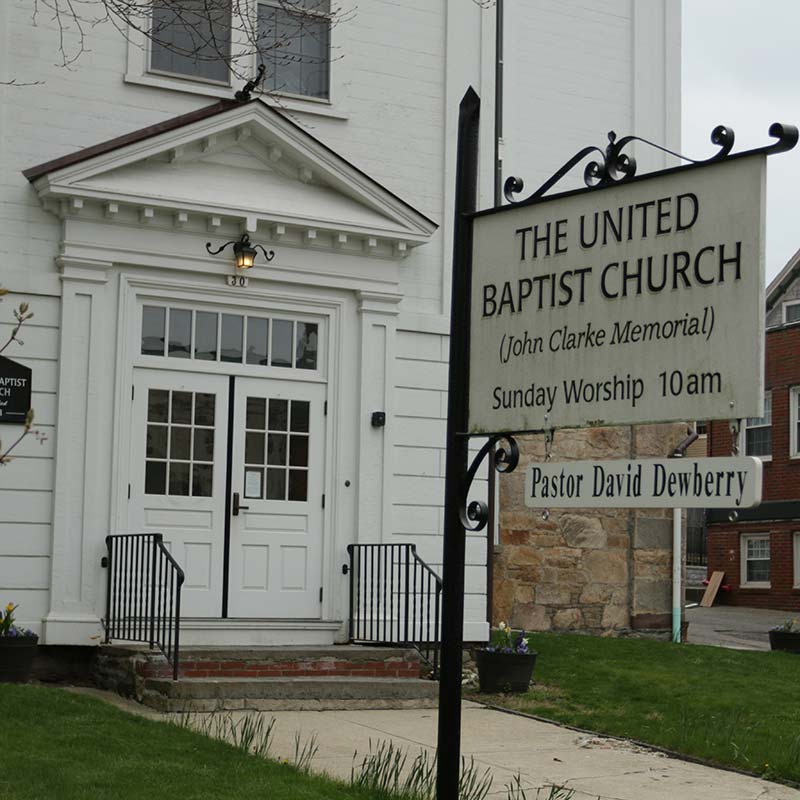
The physical structure of the church evolved alongside the congregation. Early meetinghouses gave way to more permanent buildings, including a chapel erected in the eighteenth century and the current structure, completed in 1846. This building, still standing today, serves as a visible link between the colonial past and the present.
A defining moment in the church’s modern history came in 1946, when the First and Second Baptist congregations—separated for nearly 290 years—reunited to form the present-day United Baptist Church. This reunion, born out of cooperation during World War II, stands as a rare and meaningful example of reconciliation within Christian history.
The impact of the United Baptist Church extends beyond its longevity. As one of the earliest Baptist congregations in America, it played a formative role in shaping Baptist identity, particularly the emphasis on believer’s baptism, congregational governance, and the separation of church and state. Its members and leaders were part of the early movement that challenged established religious authority and promoted freedom of worship.
Today, the church continues its ministry in Newport, maintaining a commitment to preaching, community life, and historical remembrance. While much has changed since the seventeenth century, the congregation remains rooted in the same foundational convictions that guided its founders.
In sum, the United Baptist Church is not merely a local institution but a significant chapter in American religious history. Its story embodies the enduring principles of liberty, conscience, and unity—principles that have shaped both the Baptist tradition and the broader American experience.
♦ _____ ♦
United Baptist Church, John Clarke Memorial, at 30 Spring Street, was founded in 1644 by John Clarke. It was America’s second Baptist church. Clarke was co-founder of Rhode Island and an early defender of liberty of conscience.
Copyrighted and used by permission from David Beale, Baptist History in England and America: Personalities, Positions, and Practices
_____
Image Source/Credit:
• “Home – United Baptist Church.” United Baptist Church, 27 June 2024 (unitedbaptistnewport.com)
Related
Sorry, no records were found. Please adjust your search criteria and try again.
Sorry, unable to load the Maps API.