
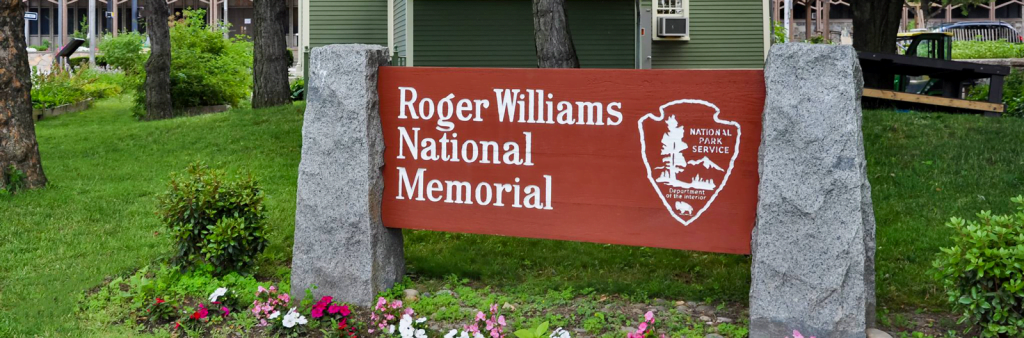
The Roger Williams National Memorial in Providence, Rhode Island, commemorates the life and legacy of Roger Williams, one of the most important figures in early American history. As the founder of Providence and a pioneering advocate for religious liberty, Williams helped shape principles that would later become central to the identity of the United States. The memorial stands not only as a tribute to the man but also as a reminder of the enduring value of freedom of conscience.
Established in 1965 and administered by the National Park Service, the memorial is located on a landscaped site in downtown Providence. The grounds include open green spaces, pathways, and interpretive features that invite visitors to reflect on the historical significance of Williams’s contributions. Unlike many monuments dominated by large statues or structures, the memorial is relatively understated, reflecting the humility and principles associated with its namesake.
Roger Williams arrived in New England in 1631 as a Puritan minister, but he soon came into conflict with colonial authorities in Massachusetts Bay. He argued for a complete separation between church and civil government, a position that was considered radical at the time. Williams also insisted that land should be fairly purchased from Native Americans rather than taken without consent. These views led to his banishment from the colony in 1635.
After his exile, Williams traveled south and established a new settlement, which he named Providence. There, he founded a community based on principles of religious tolerance and individual liberty. People of different beliefs were welcomed, making Providence one of the earliest examples of a society committed to freedom of worship. These ideas later influenced the development of Rhode Island and contributed to the broader American understanding of religious freedom.
The Roger Williams National Memorial interprets this history through exhibits, guided tours, and educational programs. Visitors can learn about Williams’s life, his interactions with Native American communities, and his role in founding Rhode Island. The site also explores the broader historical context of colonial America, including the religious conflicts and political challenges of the seventeenth century.
One of the key themes emphasized at the memorial is the concept of liberty of conscience. Williams believed that individuals should be free to follow their own religious convictions without interference from the state. This principle, though controversial in his time, became a cornerstone of American democracy and is reflected in the First Amendment to the U.S. Constitution.
The memorial also highlights Williams’s respect for Native Americans, an aspect of his legacy that sets him apart from many of his contemporaries. He learned local languages, built relationships with indigenous leaders, and advocated for fair treatment and mutual respect. These actions contributed to the relatively peaceful establishment of his settlement.
Today, the Roger Williams National Memorial serves as both a historical site and a place for reflection. Its central location in Providence makes it accessible to residents and visitors alike, offering a quiet space in the midst of the city. Educational programs and events help bring Williams’s story to life for new generations, emphasizing the continued relevance of his ideas.
In conclusion, the Roger Williams National Memorial stands as a tribute to a man whose vision helped shape fundamental American values. By preserving and interpreting his legacy, the site encourages visitors to consider the importance of religious freedom, tolerance, and respect for others—principles that remain vital in any society.
♦ _____ ♦
The Roger Williams National Memorial is the first National Park in Rhode Island, barely 4 acres, but according to the National Park Service, “commemorates the life of the founder of Rhode Island and a champion of the ideal of religious freedom. Williams, banished from Massachusetts for his beliefs, founded Providence in 1636. This colony served as a refuge where all could come to worship as their conscience dictated without interference from the state.”
Williams took this concept from the Bible. When Peter was told by the church/state establishment to alter his sermon, he replied, “We ought to obey God rather than men.“ Later Peter wrote declaring the individual priesthood of the believer, “But ye are a chosen generation, a royal priesthood, an holy nation, a peculiar people…” (1 Peter 2:9).
One mile east is where Roger landed (GPS: 41.823417, -71.390467), “And having a sense of God’s merciful Providence unto me in my distress called the place Providence I desired it might be fore a shelter for persons Distressed for Conscience”
.Two blocks south of the National Memorial is the church he started in 1638, the First Baptist Church in America (GPS: 41.827463, -71.408342).
Three miles south of the memorial is the Roger Williams Park (and Zoo GPS: 41.790422, -71.414862). This land was given to Roger Williams by the Narragansett chief Canonicus, and Roger’s descendant Betsey Williams willed it to Providence in 1872,
Paul talked often of Holding faith, and a good conscience. Likewise, Williams believed that “that no person be forced to pay nor pray, otherwise then as his soul believeth and consenteth”
Three blocks east of the National Memorial is Prospect Terrace (GPS: 41.82983, -71.40738), where you’ll find a statue of Roger Williams, and also his earthly remains
_____
Image Source/Credit:
• Beyond My Ken, CC BY-SA 4.0 <https://creativecommons.org/licenses/by-sa/4.0>, via Wikimedia Commons
Related
Sorry, no records were found. Please adjust your search criteria and try again.
Sorry, unable to load the Maps API.