
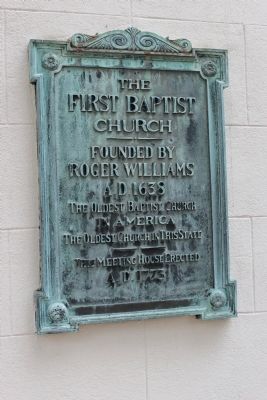
The First Baptist Church in America holds a distinguished place in American religious history as the oldest Baptist congregation in the United States. Founded in 1638, its story is closely tied to the life and convictions of Roger Williams, whose commitment to liberty of conscience helped shape the spiritual and political landscape of the nation.
Roger Williams established the church shortly after founding Providence as a refuge for those seeking freedom from religious coercion. Having been banished from the Massachusetts Bay Colony for his dissenting views, Williams believed firmly that civil authorities should not govern matters of faith. In Providence, he sought to create a community where individuals could worship according to their own convictions. The First Baptist Church was born out of this vision, becoming a gathering place for believers committed to voluntary faith and congregational independence.
The early years of the church were marked by both innovation and instability. Williams himself served as pastor for only a brief period, as he came to question the validity of apostolic succession and formal church authority. Nevertheless, the congregation endured, eventually stabilizing under later leadership and developing a more defined Baptist identity. Central to this identity were key principles such as believer’s baptism, the authority of Scripture, and the autonomy of the local church.
By the eighteenth century, the church had become an influential force in colonial America. Under the leadership of figures such as James Manning, the church expanded its reach beyond Providence. Manning, who served as pastor from 1771 to 1791, was also the founding president of Brown University. His dual role strengthened the intellectual and educational influence of the Baptist tradition, helping to establish Rhode Island as a center for both religious liberty and higher learning.
The present meetinghouse of the First Baptist Church, completed in 1775, stands as a notable architectural and historical landmark. Designed by Joseph Brown, the building reflects a blend of traditional and colonial styles, with its prominent steeple becoming a recognizable feature of Providence’s skyline. It is not only a place of worship but also a symbol of continuity, linking modern congregants with generations of believers who have gathered there over nearly three centuries.
The impact of the First Baptist Church extends far beyond its local setting. As one of the earliest organized expressions of Baptist life in America, it played a significant role in shaping the denomination’s core principles. Its unwavering commitment to religious freedom helped influence the broader American understanding of church-state separation, a concept later enshrined in the United States Constitution First Amendment.
In addition, the church has long been associated with social and moral reform movements. Throughout its history, members have engaged in efforts related to education, missions, and community service. Its legacy reflects a consistent emphasis on personal faith combined with public responsibility.
Today, the First Baptist Church in America continues to serve as an active congregation while also preserving its rich heritage. Visitors from around the world come to learn about its origins and the principles it represents. Its enduring presence stands as a testament to the power of conviction and the lasting importance of religious liberty.
In sum, the First Baptist Church in America is more than a historic institution; it is a cornerstone of American religious development. Its founding ideals—freedom of conscience, independence of the church, and devotion to faith—continue to resonate, shaping both the Baptist tradition and the broader American experience.
♦ _____ ♦
First Baptist Church, founded by Roger Williams in 1638, was the earliest Baptist Church in America. Erected in 1775, its present building is at 75 N Main St. Its twelfth pastor, James Manning, was founder and president of nearby Brown University.
Copyrighted and used by permission from David Beale, Baptist History in England and America: Personalities, Positions, and Practices
_____
Image Source/Credit:
• Djb. “Religious Freedom 101: a Lesson From Old Places.” MORE TO COME…, 20 Apr. 2015 (moretocome.net/2015/04/19/religious-freedom-101-a-lesson-from-old-places)
Related
Sorry, no records were found. Please adjust your search criteria and try again.
Sorry, unable to load the Maps API.