
The First Baptist Church of Charleston is widely recognized as the oldest Baptist church in the American South, with a history that reaches back to the late seventeenth century. Its story is closely tied to the struggle for religious liberty, the spread of Baptist convictions, and the shaping of early church life in the southern colonies.
The church traces its origins to the ministry of William Screven, an English-born preacher who had previously helped establish a Baptist congregation in Kittery, Maine. Facing opposition in New England due to his nonconformist beliefs, Screven led a group of followers southward in search of greater freedom. Around 1696, they settled near what is now Charleston, South Carolina, and organized a Baptist church—an event that marked the beginning of organized Baptist life in the South.
In its earliest years, the church faced considerable challenges. The Church of England was the established religion in the Carolina colony, and dissenting groups like the Baptists often operated under legal and social pressure. Despite this, the congregation endured, holding firmly to its principles of believer’s baptism, congregational governance, and the authority of Scripture.
By the early eighteenth century, the church had become an established presence in the growing port city of Charleston. It benefited from the leadership of Screven and later pastors who guided the congregation through periods of both hardship and growth. The church’s survival during these formative years was significant, as it provided a foothold for Baptist expansion throughout the region.
As the city of Charleston developed into a major commercial and cultural center, the First Baptist Church grew alongside it. Its membership expanded, and its influence spread into the surrounding countryside. The church played an important role in the wider Baptist movement, helping to establish new congregations and supporting the work of itinerant preachers.
The eighteenth century also brought broader religious change to the American colonies, particularly during the Great Awakening. This period of revival emphasized personal conversion and heartfelt religion, themes that resonated strongly with Baptist beliefs. While the First Baptist Church of Charleston had already been established before this movement, the revival helped strengthen its message and contributed to the growth of Baptist influence throughout the South.
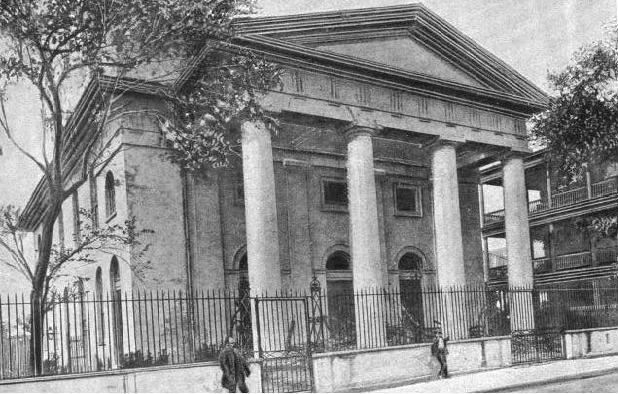
Architecturally, the church’s meetinghouses have evolved over time. The current building, constructed in the nineteenth century, reflects the dignity and permanence of a congregation with deep historical roots. Located in the heart of Charleston, it stands as both a place of worship and a historical landmark, drawing visitors interested in the early religious life of America.
Beyond its physical structure, the true legacy of the First Baptist Church lies in its role as a pioneer. It demonstrated that a Baptist congregation could take root and endure in a region dominated by established churches. Its example encouraged others to organize similar congregations, contributing to the rapid growth of Baptist life in the South during the eighteenth and nineteenth centuries.
The church has also been associated with the broader cause of religious liberty. Early Baptists, including those in Charleston, often advocated for the separation of church and state and the right of individuals to worship according to conscience. These principles would later find expression in American law, particularly in guarantees of religious freedom.
Today, the First Baptist Church of Charleston remains an active congregation, continuing a tradition that spans more than three centuries. Its history is a testament to perseverance, conviction, and faith. From a small group of dissenters seeking freedom of worship, it has grown into a lasting institution—one that reflects both the struggles and the triumphs of early Baptist life in America.
In the broader sweep of history, the church stands as a reminder that enduring institutions are often built on quiet beginnings. Through its commitment to truth and liberty, the First Baptist Church of Charleston has secured a place not only in South Carolina’s past, but in the larger story of American religious life.
_____
Image Source/Credit:
• Wikipedia contributors. File:First Baptist Church of Charleston South Carolina.jpg – Wikipedia. 8 Sept. 2012 (en.m.wikipedia.org/wiki/File:First_Baptist_Church_of_Charleston_South_Carolina.jpg)
Related
Sorry, no records were found. Please adjust your search criteria and try again.
Sorry, unable to load the Maps API.