
Eleazar Clay was an early Baptist minister associated with Chesterfield County, Virginia, whose life and work reflect the formative years of Baptist growth in the American South. Though surviving records about him are limited, his ministry belongs to the generation of earnest preachers who helped establish Baptist churches, defend religious liberty, and shape the character of evangelical Christianity in the late eighteenth and early nineteenth centuries.
Eleazar Clay likely lived during a period marked by both spiritual awakening and political transformation. The lingering effects of the First Great Awakening continued to influence religious life in Virginia, encouraging a move away from formalism toward a more personal and experiential faith. It was in this environment that many individuals, including Clay, embraced Baptist convictions—particularly the emphasis on conversion, believer’s baptism, and the authority of Scripture.
Chesterfield County, where Clay labored, was an important region in the spread of Baptist influence. Located near the James River and not far from Richmond, it lay within a corridor where Baptist preaching gained momentum despite opposition from the established Anglican Church. Early Baptist ministers in Virginia often faced legal restrictions, social hostility, and even imprisonment for preaching without authorization. While specific details about Clay’s experiences are scarce, it is likely that he shared in the broader challenges faced by dissenting preachers of his time.
As a Baptist minister—often referred to as an “Elder”—Clay would have carried out a range of responsibilities central to church life. These included preaching regularly, administering baptism to new converts, and providing pastoral care to congregants. Like many of his contemporaries, he may have traveled between meeting places, serving multiple congregations and bringing the gospel to rural communities that lacked established churches.
His preaching would have reflected the plain yet powerful style common among early Baptists. Rather than relying on elaborate rhetoric, ministers like Clay emphasized clear exposition of Scripture and direct appeals to the heart. Their goal was to bring individuals to a personal awareness of sin and a saving faith in Christ. This approach resonated deeply with ordinary people, contributing to the rapid growth of Baptist churches in Virginia.
Clay’s ministry also coincided with the growing movement for religious liberty in the colony and, later, the state of Virginia. Baptists were among the most vocal opponents of the system that required citizens to support the established church through taxation. Alongside leaders such as John Leland and Isaac Backus, they advocated for the complete separation of church and state. While Clay may not have been as prominent as these figures, his work at the local level contributed to the broader cultural shift that made such reforms possible.
The years surrounding the American Revolution were particularly significant. As political independence from Britain was pursued, many Baptists insisted that true liberty must include freedom of conscience. Their persistence helped lead to the disestablishment of the Church of England in Virginia and the passage of measures guaranteeing religious freedom. Ministers like Clay, through their preaching and example, reinforced these principles among their congregations.
In the years that followed, Baptist churches in Virginia entered a period of expansion and consolidation. Associations were formed to encourage cooperation, support missions, and maintain doctrinal unity while preserving the independence of each congregation. Clay likely participated in these networks, contributing to the strengthening of Baptist identity in the region.
Though Eleazar Clay does not occupy a prominent place in widely known historical narratives, his life represents the essential work of countless local ministers who shaped early American religious life. Their influence was often quiet but enduring, seen in the churches they helped build and the communities they served.
In sum, Eleazar Clay of Chesterfield County stands as a representative of the faithful Baptist preachers who labored during a critical period in American history. Through his ministry, he contributed to the spread of evangelical faith, the strengthening of Baptist institutions, and the advancement of religious liberty. His legacy, though modest in record, is significant in its impact—reflecting the power of steady, principled service in shaping both church and society.
_____
Image Source/Credit:
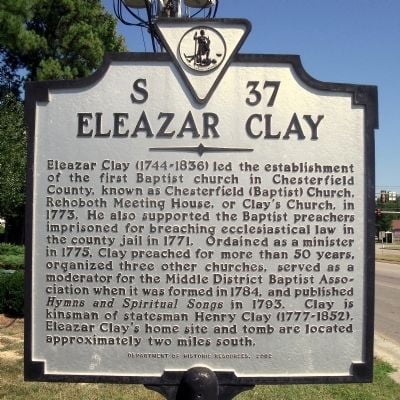
• Photo: Eleazar Clay Marker (www.hmdb.org/PhotoFullSize.asp?PhotoID=128835)
Related
Sorry, no records were found. Please adjust your search criteria and try again.
Sorry, unable to load the Maps API.