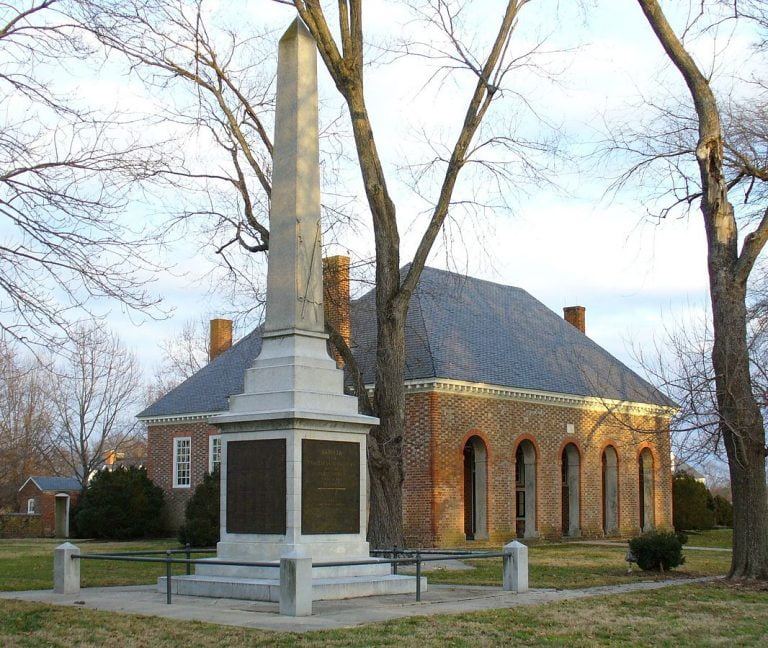
The Hanover County Courthouse occupies an important place in American history as the setting for one of the earliest and most influential public stands taken by Patrick Henry. Long before his famous speech at St. John’s Church, Henry rose to prominence within this courthouse, where his bold defense of colonial rights helped lay the groundwork for the spirit of resistance that would lead to the American Revolution.
Constructed in 1735, the Hanover County Courthouse is one of the oldest courthouses still in use in the United States. Built of brick in a simple yet sturdy colonial style, it served as the center of legal and civic life in Hanover County, Virginia. Like many courthouses of the period, it was not only a place for legal proceedings but also a gathering point for the community, where issues of law, governance, and local concern were debated and decided.
The courthouse gained lasting historical significance in 1763 during what became known as the “Parson’s Cause,” a legal dispute between Anglican clergy and the colonial government of Virginia. The controversy arose after the colony passed a law allowing debts owed to clergy—traditionally paid in tobacco—to be settled in currency at a fixed rate. When the British Crown later vetoed the law, some clergy sued for back pay, seeking higher compensation.
Patrick Henry, then a relatively unknown young lawyer, took on the case in defense of the colony’s position. Appearing before the court at Hanover, he delivered a passionate and daring argument that would change the course of his life. In his speech, Henry went beyond the technical details of the case and challenged the authority of the Crown itself, suggesting that a king who disallowed laws beneficial to his people had, in effect, forfeited his right to obedience.
This argument was considered bold—even dangerous—at a time when loyalty to the Crown was expected. Yet Henry’s powerful oratory captivated those in attendance. Witnesses later recalled the dramatic effect of his words, which stirred both excitement and controversy. The jury ultimately awarded only nominal damages to the clergy, a decision widely seen as a victory for Henry and for colonial self-governance.
The impact of the Parson’s Cause extended far beyond the immediate case. It marked one of the first instances in which an American colonist publicly questioned royal authority in such direct terms. Henry’s performance at the Hanover County Courthouse established him as a leading voice in the growing movement for colonial rights and resistance to British control.
In the years that followed, Henry would continue to build on this reputation, eventually becoming one of the most prominent advocates for independence. His later speeches, including his famous declaration at St. John’s Church, can be traced back to the confidence and conviction he displayed at Hanover.
Today, the Hanover County Courthouse stands as a preserved historical site, offering a tangible connection to the early stirrings of American independence. Its modest structure belies the significance of the events that took place within its walls. Visitors can still see the courtroom where Henry argued his case, gaining a sense of the environment in which these pivotal moments unfolded.
In sum, the Hanover County Courthouse is more than an old building; it is a landmark of American political awakening. It was here that Patrick Henry first gave voice to ideas that would later define a nation. Through his bold stand in the Parson’s Cause, he helped ignite a spirit of liberty that would grow into the movement for independence, making this courthouse a vital part of the American story.
_____
Image Source/Credit:
• Erechtheus, Public domain, via Wikimedia Commons
Related
Sorry, no records were found. Please adjust your search criteria and try again.
Sorry, unable to load the Maps API.