
The Scotchtown is one of the most significant historic homes associated with Patrick Henry, offering a valuable glimpse into the private life of one of America’s most influential voices for liberty. Located in Hanover County, Virginia, Scotchtown served as Henry’s residence from 1771 to 1778, a crucial period that included the opening years of the American Revolution.
Originally built around 1719 by Charles Chiswell, a prominent Virginia planter and ironmaster, Scotchtown was part of a large plantation complex. The name “Scotchtown” is believed to derive from Scottish workers who were employed in nearby ironworks. By the time Patrick Henry acquired the property, it was already an established and productive estate, well suited to support a growing family.
Henry purchased Scotchtown in 1771, shortly after gaining prominence in colonial politics. By then, he had already made a name for himself through his legal career and his outspoken opposition to British policies, including his famous “Virginia Resolves” against the Stamp Act. Moving his family to Scotchtown provided both stability and a base of operations during an increasingly turbulent time in American history.
It was while living at Scotchtown that Henry delivered his most famous speech at St. John’s Church in 1775, where he declared, “Give me liberty, or give me death!” Though the speech took place in Richmond, Scotchtown was the home to which he returned, and it served as the setting where he prepared for and reflected on the momentous events unfolding around him.
The years Henry spent at Scotchtown were marked by both public achievement and personal hardship. His first wife, Sarah Shelton Henry, suffered from mental illness and died in 1775, a tragedy that deeply affected him and his family. Despite these challenges, Henry remained active in the revolutionary cause, serving as a delegate to the Continental Congress and later as the first elected governor of Virginia.
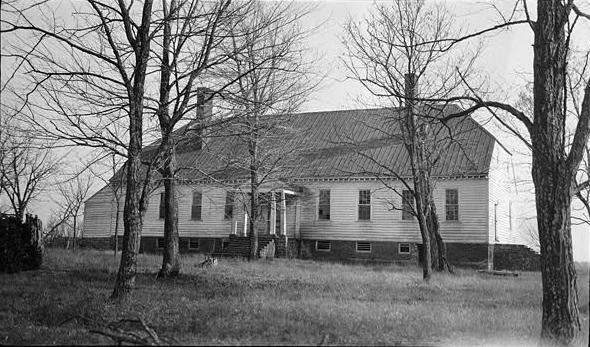
Architecturally, Scotchtown is a fine example of early eighteenth-century Virginia plantation design. Built of wood rather than brick—a rarity for homes of its size and status—it features a steep roof, dormer windows, and a large central chimney. The house reflects both practicality and a measure of elegance, offering insight into the domestic life of a prominent colonial family.
After Henry sold the property in 1778, Scotchtown passed through several owners and gradually fell into decline. By the twentieth century, however, its historical importance was recognized, and efforts were made to preserve it. Today, the site is maintained by Preservation Virginia, which has restored the house and grounds to reflect their eighteenth-century appearance.
Visitors to Scotchtown can explore the home, its outbuildings, and the surrounding landscape, gaining a deeper understanding of both Patrick Henry’s life and the broader context of colonial Virginia. The site provides a quieter, more personal perspective on a figure often remembered for his public oratory, revealing the environment in which he lived, worked, and raised his family.
In sum, Scotchtown stands as an enduring testament to Patrick Henry’s life during a defining period in American history. It was here that he balanced the responsibilities of family and public service while contributing to the cause of independence. As both a historic home and a place of reflection, Scotchtown helps preserve the legacy of a man whose words and actions helped shape the course of a nation.
♦ _____ ♦
From Plaque:
Scotchtown is best known as the site from which Patrick Henry rode to Richmond in March of 1775 to deliver his infamous “Liberty or Death” speech. . Some have even suggested that the house, where he had been forced to confine his wife Sarah due to her increasingly poor mental health, inspired his greatest speech. But the Henry family lived here only briefly, from about 1771 until 1776 when Henry was appointed Governor of Virginia and relocated to Williamsburg.
Scotchtown had been built sometime around 1725 by Charles Chiswell. Chiswell was a planter and iron industrialist. He was visited by William Byrd in 1732, who described Scotchtown as “very clean and [everything] very good.”
Originally, the house was less than half the size of the present-day Scotchtown, consisting of a four-room frame structure over a brick foundation. The house was expanded to its current size in the 1740s or 1750s.
Scotchtown remained in the Chiswell family until the 1760’s, when financial hardships forced the sale of the plantation. Afterwards, it passed through a series of hands (including Henry’s) before being purchased by John Mosby Sheppard around 1801. The Sheppard family and their descendants lived at Scotchtown until 1958 when the house was purchased and restored by Preservation Virginia.
Patrick Henry (May 29, 1736 – June 6, 1799) was the leading Virginia statesman in defending the rights of Colonial America.
Following Henry’s death, John Adams wrote to Thomas Jefferson singing his praises: “In the Congress of 1774 there was not one member, except Patrick Henry, who appeared to me sensible of the Precipice or rather the Pinnacle on which he stood, and had the candour and courage enough to acknowledge it.”
Henry was the first elected governor of Virginia, a devoted father of 17 children, and the most famous orator of his day. Born in Hanover County, Henry made a name for himself as a young lawyer in the Parsons’ Cause at Hanover Courthouse in 1763. His 1765 resolutions against the Stamp Act articulated the basic principles of the American Revolution. Henry is perhaps best known for his immortal words “Give me liberty or give me death,” which he delivered during the Second Virginia Convention in a speech to fellow delegates George Washington and Thomas Jefferson at St. John’s Church in 1775. His impassioned words helped move colonists toward American independence and they continue to inspire the cause of freedom around the world.
Known as the “Voice of the Revolution,” Henry’s political career included 26 years of service in the Virginia legislature and five terms as governor. He helped draft the Virginia Constitution of 1776 and its Declaration of Rights. A leading critic of the U.S. Constitution, Henry also strongly influenced the creation of the Bill of Rights. Following his death, Henry was buried at Red Hill Plantation, now the site of the Patrick Henry National Memorial.
_____
Image Source/Credit:
• Unknown photographer, Public domain, via Wikimedia Commons
Related
Sorry, no records were found. Please adjust your search criteria and try again.
Sorry, unable to load the Maps API.