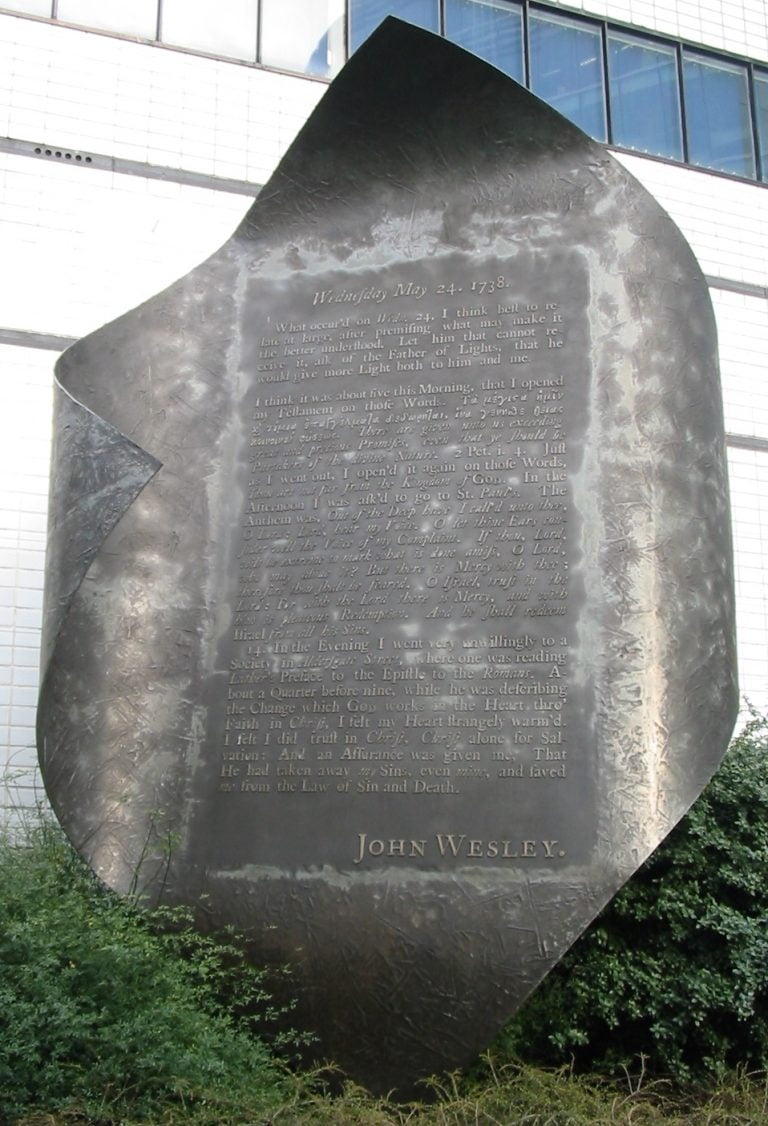
The Aldersgate Flame in London is a symbolic memorial commemorating a pivotal moment in the life of John Wesley, the eighteenth-century Anglican clergyman whose spiritual awakening helped ignite the Methodist movement. Located near the site of Aldersgate Street, where Wesley experienced a profound religious transformation in 1738, the monument serves as a reminder of the enduring influence of that event on Christian history.
On May 24, 1738, John Wesley attended a small meeting on Aldersgate Street in London. During the gathering, a reading was given from Martin Luther’s preface to the Epistle to the Romans. As Wesley listened, he later recorded that he felt his “heart strangely warmed.” In that moment, he experienced a deep assurance of personal faith in Christ, marking a turning point in his spiritual life. Though Wesley had long been a devout clergyman, this experience gave him a renewed sense of conviction and clarity regarding salvation by faith.
The Aldersgate experience is widely regarded as a defining moment in the rise of Methodism. Following this event, Wesley began to preach with greater urgency and emphasis on personal conversion, grace, and the assurance of salvation. His ministry expanded beyond traditional church settings, as he took to open-air preaching and organized societies that would eventually form the Methodist movement.
The Aldersgate Flame memorial captures the essence of this transformative moment. Designed as an eternal flame, it symbolizes the spiritual awakening that Wesley described and the continuing influence of his message. The flame serves as a visual representation of the “warming” of the heart that Wesley experienced, as well as the spread of the Methodist revival that followed.
Situated near the original site of Aldersgate Street, the memorial connects the present to a specific location in London’s religious history. While the exact building where Wesley attended the meeting no longer stands, the area remains closely associated with his experience. The placement of the flame ensures that visitors can reflect on the significance of the event in its historical context.
The Aldersgate Flame also serves as a point of pilgrimage for Methodists and others interested in church history. Visitors often come to the site to commemorate Wesley’s experience and to consider its impact on their own spiritual journeys. The memorial’s simplicity reflects the nature of the event it commemorates—an intimate moment of personal transformation rather than a grand public occasion.
Beyond its immediate religious significance, the Aldersgate experience had far-reaching effects. Wesley’s renewed ministry contributed to a broader evangelical revival in Britain and beyond, influencing social reform movements and the development of new forms of religious organization. The Methodist movement, which grew out of his work, would go on to become a global denomination with millions of adherents.
The legacy of the Aldersgate Flame lies in its ability to encapsulate a moment that changed not only one man’s life but also the course of religious history. It reminds observers that significant movements often begin with personal experiences that inspire broader action.
In conclusion, the Aldersgate Flame stands as a powerful symbol of spiritual renewal and historical transformation. By commemorating John Wesley’s “heart strangely warmed” experience, it honors a moment that helped shape the Methodist tradition and continues to inspire individuals today. Its presence in London serves as a quiet yet enduring testament to the lasting impact of faith and personal conviction.
♦ _____ ♦
Inscription Text
What occurred on Wednesday May 24, 1738, I think best to relate at large, after premising what may make it the better understood. Let him that cannot receive it, ask of the Father of lights, that he would give more light to him and me.
I think it was about five this morning that I opened my Testament on those words, “There are given unto us exceeding great and precious promises, even that ye should be partakers of the divine nature” [II Peter 1:4]. Just as I went out, I opened it again on those words, “Thou art not far from the kingdom of God” [Mark 12:34]. In the afternoon I was asked to go to St. Paul’s. The anthem was, “Out of the deep have I called unto Thee, O Lord: Lord, hear my voice. Oh, let Thine ears consider well the voice of my complaint. If Thou, Lord, wilt be extreme to mark what is done amiss, O Lord, who may abide it? For there is mercy with Thee; therefore shalt Thou be feared. O Israel, trust in the Lord: for with the Lord there is mercy, and with Him is plenteous redemption. And He shall redeem Israel from all his sins.”
In the evening I went very unwillingly to a society in Aldersgate Street, where one was reading Luther’s preface to the Epistle to the Romans. About a quarter before nine, while he was describing the change which God works in the heart through faith in Christ, I felt my heart strangely warmed. I felt I did trust in Christ, Christ alone, for salvation; and an assurance was given me that He had taken away my sins, even mine, and saved me from the law of sin and death.
_____
Image Source/Credit:
• London Museum, CC BY-SA 3.0 <http://creativecommons.org/licenses/by-sa/3.0/>, via Wikimedia Commons
Related
Sorry, no records were found. Please adjust your search criteria and try again.
Sorry, unable to load the Maps API.