
The conversions of John Wesley and Charles Wesley stand as defining moments in the history of eighteenth-century Christianity and the rise of Methodism. Though closely related as brothers, their spiritual awakenings unfolded in different ways and at slightly different times, yet together they helped shape a movement that would have global impact.
John Wesley, born in 1703, was an Anglican clergyman deeply committed to religious discipline and moral reform. Educated at Oxford University, he initially pursued a highly structured and earnest form of Christianity. Along with his brother Charles and others, he formed what became known as the “Holy Club,” a group dedicated to rigorous spiritual practices, prayer, and service. Despite his devotion, Wesley later described this period as one of inner uncertainty, as he sought assurance of personal salvation.
The turning point in John Wesley’s spiritual life came on May 24, 1738, during a meeting on Aldersgate Street in London. While listening to a reading of Martin Luther’s preface to the Epistle to the Romans, Wesley experienced a profound sense of spiritual assurance. He later wrote that his “heart was strangely warmed,” signifying an inner conviction that he was saved through faith in Christ. This experience did not change his beliefs so much as transform his understanding of them—from religious duty to personal assurance of grace.
Charles Wesley’s conversion occurred slightly earlier, in 1738, and also involved a deep spiritual awakening. Like his brother, Charles had been earnest in religious practice but struggled with a sense of spiritual fulfillment. During a period of illness, he experienced a renewed understanding of faith and grace, which led to a profound personal transformation. His conversion was marked by a strong emotional and spiritual response, which he later expressed through his writing.
Unlike John, Charles Wesley became best known not as a preacher but as a hymn writer. He composed thousands of hymns that expressed the theological and emotional dimensions of the Methodist experience. Works such as “O for a Thousand Tongues to Sing” and “Hark! The Herald Angels Sing” remain central to Christian worship today. Through music, Charles helped articulate the theology of Methodism in a form that was accessible and deeply moving.
The conversions of the Wesley brothers were closely connected to the broader evangelical revival taking place in Britain during the eighteenth century. Influenced by figures such as George Whitefield, they became increasingly convinced of the importance of personal faith, heartfelt religion, and active evangelism. Their experiences led them to move beyond traditional parish ministry into field preaching and the establishment of Methodist societies.
John Wesley’s post-conversion ministry emphasized organization, discipline, and outreach. He traveled extensively across Britain, preaching in open fields, industrial towns, and rural communities. His goal was to bring spiritual renewal to those outside the reach of established churches. Charles, while less itinerant, supported the movement through hymn writing and pastoral encouragement, giving voice to its theological convictions.
Together, the Wesley brothers helped lay the foundation for Methodism as a distinct movement within Protestant Christianity. Their conversions were not isolated emotional events but catalysts for sustained ministry and institutional development. The emphasis on personal experience of grace, combined with disciplined Christian living, became central to Methodist identity.
The legacy of their conversions extends far beyond their own lifetimes. Methodism spread rapidly across Britain, North America, and eventually around the world, becoming one of the largest Protestant traditions. The hymns of Charles Wesley and the sermons and organizational structures of John Wesley continue to influence Christian worship and practice today.
In conclusion, the conversions of John and Charles Wesley represent more than personal spiritual milestones. They mark the beginning of a movement that reshaped Christian thought and practice. Through their experiences of faith, they helped articulate a vision of Christianity centered on personal transformation, active devotion, and heartfelt worship—a legacy that continues to resonate across generations.
♦ _____ ♦
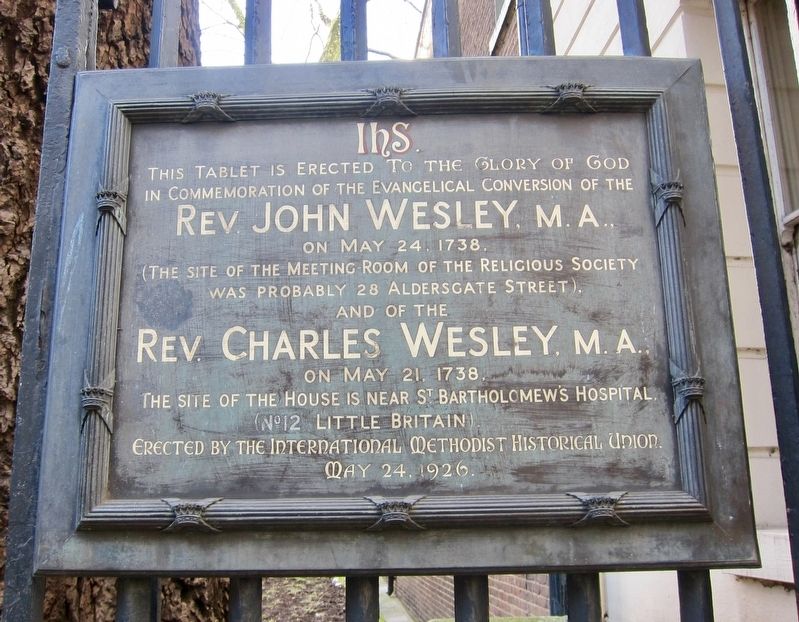
Inscription:
This tablet is erected to the glory of God
in commemoration of the evangelical conversion of the
Rev. John Wesley, M. A.,
on May 24, 1738.
(The site of the meeting room of The Religious Society
was probably 28 Aldersgate Street),
and of the
Rev. Charles Wesley, M. A.,
on May 21, 1738,
The site of the house is near St Bartholomew’s Hospital,
(No12 Little Britain).
_____
Image Source/Credit:
• Diane Griffiths, CC BY 2.0 <https://creativecommons.org/licenses/by/2.0>, via Wikimedia Commons
Related
Sorry, no records were found. Please adjust your search criteria and try again.
Sorry, unable to load the Maps API.