
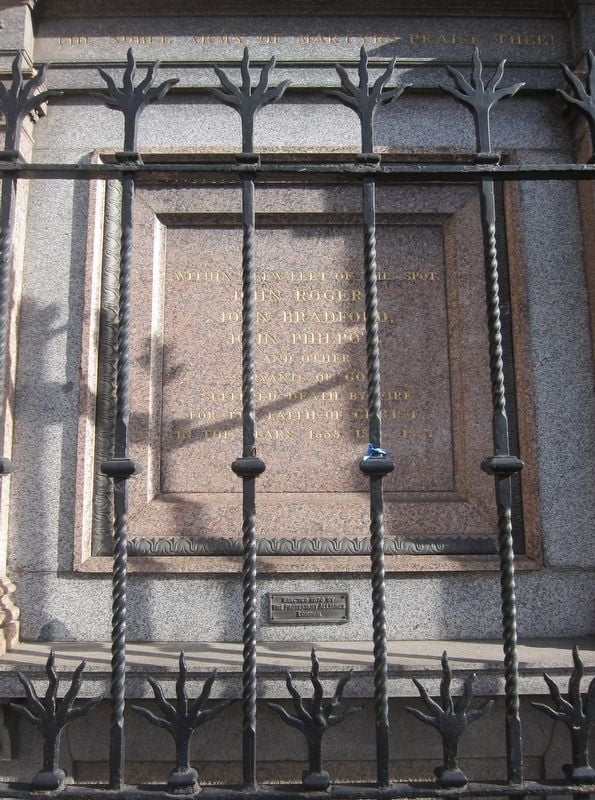
The Rogers Bradford and Philpot Memorial in London stands as a solemn tribute to three Protestant martyrs of the sixteenth century—John Rogers, John Bradford, and John Philpot. Located in Smithfield, a historic area long associated with public executions, the memorial marks a site where faith, conviction, and sacrifice intersected during one of England’s most turbulent religious periods.
The story behind the memorial is rooted in the reign of Mary I of England, often remembered as “Bloody Mary” for her efforts to restore Roman Catholicism after the Protestant reforms of her predecessors. Between 1555 and 1558, hundreds of Protestants were executed for their beliefs, many of them burned at the stake in Smithfield. Among these were Rogers, Bradford, and Philpot, whose deaths came to symbolize the cost of religious conviction.
John Rogers, the first of the three to be martyred, was burned at the stake in February 1555. A clergyman and scholar, Rogers had played a key role in the development of the English Bible, particularly through his association with the Matthew Bible. His refusal to renounce his Protestant beliefs led to his arrest and execution. Contemporary accounts describe his calm demeanor and steadfast faith even in the face of death, leaving a lasting impression on those who witnessed it.
John Bradford followed later that same year, executed in July 1555. Known for his pastoral heart and personal piety, Bradford had been a popular preacher in London. His letters from prison, filled with encouragement and spiritual reflection, circulated widely and strengthened fellow believers. His oft-quoted expression, “There but for the grace of God go I,” is said to have originated from his compassionate outlook during this time.
John Philpot, archdeacon of Winchester, was martyred in December 1555. A learned theologian and articulate defender of Protestant doctrine, Philpot had engaged in numerous debates with Catholic authorities before his arrest. His writings and recorded examinations provide insight into the theological tensions of the era, as well as the courage required to stand firm under pressure.
The memorial in Smithfield was erected in the nineteenth century, a period marked by renewed interest in Reformation history. It serves not only as a marker of the location where these men died but also as a broader reminder of the struggles for religious freedom that shaped England’s identity. Unlike grand monuments, the Rogers, Bradford, and Philpot Memorial is understated, reflecting the gravity of the events it commemorates rather than seeking to overshadow them.
Visitors to the site today encounter a quiet space amid the bustle of modern London. Yet beneath the surface lies a history that continues to resonate. The memorial invites reflection on the principles for which these men gave their lives—conviction, conscience, and the right to worship according to one’s beliefs.
The legacy of Rogers, Bradford, and Philpot extends beyond their individual stories. Their martyrdom became part of a larger narrative recorded in works such as John Foxe’s Book of Martyrs, which helped shape Protestant identity in England for generations. Through such accounts, their witness influenced not only their contemporaries but also future movements advocating religious liberty.
In conclusion, the Rogers, Bradford, and Philpot Memorial stands as a lasting testament to a defining chapter in English history. It reminds visitors that the freedoms often taken for granted today were forged in times of conflict and sacrifice. By preserving the memory of these three men, the memorial ensures that their courage and faith continue to be remembered in the very place where they gave their lives.
_____
Image Source/Credit:
• Marian Martyrs Historical Marker. 27 Jan. 2022 (www.hmdb.org/m.asp?m=116782)
Related
Sorry, no records were found. Please adjust your search criteria and try again.
Sorry, unable to load the Maps API.