
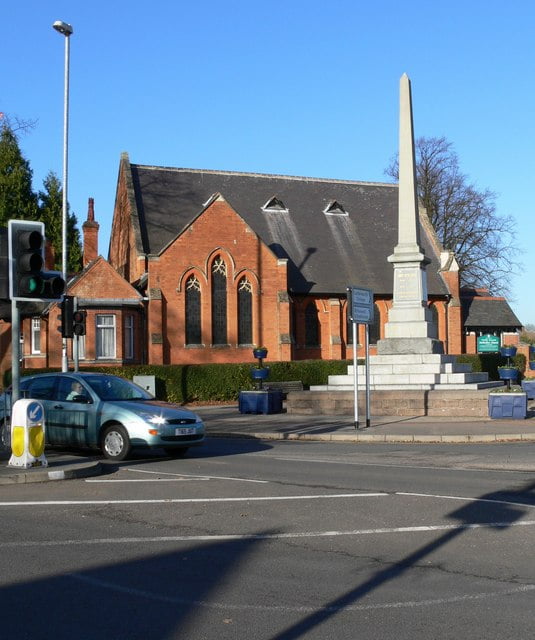
The Wycliffe Memorial in Lutterworth, England, stands as a tribute to one of the most influential figures in early English religious history, John Wycliffe. Located in the town where Wycliffe served as rector for many years, the memorial commemorates his life, his work in translating the Bible into English, and his lasting impact on the course of Christian reform.
John Wycliffe (c. 1328–1384) was a scholar, theologian, and early advocate for reform within the medieval Church. Educated at Oxford, he became known for his intellectual ability and his willingness to challenge established authority. His teachings emphasized the importance of Scripture as the ultimate authority in matters of faith, a position that placed him at odds with the institutional structures of the Church of his time.
Lutterworth holds special significance in Wycliffe’s life because it was here that he spent his final years as rector of the local parish church, St Mary’s Church, Lutterworth. During this period, he is believed to have overseen or inspired the first complete translation of the Bible into English. This work made the Scriptures more accessible to ordinary people, challenging the prevailing norm that restricted biblical texts to Latin.
The Wycliffe Memorial was erected in the nineteenth century, a time when there was renewed interest in the history of religious reform and in figures who had contributed to the development of Protestant thought. The monument reflects Victorian appreciation for Wycliffe as a forerunner of the Protestant Reformation, even though he lived more than a century before it began.
The memorial itself is typically characterized by a dignified design, often featuring inscriptions that highlight Wycliffe’s role as a translator of the Bible and a champion of religious truth. Its placement in Lutterworth connects it directly to the setting of his later ministry, allowing visitors to reflect on his life in the very place where much of his important work was carried out.
Wycliffe’s legacy extends far beyond Lutterworth. His teachings influenced a group known as the Lollards, who sought to promote the use of the English Bible and to encourage reform within the Church. Although these ideas were controversial at the time and often met with opposition, they laid important groundwork for later reform movements in Europe.
The memorial also serves as a reminder of the challenges Wycliffe faced. His ideas were condemned by Church authorities after his death, and in 1428 his remains were exhumed and burned as a posthumous act of condemnation. The ashes were scattered in the River Swift, which flows near Lutterworth—a symbolic act that, as later observers noted, ironically spread his influence even further.
Today, the Wycliffe Memorial is a site of historical and spiritual reflection. Visitors to Lutterworth can explore both the monument and St Mary’s Church, gaining insight into the life of a man whose work helped shape the future of Christianity. The site attracts those interested in church history, the development of the English Bible, and the broader story of religious reform.
In conclusion, the Wycliffe Memorial in Lutterworth stands as a lasting tribute to a man whose ideas were ahead of his time. By honoring John Wycliffe’s commitment to making Scripture accessible and his challenge to established authority, the memorial preserves the legacy of a figure whose influence continues to be felt centuries after his death.
_____
Image Source/Credit:
• Mat Fascione, CC BY-SA 2.0 <https://creativecommons.org/licenses/by-sa/2.0>, via Wikimedia Commons
Related
Sorry, no records were found. Please adjust your search criteria and try again.
Sorry, unable to load the Maps API.