
The exhumation and burning of John Wycliffe’s remains is one of the most striking episodes in the history of the late medieval church. Though John Wycliffe had died peacefully in 1384, decades later his body was exhumed, burned, and his ashes scattered—a symbolic act intended to condemn his teachings and erase his influence. Instead, the event only strengthened his legacy.
Wycliffe, often called the “Morning Star of the Reformation,” was a scholar at Oxford and a vocal critic of corruption within the medieval church. He challenged the authority of the papacy, opposed the wealth and political power of the clergy, and emphasized the supremacy of Scripture. Perhaps his most enduring contribution was his role in promoting the translation of the Bible into English, making it accessible to ordinary people rather than limiting it to Latin-speaking clergy.
During his lifetime, Wycliffe’s ideas drew both support and opposition. Although some of his teachings were condemned, he avoided execution and died of natural causes in his parish at Lutterworth. However, his influence did not end with his death. His followers, known as Lollards, continued to spread his teachings throughout England, and his writings found their way to continental Europe, where they influenced reformers such as Jan Hus.
The turning point came at the Council of Constance, which sought to address divisions and heresies within the church. In addition to condemning Hus, the council also formally denounced Wycliffe’s teachings. Though Wycliffe had been dead for over forty years, the council declared him a heretic and ordered that his remains be removed from consecrated ground.
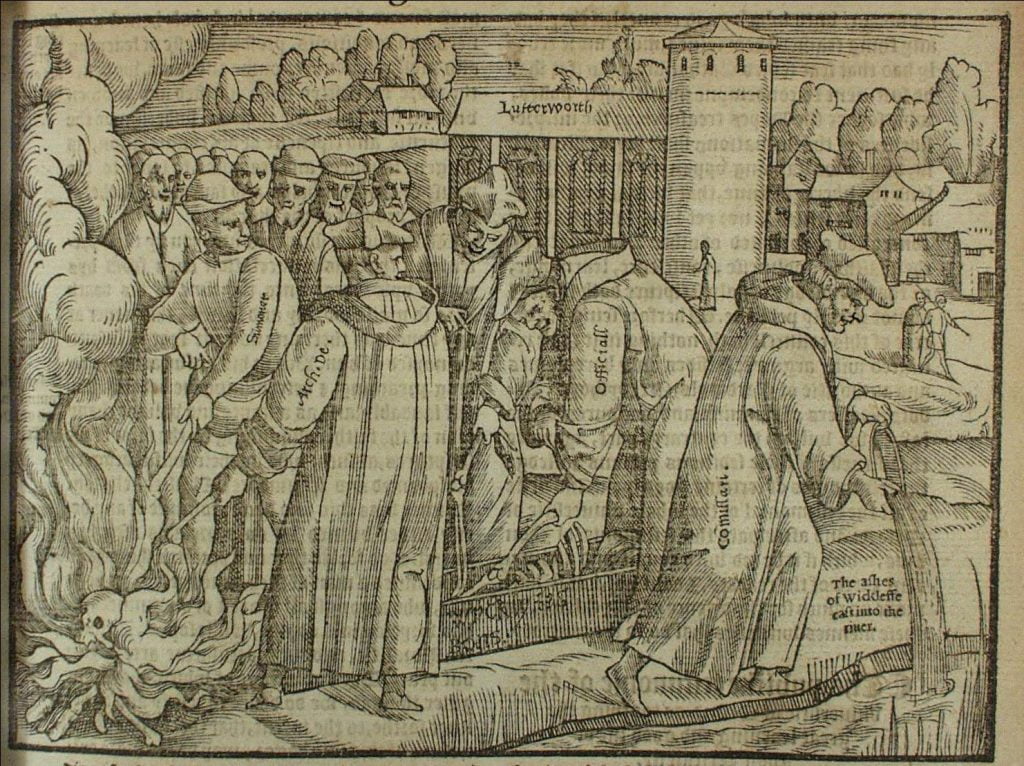
In 1428, this decree was carried out under the authority of the church. Wycliffe’s grave at Lutterworth was opened, and his bones were exhumed. They were then burned, and the ashes were scattered into the nearby River Swift. The act was meant to serve as a final judgment against him, a public declaration that his teachings were to be rejected and forgotten.
Yet the symbolism of this act has often been interpreted in quite the opposite way. Rather than extinguishing Wycliffe’s influence, the scattering of his ashes has been seen as representing the spread of his ideas. The image of his remains carried by the waters into broader streams and rivers has been used by later writers to illustrate how his teachings continued to flow across regions and generations.
Indeed, Wycliffe’s impact only grew in the years that followed. His emphasis on Scripture as the highest authority became a central principle of the Protestant Reformation in the sixteenth century. Reformers such as Martin Luther would echo many of his concerns, even if they developed them further in their own contexts. The English Bible, which Wycliffe helped pioneer, eventually became a cornerstone of Protestant faith and practice.
The episode of Wycliffe’s ashes also reveals much about the tensions of the late medieval church. It reflects a time when religious authority was closely guarded and dissent was often met with severe measures. The decision to condemn a man long after his death underscores the perceived threat of his ideas and the determination of church leaders to maintain doctrinal control.
Today, the story of John Wycliffe’s ashes is remembered not as a defeat, but as a powerful symbol of enduring influence. The attempt to silence him ultimately failed, as his teachings continued to inspire reform and shape the course of Christian history.
In the end, the burning and scattering of Wycliffe’s remains did not erase his voice. Instead, it ensured that his legacy would be remembered, not confined to a grave, but carried far beyond it—much like the ideas he so boldly proclaimed.
_____
Image Source/Credit:
• File:Wycliffe Bones Foxe.jpg – Wikimedia Commons (commons.wikimedia.org/wiki/File:Wycliffe_bones_Foxe.jpg)
Related
Sorry, no records were found. Please adjust your search criteria and try again.
Sorry, unable to load the Maps API.