Carey Baptist Church in Hackleton is a historic Baptist congregation closely connected to the evangelical revival and missionary movement of the late eighteenth century in England. Though modest in size and rural in setting, the church has played a meaningful role in shaping Baptist life in the region and is indirectly linked to one of the most influential figures in global missions, William Carey.
The origins of the Baptist witness in Hackleton date to the period following the evangelical stirrings of the Great Awakening. During this time, Nonconformist congregations were growing across Northamptonshire, encouraged by a renewed emphasis on personal conversion, biblical preaching, and congregational independence. Baptists in particular found fertile ground in rural villages like Hackleton, where small gatherings of believers often formed around shared convictions rather than formal ecclesiastical structures.
The church that would later become Carey Baptist Church developed as part of this wider movement. Early Baptist congregations in the area typically met in homes or simple meetinghouses, reflecting both their limited resources and their emphasis on simplicity in worship. Over time, as religious toleration increased following legislation such as the Toleration Act 1689, these groups were able to establish more permanent places of worship.
Hackleton’s Baptist community became more formally organized in the eighteenth century, and its growth coincided with the rise of strong Baptist leadership in Northamptonshire. The region was a center of theological reflection and missionary vision, particularly through ministers such as John Sutcliff and Andrew Fuller, who encouraged prayer, evangelism, and global mission. While Carey himself served primarily at nearby Moulton, the network of Baptist churches in the area, including Hackleton, shared in this broader spiritual movement.
The church later took the name Carey Baptist Church in honor of William Carey, reflecting his profound influence on Baptist identity and mission. Carey’s life and work—especially his role in founding the Baptist Missionary Society—reshaped the understanding of Christian responsibility toward global evangelism. Even though Carey did not pastor in Hackleton, the church’s association with his legacy highlights the shared heritage of the Northamptonshire Baptist community.
Throughout the nineteenth century, Carey Baptist Church served as a focal point for village religious life. Like many rural Baptist congregations, it provided not only worship services but also a sense of community identity. Baptisms, marriages, and funerals were central to its ministry, and the church functioned as a moral and social anchor for local families. Its continuity through generations reflects the stability often found in small English Nonconformist churches.
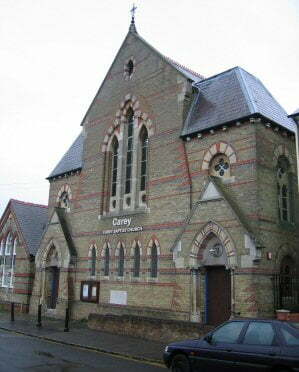
Architecturally, the church building reflects the practical and unadorned style typical of Baptist meetinghouses. Its simplicity underscores the theological emphasis on worship centered on Scripture and preaching rather than elaborate ritual or decoration. Over time, modest renovations have allowed the building to serve changing needs while preserving its historic character.
The impact of Carey Baptist Church lies less in national prominence and more in its connection to a wider spiritual movement. It represents the network of local congregations that supported revival, nurtured faith, and contributed to the missionary vision that emerged from Northamptonshire in the late eighteenth century. These churches formed the foundation upon which larger institutions and global efforts were built.
Today, Carey Baptist Church continues as an active congregation, maintaining its role in the spiritual life of Hackleton. At the same time, it stands as a reminder of the enduring influence of the Baptist tradition in rural England. Its history reflects the quiet but important contribution of local churches to movements that ultimately reached across the world.
_____
Image Source/Credit:
• “Walk 160: Quinton, Piddington, Horton and Hackleton Circular.” Northamptonshirewalks, 12 Sept. 2023 (northamptonshirewalks.co.uk/about/walk-160-quinton-piddington-horton-hackleton-circular)
Related
Sorry, no records were found. Please adjust your search criteria and try again.
Sorry, unable to load the Maps API.