
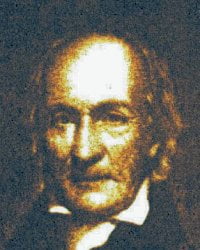
John Leland (1754–1841) was one of the most influential Baptist preachers and advocates for religious liberty in early American history. Known for his plainspoken preaching, independent spirit, and unwavering defense of freedom of conscience, Leland helped shape the emerging nation’s understanding of the proper relationship between church and state.
Leland was born in Grafton, Massachusetts, and raised in a Congregationalist environment typical of New England in the mid-eighteenth century. As a young man, he experienced a period of deep spiritual concern that culminated in his conversion during the era of evangelical revival following the First Great Awakening. Though the height of that movement had passed, its influence lingered, emphasizing personal faith and a direct relationship with God rather than reliance on established religious forms.
After his conversion, Leland became convinced of Baptist principles, particularly believer’s baptism and the independence of the local church. He began preaching in his early twenties and soon gained a reputation for his fervor, clarity, and ability to connect with ordinary people. Unlike more formally trained ministers, Leland embraced a direct and accessible style, often traveling extensively to preach in rural areas where organized churches were scarce.
A significant portion of Leland’s ministry took place in Virginia, where Baptists were still a marginalized group in a society dominated by the established Anglican Church. There, he encountered firsthand the legal and social challenges faced by dissenters, including restrictions on preaching and requirements to support the state church through taxes. These experiences sharpened his commitment to religious liberty and convinced him that true faith could never flourish under coercion.
Leland became a leading voice among Baptists in calling for the complete separation of church and state. He argued that government should protect civil order but leave matters of religion entirely to the individual conscience. This position was not merely theoretical; it was grounded in the lived experience of those who had suffered under religious establishment. Leland’s preaching and writing consistently emphasized that liberty of conscience was both a natural right and a biblical principle.
His influence reached beyond the pulpit into the political life of the new nation. During the debates over the ratification of the Constitution, Leland initially expressed concern that the absence of explicit protections for individual rights—especially religious freedom—posed a serious danger. His discussions with James Madison, a leading architect of the Constitution, proved pivotal. Leland agreed to support Madison’s political efforts after receiving assurances that amendments would be introduced to safeguard essential liberties.
This cooperation contributed to Madison’s eventual role in drafting the United States Constitution First Amendment. The First Amendment’s guarantees of free exercise of religion and prohibition of religious establishment reflected principles long championed by Leland and other Baptists. Though he did not hold political office himself, Leland’s advocacy helped secure freedoms that would benefit generations to come.
In addition to his public influence, Leland was a prolific writer. His sermons, essays, and pamphlets addressed a wide range of topics, from theology to politics. He wrote with wit and conviction, often using vivid illustrations to make complex ideas understandable. His works circulated widely, extending his influence far beyond the communities he personally visited.
Later in life, Leland returned to Massachusetts, where he continued preaching and engaging in public discourse. He remained active well into his later years, maintaining the same commitment to liberty and gospel proclamation that had marked his earlier ministry. One of the more colorful episodes associated with him is the presentation of a massive cheese to President Thomas Jefferson, a gesture symbolizing Baptist support for religious freedom under the new government.
John Leland died in 1841, having witnessed the growth of both the Baptist movement and the United States itself. By the time of his death, many of the principles he had defended—particularly the separation of church and state—had become widely accepted features of American life.
In sum, John Leland’s life was marked by a steadfast dedication to both faith and freedom. As a preacher, he brought the message of the gospel to countless individuals; as an advocate, he helped secure the liberties that allow such preaching to flourish without restraint. His legacy endures in the continued vitality of Baptist life and in the broader American commitment to religious liberty, a principle he labored long and faithfully to defend.
_____
Image Source/Credit:
• Public domain, via Wikimedia Commons
Related
Sorry, no records were found. Please adjust your search criteria and try again.
Sorry, unable to load the Maps API.