
The Cheshire Mammoth Cheese stands as one of the most unusual and memorable episodes in early American history, symbolizing both political support and the principle of religious liberty. Created in the small town of Cheshire, Massachusetts, this enormous wheel of cheese became a national sensation and a powerful expression of goodwill toward President Thomas Jefferson.
The story begins in 1801, shortly after Jefferson’s election to the presidency. At the time, the United States was still a young nation, and political divisions ran deep. Jefferson, a champion of republican ideals and religious freedom, was both admired and criticized, particularly by those who feared his views on church and state. Among his supporters, however, were many Baptists, who appreciated his commitment to protecting liberty of conscience.
In Cheshire, a predominantly Baptist community, the idea arose to create a grand gift that would express their admiration. The project was led by John Leland, a prominent preacher and advocate for religious liberty. Leland had long supported Jefferson’s views and saw the gift as a way to honor a leader who had defended the separation of church and state.
The cheese itself was an extraordinary undertaking. Weighing approximately 1,235 pounds and measuring several feet in diameter, it required the milk of hundreds of cows contributed by local farmers. Notably, the cheese was produced without the use of slave labor, reflecting both the values of the community and Leland’s own convictions. Once completed, it was inscribed with a message celebrating Jefferson as a “friend of religious liberty.”
Transporting the cheese from rural Massachusetts to the nation’s capital was no small feat. It was placed on a specially constructed wagon and drawn by a team of horses over hundreds of miles to Washington, D.C. The journey attracted attention at every stop, with crowds gathering to see the massive creation. By the time it arrived in early 1802, the cheese had already become something of a national curiosity.
Jefferson received the gift with appreciation, recognizing both its novelty and its symbolic meaning. The presentation of the cheese coincided with ongoing debates about religion in public life. Just days later, Jefferson wrote his famous letter to the Danbury Baptist Association, in which he referred to the “wall of separation between church and state”—a phrase that would become central to American constitutional interpretation.
The impact of the Cheshire Mammoth Cheese extended beyond its immediate novelty. It became a symbol of the alliance between Baptist communities and advocates of religious freedom. At a time when some states still maintained established churches, the cheese represented a public endorsement of a different vision—one in which government neither controlled nor favored religion.
The event also captured the imagination of the public and the press. Newspapers of the day reported on the cheese with a mixture of humor and admiration, and it quickly entered the folklore of the early republic. Though the cheese itself was eventually consumed, its story endured as a testament to the creativity and convictions of those who produced it.
In retrospect, the Cheshire Mammoth Cheese was more than a curious gift. It was a statement of principle, rooted in the belief that faith should be free and that government should respect the rights of conscience. Through this remarkable gesture, a small New England town made a lasting contribution to the larger American story—one that continues to be remembered for both its scale and its significance.
♦ _____ ♦
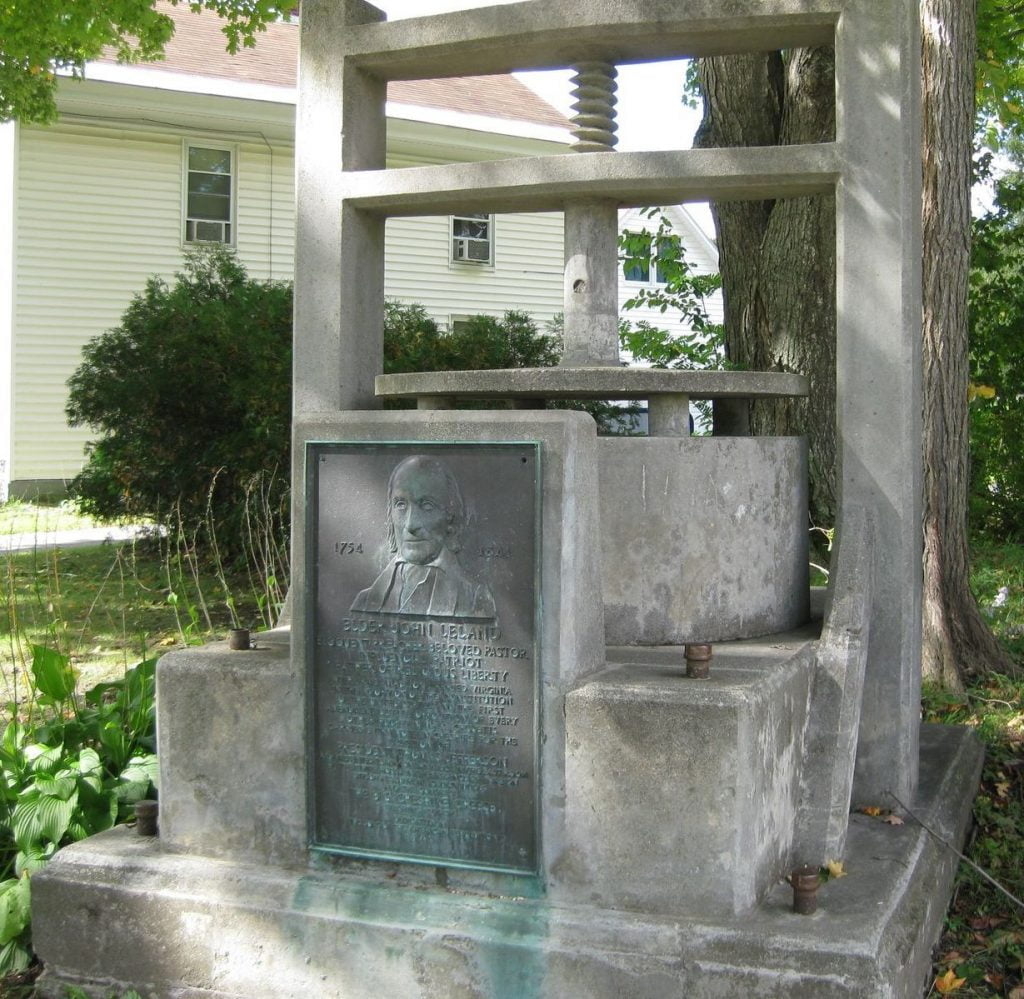
On the corner of Church and School streets stands a concrete replica of the cider press that produced the gigantic cheese that John Leland gave to President Thomas Jefferson. In Cheshire Cemetery, Leland’s obelisk grave-marker displays a commemorative plaque.
Copyrighted and used by permission from David Beale, Baptist History in England and America: Personalities, Positions, and Practices
From Wikipedia:
The Cheshire Mammoth Cheese was a gift from the town of Cheshire, Massachusetts to President Thomas Jefferson in 1802. The 1,235-pound (560 kg) cheese was created by combining the milk from every cow in the town, and made in a makeshift cheese press to handle the cheese’s size. The cheese bore the Jeffersonian motto “Rebellion to tyrants is obedience to God.”[1]
_____
Image Source/Credit:
• Makeitalready, CC BY-SA 3.0 <https://creativecommons.org/licenses/by-sa/3.0>, via Wikimedia Commons
Related
Sorry, no records were found. Please adjust your search criteria and try again.
Sorry, unable to load the Maps API.