William Brewster stands as one of the most respected and steady figures among the Pilgrim Fathers, serving as their spiritual guide and elder during one of the most challenging chapters in early American history. Though not formally ordained as a minister, Brewster fulfilled the role of pastor to the Pilgrims, providing leadership, encouragement, and biblical instruction from their days in England through their settlement in the New World.
Born around 1568 in Nottinghamshire, Brewster was educated at University of Cambridge, where he developed a strong foundation in religious thought and classical learning. He later served in diplomatic and administrative roles, including working under a government official connected to Queen Elizabeth I’s court. Despite these promising beginnings, Brewster became increasingly drawn to the growing movement of religious reformers who sought a purer form of worship than that offered by the Church of England.
Brewster eventually joined the Separatist congregation in Scrooby, where he worked closely with John Robinson, the group’s primary pastor. As pressure from English authorities intensified, Brewster played a key role in organizing the congregation’s escape to the more tolerant Netherlands. In 1608, the group settled in Leiden, where they were able to worship freely.
While in Leiden, Brewster took on increasing responsibility within the congregation. He was known for his deep knowledge of Scripture, his steady character, and his practical wisdom. When the Pilgrims later decided to journey to America, Brewster was among those who made the voyage aboard the Mayflower. Unlike Robinson, who remained behind in Europe, Brewster accompanied the settlers and became their principal spiritual leader in the New World.
Upon arriving in what would become Plymouth Colony, Brewster’s role proved vital. The Pilgrims faced harsh conditions, including a difficult winter, food shortages, and disease. During this time, Brewster provided stability and guidance. He led worship services, read sermons, and offered counsel to the struggling community. Though he did not claim the title of ordained pastor, his influence was pastoral in every sense.
Brewster’s leadership style was marked by humility and consistency. He was not known for dramatic speeches or forceful authority but for quiet strength and faithful service. He helped maintain unity within the colony and encouraged the settlers to remain committed to their shared values and faith. His example reinforced the principles of cooperation, discipline, and mutual care that were essential to the survival of the colony.
In addition to his spiritual duties, Brewster was involved in the daily life of the settlement. He worked alongside others, contributing to the practical needs of the community. This combination of spiritual and practical leadership made him a trusted and respected figure among the Pilgrims.
William Brewster remained in Plymouth for the rest of his life, continuing to serve as elder until his death in 1644. By that time, the colony had become more established, and the early struggles had given way to a more stable existence. Brewster’s steady hand during those formative years left a lasting impression on the community he helped guide.
Today, Brewster is remembered as a faithful shepherd to the Pilgrims—a man who, without seeking prominence, provided the leadership they needed in a time of uncertainty. His life reflects the enduring value of quiet devotion, strong character, and unwavering commitment to faith and community.
♦ _____ ♦
The Pilgrim Voyage is the subject of the Brinkman Adventures series: Freedom.
_____
Image Source/Credit:
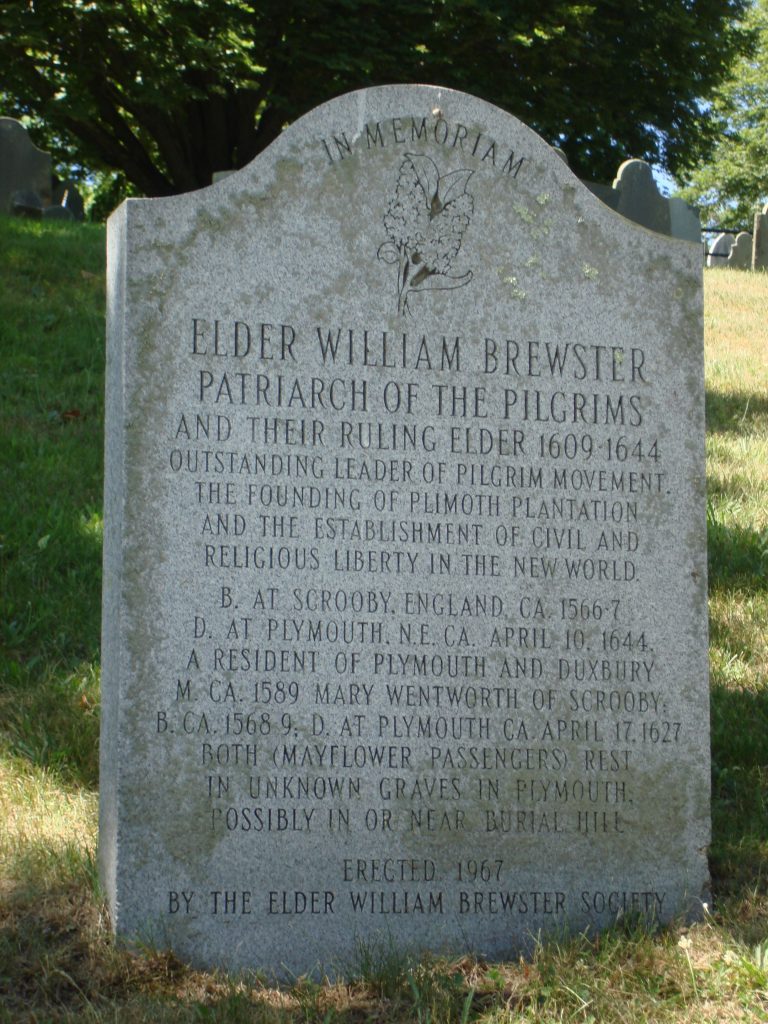
• Frazel, Midge, and Midge Frazel. “William Brewster Memorial Stone.” World History Encyclopedia, 14 Feb. 2026 (www.worldhistory.org/image/13111/william-brewster-memorial-stone)
Related
Sorry, no records were found. Please adjust your search criteria and try again.
Sorry, unable to load the Maps API.