
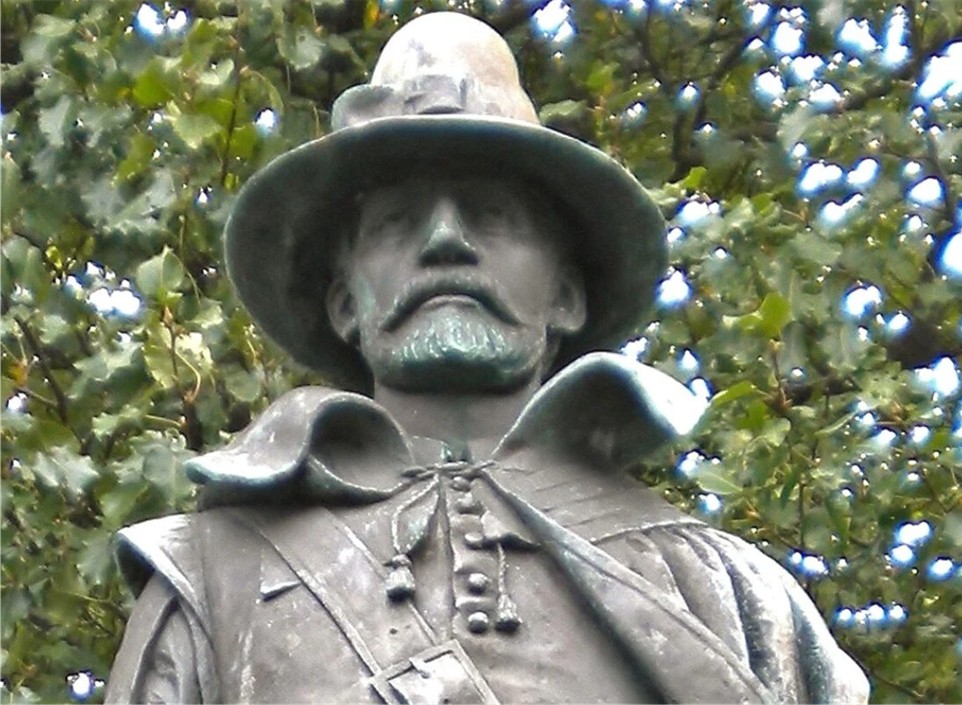
The William Bradford Statue in Plymouth, Massachusetts, stands as a tribute to one of the most important leaders of early colonial America, William Bradford. Overlooking Plymouth Harbor, the statue commemorates Bradford’s role as governor of the Plymouth Colony and his enduring influence on the development of self-governance and religious life in the New World.
Erected in the late nineteenth century, the statue reflects a period when Americans sought to honor the founders of the nation and preserve their legacy through public monuments. Sculpted by Augustus Saint-Gaudens, one of the most respected American sculptors of his time, the statue presents Bradford in a dignified and thoughtful pose. He is depicted standing, holding a Bible, symbolizing both his leadership and the religious convictions that guided the Pilgrims.
The location of the statue is significant. Positioned on Burial Hill, one of the oldest cemeteries in the United States, it overlooks the site where the Plymouth Colony was established in 1620. This setting connects the monument directly to the history it commemorates, allowing visitors to reflect on the challenges and achievements of the early settlers in the very landscape where they lived.
William Bradford was a central figure in the history of the Plymouth Colony founding. Born in England in 1590, he became part of a group of Separatists who sought to practice their faith free from interference by the Church of England. After a period in the Netherlands, Bradford and his fellow Pilgrims embarked on the voyage of the Mayflower, eventually landing in what is now Massachusetts.
Bradford served as governor of Plymouth Colony for more than thirty years, guiding the settlement through its most difficult early years. His leadership was marked by resilience, practicality, and a commitment to the community’s survival. He helped establish systems of self-government, including participation in agreements such as the Mayflower Compact, which emphasized cooperation and shared responsibility among the settlers.
In addition to his political role, Bradford is remembered for his historical writings, particularly Of Plymouth Plantation. This work provides a detailed account of the Pilgrims’ journey, their struggles, and their faith. It remains one of the most important primary sources for understanding early colonial life in America.
The statue captures these aspects of Bradford’s legacy. The Bible he holds represents the central role of faith in his life and in the founding of the colony. His upright stance conveys determination and leadership, qualities that were essential during the colony’s formative years. The simplicity of the design reflects the values often associated with the Pilgrims—modesty, discipline, and devotion.
Today, the William Bradford Statue is a prominent landmark in Plymouth and a point of interest for visitors exploring the history of early America. It forms part of a broader historical landscape that includes other monuments and sites connected to the Pilgrims. Together, these locations provide a fuller picture of the challenges faced by the settlers and the principles that shaped their community.
The statue also serves an educational purpose, encouraging reflection on the origins of American self-government and religious freedom. While interpretations of early colonial history have evolved over time, Bradford’s role as a leader and chronicler remains widely recognized.
In conclusion, the William Bradford Statue in Plymouth stands as a lasting tribute to a foundational figure in American history. Through its placement, design, and symbolism, it honors a man whose leadership helped establish one of the earliest successful English settlements in North America. It continues to invite visitors to consider the legacy of the Pilgrims and the enduring impact of their journey.
_____
Image Source/Credit:
• mark.suko@discoverybaptist.org. “A THANKFUL PILGRIM — Discovery Bible.” Discovery Bible, 27 Nov. 2019 (www.discoverybible.church/blog/2019/11/5/impact-of-our-first-thanksgiving)
Related
Sorry, no records were found. Please adjust your search criteria and try again.
Sorry, unable to load the Maps API.