Our Christian Heritage

  • Browse/Search Sites
  • Map
  • OI Tour
  • Podcast
  • OCH TV
  • VCY
  • About

Plymouth Rock

Get Directions
 
Plymouth Rock Plymouth MA closeup Photo Ted Curtin 850x850 1 768x768
Previous Next
Place Categories: Marker Museum - SecularPlace Tags: Cape Cod Mayflower New World North America Pilgrim Plymouth Colony Religious Freedom
 
  • Profile
  • Photos
  • Map
  • Reviews

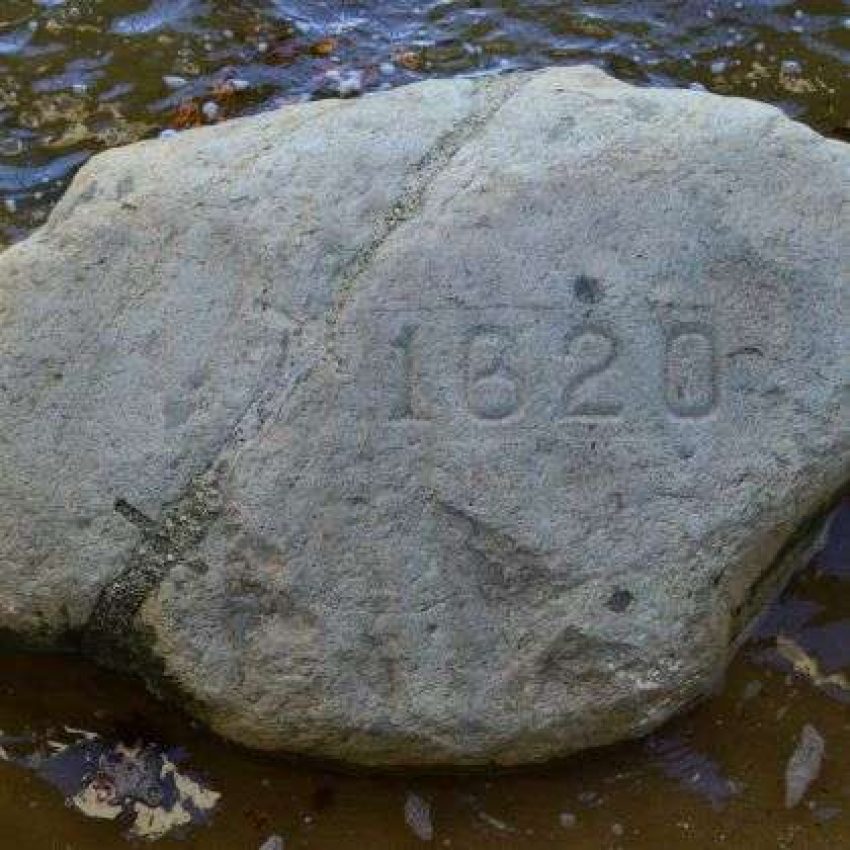
Plymouth Rock is one of the most famous historical landmarks in the United States, traditionally identified as the landing site of the Pilgrims in 1620. Located along the waterfront in Plymouth, Massachusetts, it has become a powerful symbol of the founding of one of the earliest English settlements in North America and of the broader story of American origins.

According to long-standing tradition, the Pilgrims who arrived aboard the Mayflower first stepped onto this rock when they came ashore in December 1620. These settlers, seeking religious freedom, had crossed the Atlantic from England and, after a difficult voyage, established what would become the Plymouth Colony founding. Over time, Plymouth Rock came to represent the courage, determination, and faith of these early colonists.

However, it is important to note that the historical accuracy of Plymouth Rock as the exact landing site is uncertain. There are no contemporary accounts from the Pilgrims themselves that mention the rock. The association appears to have originated more than a century later, when a local resident claimed that his ancestors had identified it as the place where the Pilgrims first came ashore. Despite this lack of direct evidence, the story gained widespread acceptance and became an enduring part of American tradition.

Throughout the eighteenth and nineteenth centuries, Plymouth Rock was treated as a significant national relic. Efforts were made to preserve and display it, though these efforts were not always successful. The rock was moved several times, and during these relocations it was broken into pieces. Portions were even taken as souvenirs, a practice that reflected the strong public interest in the site but also contributed to its physical fragmentation.

Today, Plymouth Rock rests beneath a classical granite canopy along the Plymouth waterfront. The structure, built in the early twentieth century, was designed to protect the rock while also highlighting its importance. The number “1620” is carved into its surface, marking the year traditionally associated with the Pilgrims’ arrival. Visitors can view the rock from above, reflecting on its symbolic meaning rather than its physical size, which is relatively modest.

The significance of Plymouth Rock lies less in its physical characteristics and more in what it represents. It has come to symbolize the beginning of a new chapter in American history, associated with ideals such as perseverance, faith, and the pursuit of liberty. For many, it serves as a tangible connection to the early colonial period and to the narrative of the Pilgrims’ journey.

At the same time, modern interpretations of Plymouth Rock and the events surrounding it have become more nuanced. Historians and educators often emphasize the broader context of colonization, including the experiences of Native American communities who lived in the region long before the arrival of European settlers. This perspective encourages a more comprehensive understanding of the historical moment that Plymouth Rock represents.

Despite these evolving interpretations, Plymouth Rock remains a popular destination for visitors and an enduring symbol in American culture. It is often included in educational materials, historical commemorations, and public discussions about the nation’s beginnings.

In conclusion, Plymouth Rock stands as a modest yet powerful emblem of early American history. While its exact historical role may be uncertain, its symbolic significance is undeniable. It continues to invite reflection on the challenges and aspirations of the Pilgrims and on the complex history of the nation that would emerge from their settlement.

_____
Image Source/Credit:
• “Plymouth Rock | See Plymouth.” See Plymouth, 8 Feb. 2024 (seeplymouth.com/listing/plymouth-rock)

Related
Plymouth Rock Plymouth MA closeup Photo Ted Curtin 850x850 1 768x768
Loading...
No Records Found

Sorry, no records were found. Please adjust your search criteria and try again.

Maps failed to load

Sorry, unable to load the Maps API.

Leave a Review Cancel reply

Your email address will not be published.
Select a rating

Previous
Next

Related

Find History Near Me
Loading...
No Records Found

Sorry, no records were found. Please adjust your search criteria and try again.

Maps failed to load

Sorry, unable to load the Maps API.

Address: 57 Water Street
Plymouth
Massachusetts
02360
United States

Nearby Places:

William Bradford 768x563

William Bradford Statue

287 feet
No Reviews
Favorite
The William Bradford Statue in Plymouth, Massachusetts, stands as a tribute to one of the most important leaders of early colonial America, William Bradford. Overlooking Plymouth Harbor, the statue commemorates Bradford’s role as governor of the Plymouth Colony and his enduring influence on the development of self-governance and religious life in the New World. Erected in the late nineteenth century, Read more...
683px Church of the Pilgrimage   Plymouth Massachusetts USA   August 13 2015   panoramio

Church of the Pilgrimage

0.21 miles
No Reviews
Favorite
In 1801, the Church of the Pilgrimage broke off from the First Parish Church in Plymouth in the Unitarian Controversy. The Congregationalists formed this church, which later became part of the United Church of Christ. On the front of the church is this plaque:   This tablet is inscribed in grateful memory of the Pilgrims and of their successors who Read more...
Town Square Plymouth

First Parish Church in Plymouth

0.23 miles
No Reviews
Favorite
The Pilgrims who gathered first in Scrooby, then moved to the Netherlands, then they worshipped together in the Mayflower as they sailed in 1620. Their meetinghouse was the fort (depicted at Plimoth Plantation but originally located on Burial Hill), then moved down the hill to the current location. In 1801, the Trinitarians left in the split (identifying with the theological Read more...
Bradford Grave Marker 768x1025

William Bradford Grave

0.24 miles
No Reviews
Favorite
  William Bradford stands as one of the most important figures among the Pilgrim Fathers, remembered especially for his role as a signer of the Mayflower Compact and for his long service as governor of Plymouth Colony. His life reflects both the hardships and the determination that marked the early years of English settlement in America. Born in 1590 in Read more...
Memorial for William Brewster 768x1024

William Brewster Cenotaph

0.24 miles
No Reviews
Favorite
William Brewster stands as one of the most respected and steady figures among the Pilgrim Fathers, serving as their spiritual guide and elder during one of the most challenging chapters in early American history. Though not formally ordained as a minister, Brewster fulfilled the role of pastor to the Pilgrims, providing leadership, encouragement, and biblical instruction from their days in Read more...
View all

Browse By Topic

Adoniram Judson
Archaeology
Baptist History Preservation Society
Billy Sunday
Charles Spurgeon
Creation
David Beale’s Baptist History
David Livingstone
DL Moody
English Bible
Erwin Lutzer: Swastika & Cross
Fanny Crosby
George Whitefield
Great Hymns of the Faith
John Newton
Jonathan Edwards
Martin Luther
Missions
New Testament
Old Testament
Patrick Henry
Philip Bliss
Pilgrims
Presidents
Robert Sheffey
Wesleys
William Jennings Bryan
YWAM Heroes
100 Bible Verses That Made America

Recently Viewed History

Loading...

Change Location
Find awesome listings near you!
 

Loading Comments...