
The first English-language Bible printed in America, commonly known as the Aitken Bible, stands as a remarkable achievement in the early history of the United States. Produced in 1782 by Robert Aitken in Philadelphia, this edition of the Scriptures was born out of both necessity and conviction during the years following the American Revolution.
Before independence, most English Bibles used in the American colonies were imported from Britain. However, the American Revolutionary War disrupted trade routes, making it difficult—and often impossible—to obtain copies of the Bible. This shortage created a pressing need for a domestically printed edition. Recognizing the importance of Scripture in American religious and cultural life, Robert Aitken undertook the ambitious task of printing a complete English Bible on American soil.
Aitken was already an established printer, known for publishing books, pamphlets, and even the journals of Congress. Yet printing a Bible presented unique challenges. The project required significant resources, careful typesetting, and meticulous proofreading. Despite these obstacles, Aitken persisted, driven by the belief that Americans should have ready access to the Scriptures without relying on foreign supply.
Understanding both the scale of the project and its importance, Aitken sought official support. In 1781, he petitioned the Continental Congress for approval and encouragement. Congress responded favorably, appointing chaplains to review the work for accuracy. After their examination, they commended Aitken’s efforts and recommended the Bible to the people of the United States. This endorsement marked a rare and significant moment in which the national government supported the publication of a religious text, reflecting the widespread value placed on the Bible in early American society.
The Aitken Bible, often called “The Bible of the Revolution,” was printed in a relatively small and portable format, making it accessible for personal use. It was based on the King James Version, the most widely read English translation at the time. While not a large or ornate edition, its significance lay in its origin rather than its appearance. It symbolized both independence from Britain and a commitment to preserving the moral and spiritual foundations that many Americans believed were essential to the new nation.
Despite its importance, the Aitken Bible was not a commercial success. The costs of production were high, and Aitken struggled to sell enough copies to recover his investment. Nevertheless, the historical value of the work far outweighs its financial outcome. It demonstrated that American printers were capable of producing a complete Bible and helped lay the groundwork for future publishing efforts in the young republic.
Today, the Aitken Bible is remembered as a milestone in American religious and printing history. It represents a moment when faith, necessity, and national identity converged. In providing Americans with their own printed copy of the Scriptures, Robert Aitken contributed not only to the spread of the Bible but also to the cultural independence of the United States.
♦ _____ ♦
Inscription:
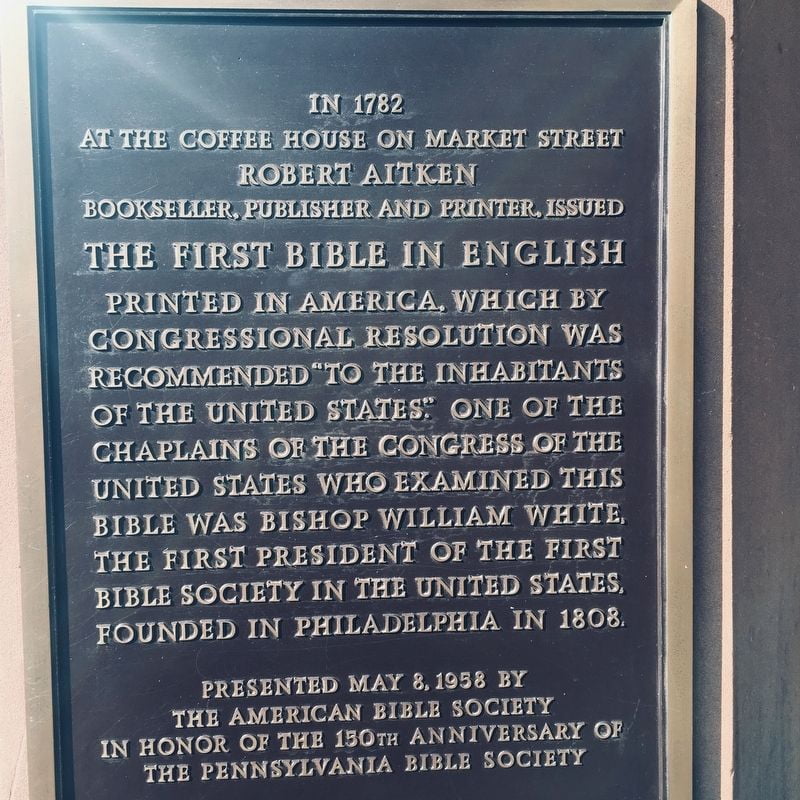
In 1782, at the coffee house on Market Street, Robert Aitken, bookseller, publisher and printer issued the FIRST BIBLE PRINTED IN ENGLISH. Printed in America, which by Congressional Resolution was recommended “To the inhabitants of the United States.” One of the Chaplains of the congress of the United States who examined this Bible was Bishop William White, the first President of the first Bible Society in the United States founded in Philadelphia in 1808.
_____
Image Source/Credit:
• Photo: THE FIRST BIBLE IN ENGLISH Marker (www.hmdb.org/PhotoFullSize.asp?PhotoID=462310)
Related
Sorry, no records were found. Please adjust your search criteria and try again.
Sorry, unable to load the Maps API.