

The Pennsylvania Bible Society stands as one of the oldest Bible societies in the United States, reflecting a long-standing commitment to the distribution of Scripture and the promotion of biblical literacy. Founded in 1808 in Philadelphia, the society emerged during a period of religious revival and growing interest in organized efforts to make the Bible widely available to all people, regardless of social or economic status.
The early nineteenth century saw a surge of voluntary religious organizations across the young republic. These groups were often driven by a shared conviction that moral and spiritual renewal depended on access to the Bible. The Pennsylvania Bible Society was established with a clear and practical mission: to ensure that every household that desired a copy of the Scriptures could obtain one. This aim reflected a deeply rooted belief in the Bible’s central role in shaping both individual character and public virtue.
From its earliest days, the society engaged in the printing, distribution, and donation of Bibles. It worked closely with churches, ministers, and community leaders to identify those in need, including the poor, immigrants, and those living in remote areas. Volunteers and agents traveled throughout Pennsylvania and beyond, delivering Bibles and encouraging their use in homes and communities. These efforts were not merely logistical; they were grounded in the conviction that Scripture should be read, understood, and lived out in daily life.
The Pennsylvania Bible Society also became part of a broader movement that included organizations like the American Bible Society. While the national society coordinated large-scale printing and international distribution, the Pennsylvania organization maintained a strong local presence. Its work complemented the larger movement by focusing on personal connections and community-based outreach, ensuring that distribution efforts were both effective and compassionate.
Throughout the nineteenth century, the society played an important role in responding to waves of immigration. As new populations arrived in Pennsylvania, many brought different languages and cultural backgrounds. The society adapted by helping to provide Scriptures in various languages, recognizing that access to the Bible should not be limited by linguistic barriers. This adaptability contributed to its continued relevance in a rapidly changing society.
In addition to distribution, the Pennsylvania Bible Society supported educational and charitable initiatives. It encouraged Bible reading in schools, supported missionary work, and partnered with other organizations to promote literacy. The underlying belief was that the availability of Scripture would contribute not only to spiritual growth but also to moral stability and social well-being.
Over time, the methods of the society evolved, but its core mission remained consistent. In the modern era, it has embraced new forms of outreach, including partnerships with urban ministries, prison programs, and digital distribution efforts. While the means have changed, the goal of making the Bible accessible to all who seek it continues to guide its work.
The impact of the Pennsylvania Bible Society is best understood not only in the number of Bibles distributed, but in the lives touched through its efforts. For more than two centuries, it has served as a steady witness to the enduring importance of Scripture in American life. Its history reflects a tradition of practical service, rooted in faith and carried forward with quiet determination.
♦ _____ ♦
Inscription
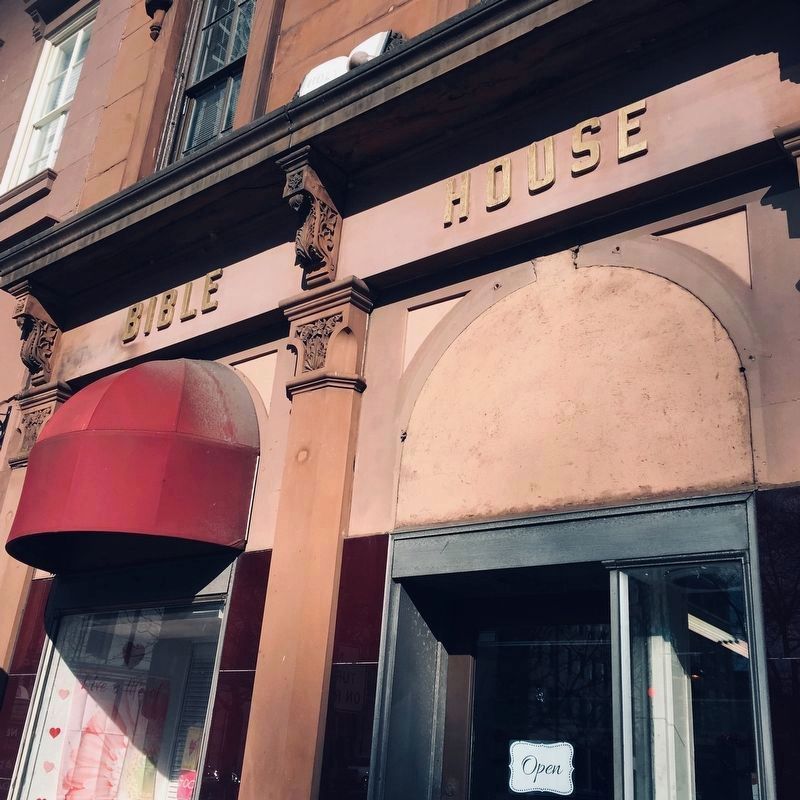
America’s first Bible society, founded in 1808 by Robt. Ralston, Bishop Wm. White, and Dr. Benj. Rush. In 1812 PBS was first in the U.S. to print Bibles using stereotyped plates which made them affordable and advanced literacy. Bible House has been its center of distribution since 1854.
_____
Image Source/Credit (in order):
• NMGiovannucci, CC BY-SA 4.0 <https://creativecommons.org/licenses/by-sa/4.0>, via Wikimedia Commons
• Pennsylvania Bible Society Historical Marker. 3 June 2024 (www.hmdb.org/m.asp?m=81979)
Related

Sorry, no records were found. Please adjust your search criteria and try again.
Sorry, unable to load the Maps API.