
Sacred to the memory of
Edmund Botsford
11-1-1745 —- 12-25-1819
BAPTIST PREACHER – AUTHOR – CHURCH PLANTER
First Pastor of the Baptist Church in this town
A pious Christian and a faithful minister
He exchanged worlds on the 25th of December 1819,
in the 75th year of his age.
England gave him birth,
Carolina a sepulchre.
In the American Church, where saving grace
First visited him, he was for 48 years,
a burning and a shining light
In talents, respectable.
In grace and virtue, eminent.
In usefulness, distinguished.
Trying were his afflictions, but his end was peace.
Hail happy saint, Thy conflicts now are o’er,
Thou hast the ocean passed and gained the heavenly shore.
Faithful to death, the Crown of Life is thine,
And clothed in robes of light with dazzling glories shine.
Now take thy golden harp, raise thy immortal voice,
Resound the Saviour’s praise and in his love rejoice.
Marker Placed by the Baptist History Preservation Society – May 11, 2004
♦ _____ ♦
Edmund Botsford was a respected Baptist preacher, educator, and missionary-minded leader whose life spanned the late eighteenth and early nineteenth centuries. Though not as widely known today as some of his contemporaries, Botsford played an important role in the development of Baptist life in the early United States, particularly in the areas of education and church organization.
Born in 1745 in England, Botsford immigrated to America during a period of significant religious growth and change. The Baptist movement, still developing in the colonies, was marked by a strong emphasis on personal conversion, believer’s baptism, and the authority of Scripture. Botsford quickly became part of this movement, embracing its principles and dedicating himself to ministry.
He eventually settled in the southern colonies, particularly in South Carolina, where he would spend much of his life. At a time when the region was still being shaped socially and religiously, Botsford’s work contributed to the establishment and strengthening of Baptist churches. His preaching was known for its clarity, seriousness, and adherence to biblical teaching, qualities that earned him respect among both colleagues and congregants.
In addition to his pastoral work, Botsford had a strong interest in education. He believed that ministers should be well prepared and that churches would benefit from leaders who were grounded in both Scripture and learning. This conviction led him to become involved in early efforts to provide theological and general education for Baptist ministers in the South. His influence helped lay the groundwork for later institutions that would serve the growing denomination.
Botsford’s commitment to education found practical expression in his teaching and mentorship. He worked with younger ministers, encouraging them in their studies and helping to prepare them for service. At a time when formal theological schools were still relatively rare, such personal instruction was essential. Through these efforts, Botsford contributed to the development of a more informed and capable ministry within the Baptist tradition.
The era in which Botsford lived was one of great upheaval, including the American Revolution. Like many ministers of his time, he was affected by the political and social changes that accompanied the struggle for independence. The Baptist commitment to religious liberty aligned closely with the broader ideals of the Revolution, and leaders like Botsford supported the principle that faith should be free from government control.
Botsford was also involved in the organizational life of the Baptist churches. He participated in associations and cooperative efforts that sought to promote unity and shared purpose among congregations. These early associations were important in providing support, encouraging doctrinal consistency, and facilitating missionary activity. Botsford’s role in these efforts demonstrated his concern not only for individual churches but for the health of the broader Baptist community.
Throughout his life, Botsford maintained a steady and disciplined approach to ministry. He was not known for dramatic or controversial actions, but rather for faithful service over many years. His influence was often quiet, working through teaching, preaching, and personal relationships rather than public acclaim. This kind of steady leadership was vital in a time when churches were being established and strengthened across a growing nation.
Edmund Botsford died in 1819, leaving behind a legacy rooted in faithfulness and service. His contributions to Baptist life, particularly in the South, helped shape the development of the denomination during its formative years. Through his emphasis on education, he encouraged a tradition of thoughtful and informed ministry that would continue to grow in the decades that followed.
Today, Botsford is remembered as a representative figure of early American Baptist leadership—a man committed to Scripture, devoted to the church, and mindful of the importance of preparing future generations. His life illustrates how lasting influence is often built not through prominence, but through consistent dedication to one’s calling.
In reflecting on his legacy, one sees the importance of foundational work. While later leaders and institutions would gain greater recognition, they often built upon the efforts of men like Edmund Botsford. His life serves as a reminder that the strength of any movement depends not only on its most visible figures, but also on those who labor faithfully behind the scenes, shaping its character and direction for years to come.
_____
Image Source/Credit:
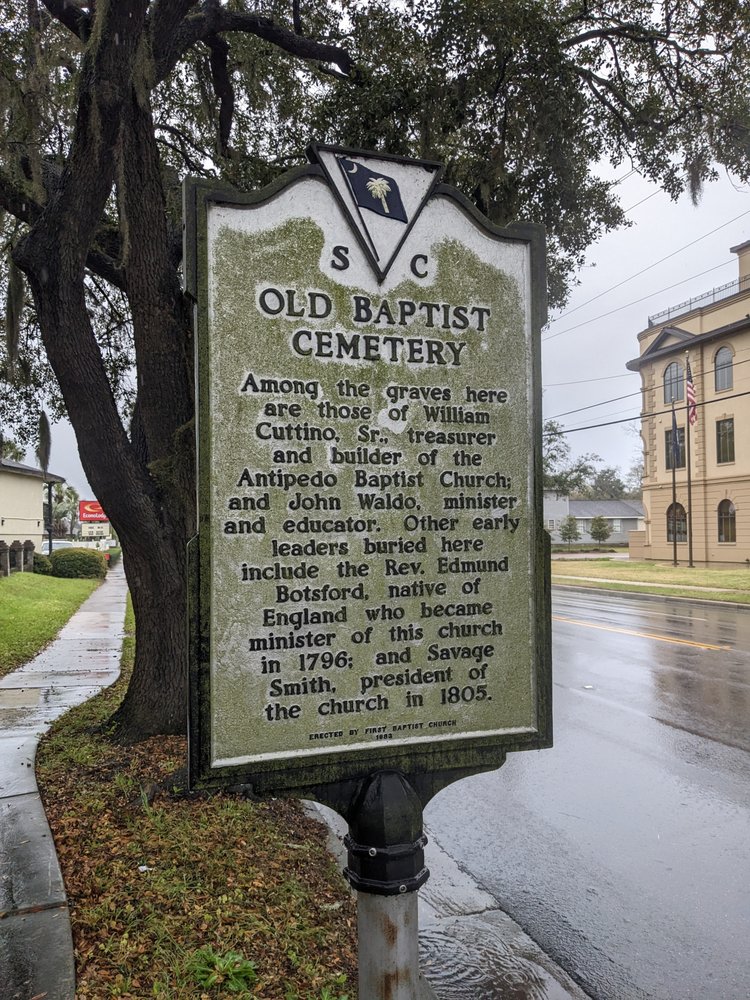
• K, Bruce. “Old Baptist Cemetery – Georgetown, SC.” Yelp, 29 Aug. 2023 (www.yelp.com/biz_photos/old-baptist-cemetery-georgetown?select=IF6AGyQnKc15onwLJjl1ww)
Related
Sorry, no records were found. Please adjust your search criteria and try again.
Sorry, unable to load the Maps API.