
The Screven Family Cemetery in Georgetown is one of the oldest and most historically significant burial grounds in the American South. Though modest in size and appearance, it preserves the memory of a family deeply connected to the early religious and civic development of the region, particularly in the rise of Baptist life in the southern colonies.
The cemetery dates back to the late seventeenth and early eighteenth centuries, a period when the Carolina colony was still in its formative years. It is most closely associated with William Screven (1624–1713), widely regarded as the first Baptist pastor in the South. Born in England, Screven immigrated to New England, where he helped establish a Baptist congregation in Kittery, Maine. Facing persecution for his nonconformist beliefs, he eventually led members of his church southward to the Carolina colony in the 1690s.
By the time Screven settled in South Carolina, Baptist influence in the region was almost nonexistent. His leadership helped establish what became the first Baptist church in the South, laying a foundation for a tradition that would later flourish across the region. The Screven Family Cemetery became the final resting place not only for William Screven himself but also for several members of his family, making it a site of considerable religious importance.
The cemetery is also closely tied to Elisha Screven, William’s son. Elisha played a central role in the development of Georgetown, one of South Carolina’s oldest towns. In the early eighteenth century, he laid out plans for the town, intentionally reserving space for multiple churches—including Anglican, Presbyterian, and Baptist congregations—as well as public institutions. Notably, the family cemetery was preserved within this plan, reflecting both its importance and the family’s standing in the community.
This detail highlights a significant aspect of early colonial life: the intertwining of family, faith, and settlement. In many early American communities, family burial grounds served not only as places of remembrance but also as symbols of permanence and continuity. The Screven Family Cemetery embodies this tradition, standing as a witness to the establishment of both religious liberty and organized community life in the region.
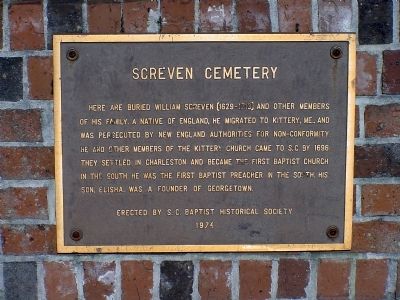
Physically, the cemetery reflects its age. Early graves were often marked with simple stones or, in some cases, left unmarked altogether. Over time, markers and memorials were added, and in the twentieth century, historical plaques were erected to commemorate the significance of the site. One such marker, placed by Baptist and local historical organizations, emphasizes William Screven’s role as a pioneering Baptist minister and acknowledges the cemetery as a place of early religious heritage.
The cemetery’s location in Georgetown also places it within a broader historical landscape. Georgetown was among the earliest planned towns in the colony, and its development reflected both economic ambitions and religious considerations. The inclusion of a family cemetery within the town’s design suggests a respect for ancestry and a recognition of the role that founding families played in shaping the community.
Today, the Screven Family Cemetery is valued not only as a burial ground but as a historical landmark. It offers insight into the struggles and convictions of early Baptists, who often faced opposition for their beliefs, as well as into the broader story of colonial settlement in South Carolina. The site serves as a quiet reminder of a time when religious conviction required courage and when communities were built with deliberate care for both spiritual and civic life.
In a broader sense, the cemetery stands as a testament to legacy. The lives represented there—particularly that of William Screven—had an influence far beyond their immediate surroundings. From this small burial ground, one can trace the beginnings of a religious movement that would grow to shape the character of the American South.
Though simple in appearance, the Screven Family Cemetery endures as a place of memory, faith, and history—linking the present with the earliest chapters of Baptist and colonial life in South Carolina.
_____
Image Source/Credit:
• Photo: Screven Cemetery Marker (www.hmdb.org/PhotoFullSize.asp?PhotoID=23094)
Related
Sorry, no records were found. Please adjust your search criteria and try again.
Sorry, unable to load the Maps API.