
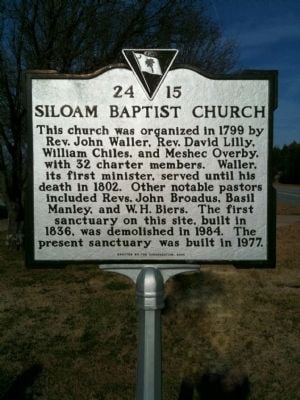
Siloam Baptist Church and John Waller are closely connected to the rise of Baptist life and the struggle for religious liberty in eighteenth-century Virginia. Their story reflects a time when Baptist preachers faced opposition from established religious authorities and yet helped lay the groundwork for the freedoms later secured in American law.
John Waller, born in 1741, was an unlikely candidate for ministry. In his early years, he was known for a wild and disorderly lifestyle, far removed from religious seriousness. However, a dramatic conversion experience transformed his life, leading him to embrace the Baptist faith. This change was so profound that he soon began preaching, becoming one of the most energetic and influential Baptist ministers in colonial Virginia.
Waller was associated with the growing number of Baptist congregations in the region, including Siloam Baptist Church, which emerged as part of the rapid expansion of Baptist influence during the latter half of the eighteenth century. These churches were often formed by ordinary people seeking a more personal and direct expression of faith, emphasizing believer’s baptism, heartfelt preaching, and the authority of Scripture.
At the time, the Church of England was the established church in Virginia, supported by law and public taxation. Baptist preachers like Waller were considered dissenters and were often viewed with suspicion or hostility. Their refusal to conform to Anglican practices, combined with their enthusiastic style of preaching, sometimes led to conflict with local authorities.
Waller himself became a central figure in this struggle. He was imprisoned multiple times for preaching without a license, most notably in 1768 in Fredericksburg. During his imprisonment, Waller and his fellow preachers continued to proclaim their message from the jail windows, drawing crowds and increasing public sympathy for their cause. These events highlighted the tension between established authority and the growing demand for religious freedom.
Siloam Baptist Church, like many early Baptist congregations, was shaped by this environment of challenge and perseverance. It served not only as a place of worship but also as a center of community and mutual support. The church’s existence testified to the determination of its members to practice their faith according to conscience, despite legal and social obstacles.
The efforts of Waller and other Baptist leaders contributed significantly to the broader movement for religious liberty in Virginia. Their experiences of persecution helped bring attention to the need for change, influencing figures such as James Madison and Thomas Jefferson. This movement ultimately led to the passage of the Virginia Statute for Religious Freedom, which established the principle that individuals should be free to worship without government interference.
Waller’s preaching style was direct, passionate, and accessible, appealing to common people across the region. He traveled widely, helping to establish new churches and strengthen existing ones. His influence extended far beyond any single congregation, contributing to the rapid growth of Baptist life in Virginia.
The legacy of Siloam Baptist Church and John Waller lies in their role in advancing both religious faith and civil liberty. The church represents the local expression of a movement that was transforming the religious landscape, while Waller embodies the courage and conviction that drove that change.
Today, their story serves as a reminder of the cost at which religious freedom was secured. Through perseverance, preaching, and steadfast commitment, John Waller and the congregations he served helped shape a principle that would become central to American identity—the right to worship freely according to conscience.
_____
Image Source/Credit:
• Photo: Siloam Baptist Church Marker (www.hmdb.org/PhotoFullSize.asp?PhotoID=95768)
Related
Sorry, no records were found. Please adjust your search criteria and try again.
Sorry, unable to load the Maps API.