
Thomas Green Ryman (1841–1904) was a Tennessee riverboat captain and businessman whose legacy extends far beyond commerce and navigation. He is best remembered as the founder of what became the Ryman Auditorium, one of the most important cultural landmarks in American music history. Originally conceived as a gospel meeting hall, the building that bears his name became a central stage for religious revivalism and, later, the birth of modern country music.
Ryman was born in South Carolina in 1841 and later moved to Tennessee, where he became involved in river transportation. During the nineteenth century, steamboats were a vital part of trade and travel along the Mississippi River and its tributaries, and Ryman established himself as a capable and respected captain. His work placed him in the midst of the commercial growth of the post-Civil War South, where river commerce played a crucial economic role.
Although successful in business, Ryman’s life took a dramatic turn in the 1880s when he attended a tent revival led by evangelist Samuel Porter Jones in Nashville. Jones was known for his fiery preaching and mass gatherings that drew large crowds seeking spiritual renewal. Ryman initially attended out of curiosity, reportedly intending to observe and critique the event rather than participate.
However, the experience profoundly affected him. According to accounts, Ryman experienced a deep personal conversion during the revival meeting and became a committed Christian. This transformation led him to support evangelical work in Nashville in a significant way. He became convinced that the city needed a permanent structure where large-scale gospel meetings could be held in a dignified and orderly setting.
This conviction led to his most lasting achievement: the construction of the Union Gospel Tabernacle, later known as the Union Gospel Tabernacle. Completed in 1892, the building was designed as a non-denominational space for revival meetings, preaching, and Christian gatherings. Ryman financed much of the project himself, demonstrating both his personal commitment and his belief in the importance of public worship spaces.
The tabernacle was notable for its size and design. It featured large seating capacity, excellent acoustics, and a simple architectural style focused on function rather than ornamentation. Its purpose was to accommodate thousands of people for religious services, reflecting the popularity of revivalism in the American South during this period.
Although Ryman intended the building primarily for religious use, its role soon expanded. The structure’s acoustics and central location made it an ideal venue for public events beyond church gatherings. After Ryman’s death in 1904, the building was renamed the Ryman Auditorium in his honor, securing his name in the history of Nashville’s cultural development.
Over time, the Ryman Auditorium became one of the most important venues in American entertainment history. It served as the home of the Grand Ole Opry for several decades, helping to launch the careers of countless country music artists. This transformation from gospel tabernacle to music hall was not something Ryman himself lived to see, but it grew naturally from the space he had created for large public gatherings.
Ryman’s legacy is therefore twofold. On one hand, he is remembered as a successful steamboat captain and businessman who contributed to the economic life of the South. On the other, and more significantly, he is recognized as a man whose personal religious experience led him to create a lasting institution that shaped both spiritual and cultural life in the United States.
His impact is especially evident in Nashville, a city now known worldwide as a center of music and performance. The Ryman Auditorium remains a historic landmark, celebrated for its architecture, acoustics, and cultural significance. It continues to host concerts and events, preserving the spirit of public gathering that Ryman originally envisioned.
In conclusion, Thomas G. Ryman’s life demonstrates how personal transformation can lead to enduring public legacy. From riverboat captain to benefactor of one of America’s most iconic venues, his story reflects themes of faith, generosity, and cultural influence. The building that bears his name stands as a lasting tribute to his vision and continues to shape American music and public life more than a century after its creation.
♦ _____ ♦
In 1885, a heckler came to Sam Jones‘ meetings. Thomas Ryman (1843-1904) was 42, a Nashville steamboat line owner. He had just moved into a new house, and thought little of this Christian evangelist. But the preaching turned his life around, and he talked to Jones about building a tabernacle for the revival. Seven years and $100,000 later (almost $3,000,000 today), the Union Gospel Tabernacle opened in Nashville on May 25, 1890. After Ryman’s death in 1904, and his funeral in the Tabernacle, the building was renamed the Ryman Auditorium. Featuring Presidents Roosevelt and Taft, and entertainers Will Rogers and John Philip Sousa, it became a cultural center. In 1943, the Grand Ole Opry moved to the Ryman Auditorium.
_____
Image Source/Credit:
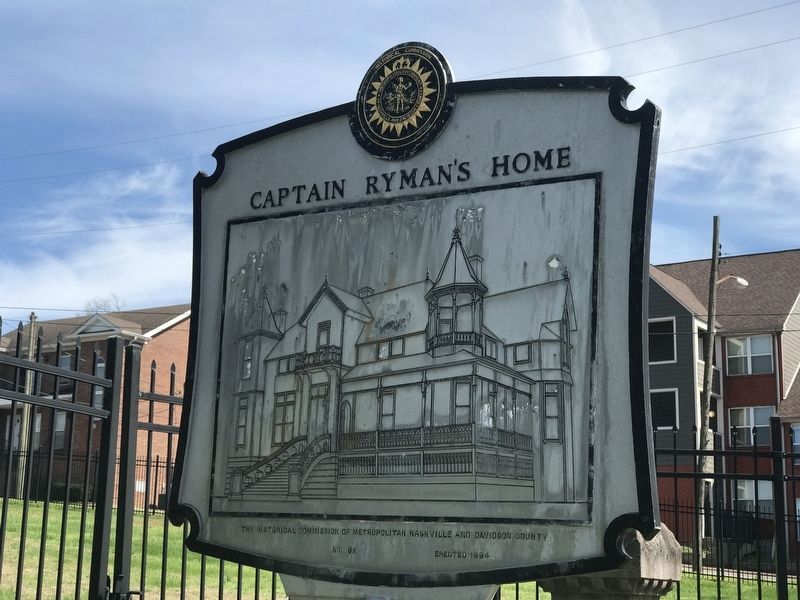
• Photo: Captain Ryman’s Home Marker (www.hmdb.org/PhotoFullSize.asp?PhotoID=515437)
Related
Sorry, no records were found. Please adjust your search criteria and try again.
Sorry, unable to load the Maps API.