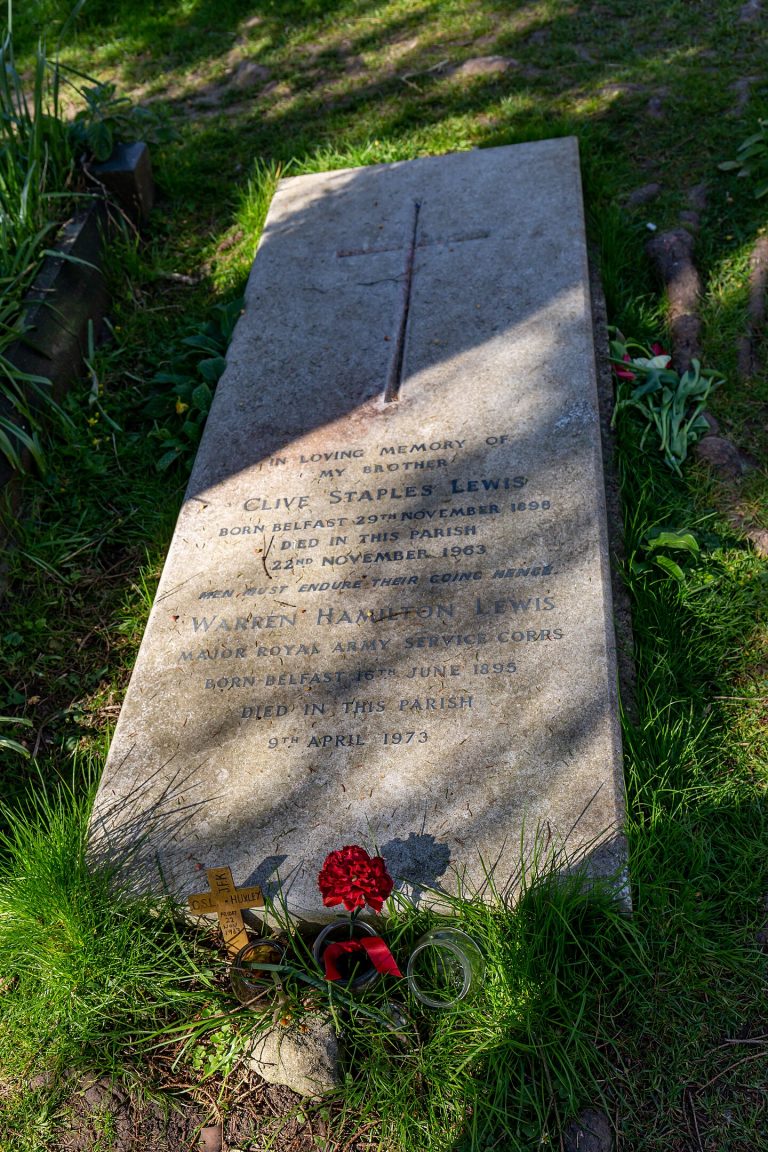
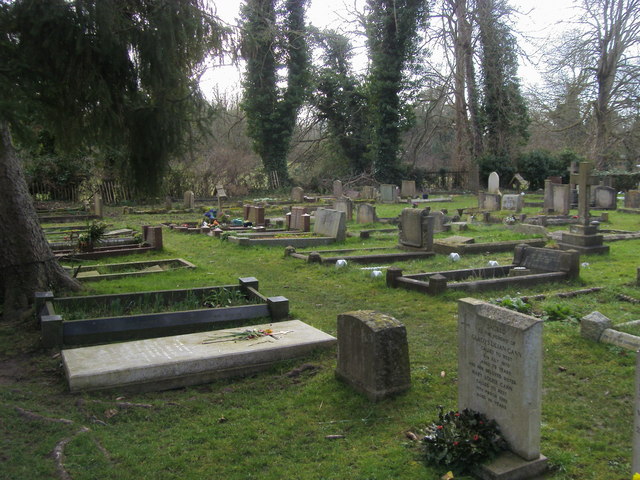
The grave of C.S. Lewis is a place of quiet reflection and lasting significance, located in the churchyard of Holy Trinity Church Headington Quarry in Oxford. Though simple in appearance, the site draws visitors from around the world who come to honor the life and legacy of one of the twentieth century’s most influential Christian thinkers and writers.
Clive Staples Lewis died on November 22, 1963, at his home, The Kilns, after a period of declining health. His passing, occurring on the same day as the assassination of President John F. Kennedy, went largely unnoticed at the time by the wider public. Yet in the years that followed, his reputation grew steadily, and his writings reached an ever-expanding audience. He was buried a few days later in the churchyard of Holy Trinity, the parish church he had faithfully attended for many years.
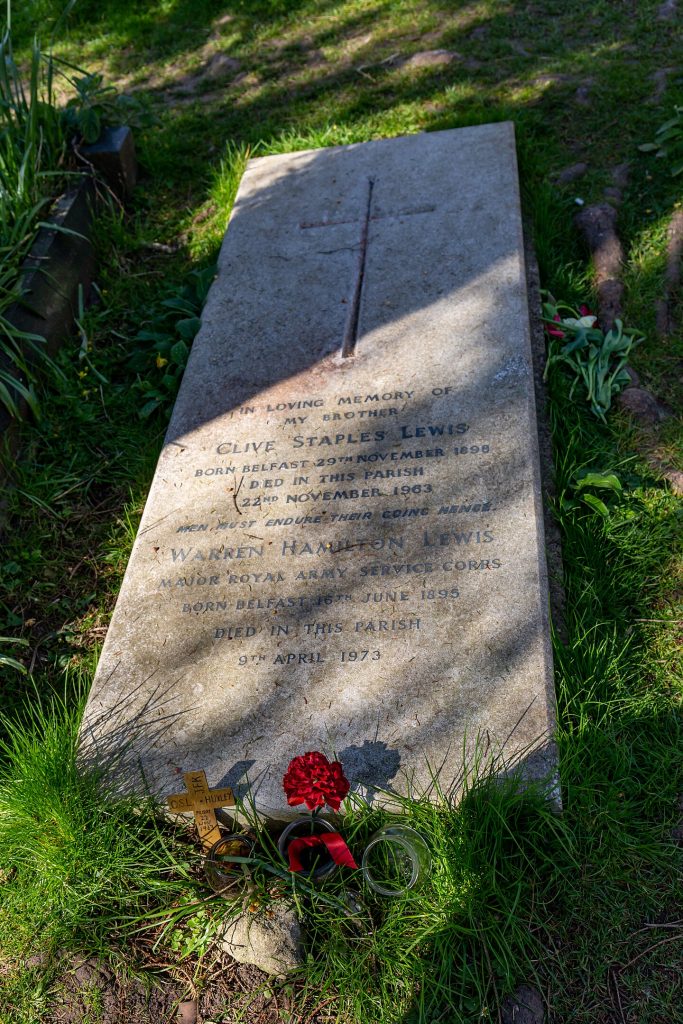
The grave itself reflects the character of the man it commemorates. Marked by a modest headstone, it bears Lewis’s name, his dates of birth and death, and a brief inscription. The simplicity of the site is fitting for someone who, despite his literary fame, lived a relatively quiet and disciplined life centered on study, teaching, and Christian faith. There is no grand monument or elaborate decoration—only a straightforward marker set among the grass and trees of an English parish churchyard.
Over time, the grave has become a place of pilgrimage for admirers of Lewis’s work. Readers who have been shaped by books such as Mere Christianity, The Screwtape Letters, and The Chronicles of Narnia often feel a personal connection to the author and seek out the place where he was laid to rest. Many visitors leave small tokens, notes, or flowers, expressing gratitude for the influence his writings have had on their lives.
In 2013, on the fiftieth anniversary of Lewis’s death, a memorial stone was dedicated in Westminster Abbey’s Poets’ Corner, further cementing his place among the great literary figures of Britain. Nevertheless, it is the humble grave at Holy Trinity that remains the most direct and personal point of connection to his life.
The setting of the grave is itself significant. Holy Trinity Church, with its simple architecture and longstanding parish life, reflects the ordinary yet meaningful context in which Lewis practiced his faith. He was not only a writer but also a regular worshiper, participating in the life of his local church. This connection underscores the practical and lived nature of his Christianity, which emphasized not only belief but also daily devotion.
The legacy of C. S. Lewis’s grave lies not in its physical form but in what it represents. It marks the resting place of a man whose words have guided countless readers in matters of faith, imagination, and moral reflection. His ability to explain complex theological ideas in clear and engaging language, combined with his gift for storytelling, has ensured that his influence endures long after his death.
Today, the grave stands as a quiet reminder of a life well lived. It invites visitors to pause, reflect, and perhaps revisit the writings that have meant so much to so many. In its simplicity, it mirrors the enduring truth that lasting impact is not measured by outward display, but by the depth and reach of one’s influence.
♦ _____ ♦
Wikipedia:
Attached to the church is a small graveyard, particularly noted for including the grave of C. S. Lewis,[5] who died on 22 November 1963. The epitaph on his tombstone, chosen by his brother Warren Hamilton Lewis (buried in the same grave after his own death on 9 April 1973) and taken from Shakespeare‘s King Lear, reads “Men must endure their going hence.” This quotation was the quotation on the family calendar the day the mother of Warren and Clive Lewis died, 23 August 1908.
“You never know how much you really believe anything until its truth or falsehood becomes a matter of life and death to you.” -C.S. Lewis
_____
Image Source/Credit (in order):
• Wide Photo By Shaun Ferguson, CC BY-SA 2.0
• Grave Photo by Balon Greyjoy
Related
Sorry, no records were found. Please adjust your search criteria and try again.
Sorry, unable to load the Maps API.