

Erwin Lutzer at St. Mary’s Church:
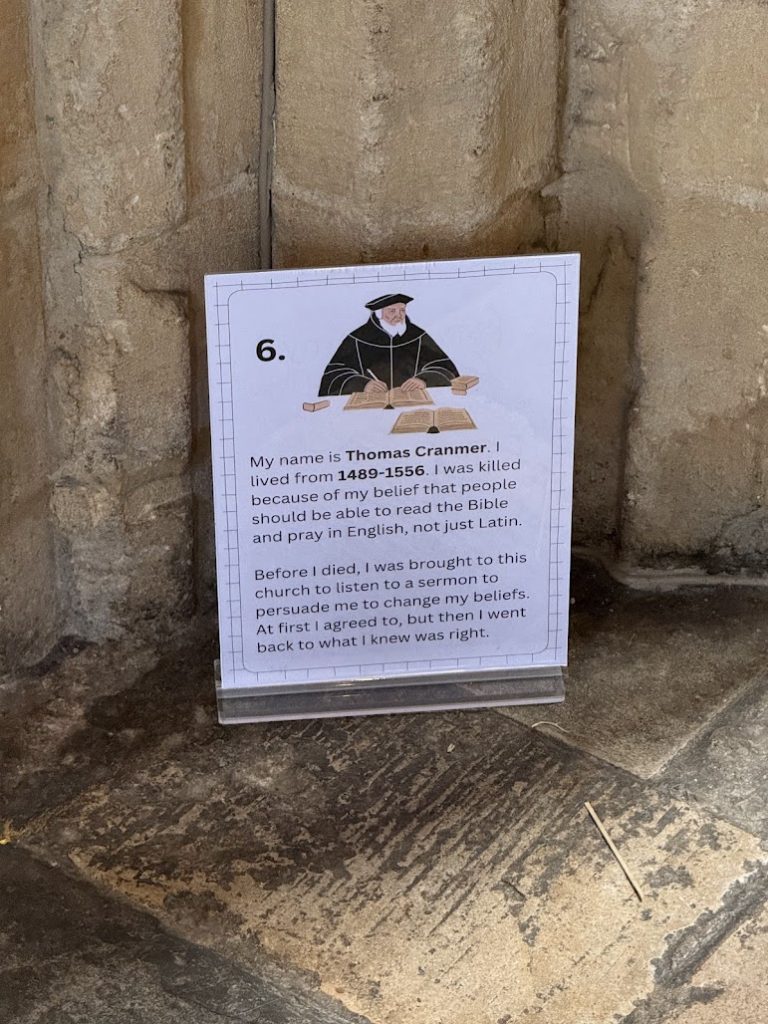
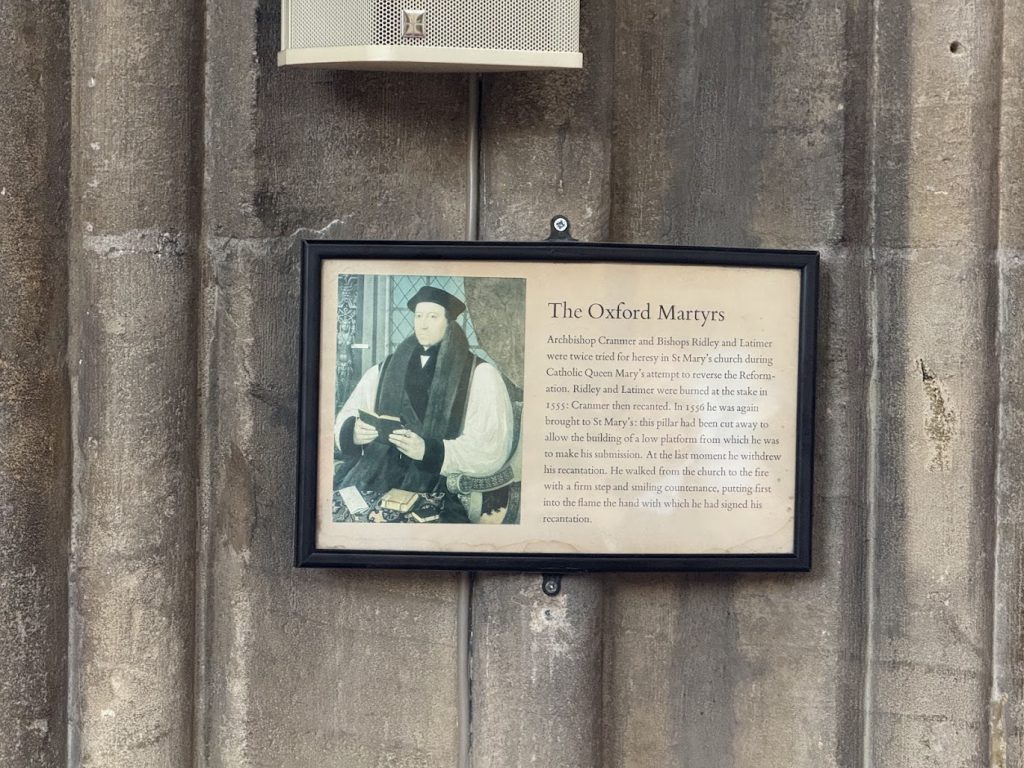
Some of us have just had the opportunity of visiting St. Mary’s Church here in Oxford, England, and we recounted the story of Bishop Cranmer, who was a Protestant and advanced the Protestant faith, eventually converted to Catholicism out of fear. He knew that Queen Mary wanted to kill him. And then here in this church, he changed his mind. A special platform was put up, and everyone was expecting him to affirm his Catholicism, but he changed. And he said that what he had previously affirmed, his recantation, He was recanting his recantation and was dying with his faith in Jesus Christ, renouncing Catholicism. And then he was taken to the stake and burned where Ridley and Latimer had previously been burned five months before.
But what are the lessons that we learn? What lessons did Cranmer leave behind? Lesson number one is very clear that oftentimes Christians are flawed. And when you read the Bible, you discover whether it’s Abraham who lied, whether or not it’s David who committed murder and adultery. Oftentimes in the history of the church and in our own lives, there is light, but there is also some shadows. And we see that in Cranmer.
Another lesson that I think is very important is that death, the prospect of death, clarifies our values. When we know we’re going to die, suddenly a lot of things that we think are very important are no longer important. I have a friend who has cancer and he said, cancer clarifies. It takes away all the trivial things and you begin to concentrate on eternity.
And then I think that there’s another powerful lesson Cranmer has to teach us. And that is simply this, people will always remember how you end. They may not remember how you began, but they will remember how you ended. And despite Cranmer’s failure, we remember him as a great martyr for the cause of Jesus Christ because he ended well. The Bible says in the book of Proverbs, a good man falls seven times, but gets up again. And Cranmer illustrates that. The bottom line is this, that the only thing that really matters is what matters forever.
The trial of Hugh Latimer, Nicholas Ridley, and Thomas Cranmer stands as one of the most solemn and consequential episodes of the English Reformation. Taking place during the reign of Mary I of England, the proceedings reflected the deep religious divisions that marked mid-sixteenth-century England and the determined effort to restore Roman Catholic authority after years of Protestant reform.
Following the death of King Edward VI in 1553, Mary I ascended the throne and sought to reverse the Protestant changes that had taken root under her father, Henry VIII, and her half-brother. A devout Catholic, she reestablished papal authority and moved to suppress those who had promoted or embraced Protestant teaching. Among the most prominent of these were Latimer, Ridley, and Cranmer, all of whom had played key roles in advancing reform within the Church of England.
Hugh Latimer, a powerful preacher known for his plain speech and moral earnestness, had served as Bishop of Worcester. Nicholas Ridley, Bishop of London, was a respected theologian and administrator. Thomas Cranmer, as Archbishop of Canterbury, had been the principal architect of the English Reformation, responsible for shaping its doctrine and liturgy, including the Book of Common Prayer. Their influence made them natural targets for the Marian government.
The three men were arrested and brought to Oxford, where they were imprisoned and later put on trial for heresy. The charges centered on their rejection of key Catholic doctrines, particularly the teaching of transubstantiation in the Eucharist. The trials, held in 1554 and 1555, were conducted under ecclesiastical authority but with the full support of the crown. Each man was given the opportunity to recant his views and return to the Catholic faith, but Latimer and Ridley remained steadfast in their convictions.
Latimer and Ridley were condemned and executed on October 16, 1555, in Oxford. They were burned at the stake outside Balliol College, an event that left a lasting impression on those who witnessed it. Latimer’s reported words to Ridley—encouraging him to be of good courage and to trust that their deaths would kindle a light in England—have echoed through history as a testament to their resolve.
Thomas Cranmer’s case followed a more complicated path. Initially, he signed several recantations under pressure, appearing to submit to Catholic teaching. However, at his final appearance in 1556, he dramatically withdrew his recantations, reaffirming his Protestant beliefs. He declared that the hand which had signed the recantations would be the first to burn. Cranmer was then executed by fire on March 21, 1556, meeting his death with a mixture of repentance and renewed conviction.
The legacy of the trial of Latimer, Ridley, and Cranmer is profound. Their deaths became emblematic of the cost of religious conviction and were later recorded in works such as John Foxe’s Book of Martyrs, which helped shape Protestant identity in England for generations. They came to be regarded as martyrs who stood for the authority of Scripture and the principles of the Reformation.
In the end, their trial reveals the intensity of the religious struggles of the sixteenth century. It serves as a reminder of a time when matters of faith were inseparable from matters of state and when deeply held beliefs could lead to suffering and death. Their witness continues to be remembered as a powerful example of conscience and courage in the face of persecution.
♦ _____ ♦
Wikipedia:
St Mary’s was the site of the 1555 trial of the Oxford Martyrs, when the bishops Latimer and Ridley and Archbishop Cranmer were tried for heresy. The martyrs were imprisoned at the former Bocardo Prison near St Michael at the Northgate in Cornmarket Street and subsequently burnt at the stake just outside the city walls to the north. A cross set into the road marks that location on what is now Broad Street; the nearby Martyrs’ Memorial, at the south end of St Giles’ Street, commemorates the events.
A section cut out of “Cranmer’s Pillar” remains from the morning of Cranmer’s death on 21 March 1556 when he was brought to the church for a sermon from Henry Cole, Provost of Eton College, who on Mary I‘s instructions, spelt out the reasons why he must die. Cranmer stood on a stage, the corner of which was supported by a small shelf cut from the pillar opposite the pulpit; withdrawing his recantations of his Reformed beliefs, he swore that when he was burnt, the hand which had signed them would be the first to burn.[3]
_____
Image Source/Credit (in order):
• Photos by the author
Related

Sorry, no records were found. Please adjust your search criteria and try again.
Sorry, unable to load the Maps API.