
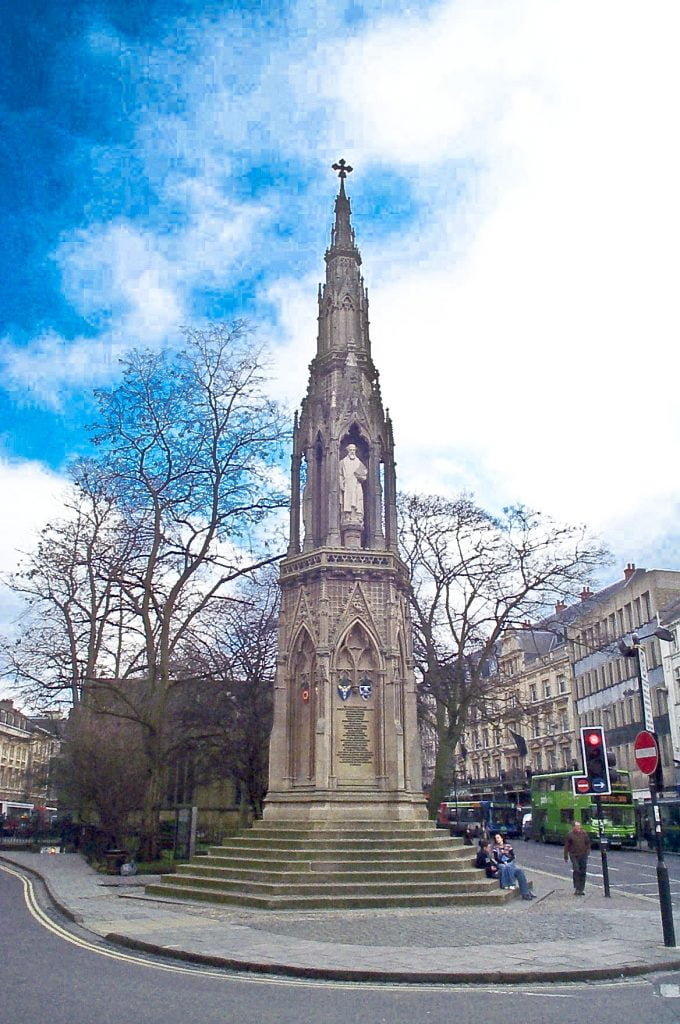
The Martyrs’ Memorial in Oxford is one of the most prominent Victorian monuments in England, commemorating three key figures of the English Reformation: Hugh Latimer, Nicholas Ridley, and Thomas Cranmer. The memorial stands as a striking reminder of the religious upheavals of the sixteenth century and the profound costs associated with doctrinal change in England.
The monument was completed in 1843 during the height of the Gothic Revival, a period when architects and patrons sought to revive medieval styles and commemorate England’s religious and national history. Designed by Sir George Gilbert Scott, one of the leading architects of the era, the memorial reflects a deliberate attempt to evoke the architectural language of the Middle Ages. Its intricate stonework, pinnacles, and statues make it one of Oxford’s most recognizable landmarks.
The purpose of the memorial is to honor the three Protestant leaders who were executed during the reign of Queen Mary I in the mid-sixteenth century. Their deaths became symbolic of the struggle between Catholic and Protestant forces during the English Reformation. Latimer and Ridley were burned at the stake in 1555, while Cranmer, the former Archbishop of Canterbury and principal author of the Book of Common Prayer, was executed in 1556.
According to historical accounts, Latimer famously encouraged Ridley during their execution with the words, “Be of good comfort, Master Ridley, and play the man; we shall this day light such a candle, by God’s grace, in England, as I trust shall never be put out.” This phrase became emblematic of their martyrdom and is inscribed in spirit upon the memory of the event.
The Martyrs’ Memorial was commissioned by members of the Anglican establishment and reflects nineteenth-century Protestant identity. It was intended not only as a tribute to the individuals but also as a statement of religious continuity, linking the Church of England to the Reformation heritage. At the time of its construction, England was experiencing renewed interest in its ecclesiastical history, particularly in Oxford, where theological debate between High Church and Evangelical traditions was active.
The monument itself is highly decorative. At its base are statues of Latimer, Ridley, and Cranmer, each depicted in clerical dress. Above them rises a tall stone canopy adorned with carvings and inscriptions. The design emphasizes both solemnity and grandeur, reinforcing the significance of the figures it commemorates. Its location at the intersection of St Giles’ and Magdalen Street ensures that it remains a prominent feature of Oxford’s urban landscape.
Over time, the memorial has become more than a religious monument; it is also a historical landmark that attracts visitors from around the world. It serves as a point of reflection on the complex history of religious change in England, including the tensions between tradition and reform, authority and conscience.
The impact of the Martyrs’ Memorial lies in its ability to embody a pivotal moment in English history. It commemorates individuals who suffered for their convictions while also reflecting the evolving identity of the Church of England. As a piece of Victorian architecture, it also represents the nineteenth-century fascination with medieval heritage and national religious memory.
Today, the Martyrs’ Memorial continues to stand as a powerful reminder of sacrifice and conviction. It links the past to the present, encouraging reflection on the cost of religious change and the enduring significance of faith and conscience in English history.
♦ _____ ♦
See the Martyrs Memorial, a stone monument, near Balliol College, at the intersection of St. Giles, Magdalen, and Beaumont Streets. The Memorial commemorates Oxford’s Reformer-martyrs, Thomas Cranmer, Nicholas Ridley, and Hugh Latimer. The earliest Baptists were products of the Reformation.
Copyrighted and used by permission from David Beale, Baptist History in England and America: Personalities, Positions, and Practices
To the Glory of God
And in Grateful Commemoration
of His Servants
Thomas Cranmer
Nicholas Ridley
Hugh Latimer
Prelates of the Church
of England
Who Near This Spot
Yielded Their Bodies
To Be Burned
Bearing Witness to the Sacred Truths
Which They Had
Affirmed and Maintained
Against the Errors
of the Church of Rome
And Rejoicing That
To Them It Was Given
Not Only to Believe in Christ
But Also to Suffer for His Sake
this Monument was Erected
by Public Subscription
in the Year of our Lord God
M.DCCCXLI
_____
Image Source/Credit:
• File:Martyrs Memorial Oxford 20050317.jpg – Wikimedia Commons. Copyright © 2005 Kaihsu Tai
Related
Sorry, no records were found. Please adjust your search criteria and try again.
Sorry, unable to load the Maps API.