Erwin Lutzer at the Martyr’s Cross:
Mary Tudor believes it’s God’s will that she turn England back to Catholicism. And she thought that if she killed a number of martyrs, if she killed a number of people, a number of Protestants, surely the country would turn back. Well, she killed nearly 300, but there are three that are famous, and they were burned here.
First of all, you have Ridley, who was the Bishop of London. As a matter of fact, when Mary was crowned, he actually visited her, and they had a pleasant conversation. So he may not have known what awaited him. And then there was Latimer, who preached to Henry and to others in the court. One day, somebody said, Latimer, you are preaching to the king. Watch what you say, because we know that Henry beheaded people rather quickly. And he said, but I’m standing before the King of Kings. And so Latimer, Hugh Latimer and Ridley, they were imprisoned. And then, of course, they were brought out and gather here to be burned.
Ridley said, so long as there is breath in my body, I will never deny my Lord Jesus Christ and his known truth. God’s will will be done in me. Ridley held up his hand and said, Ridley also said, and this is very theological, I take it to be sent of God, therefore I will receive it.” He’s talking about the gunpowder that is going to be tied around his neck as an act of mercy so that when the fire came to the gunpowder, they of course would die instantly. He said, I take it as an act of God. I will therefore receive it as being from God.
And earlier that morning, Ridley had said to Latimer, you know, we’re going to have a very difficult breakfast, but our supper tonight is going to be with Christ and it’s going to be very pleasant. Now, they were brought here to the stake to be burned.
And there’s a very famous line, because Latimer burned quickly, And Ridley did not. But as they were coming here to the fire, Latimer said to Ridley, be of good cheer, Ridley, and play the man, for we shall this day, by God’s grace, light up such a candle in England as I trust will never be put out. Well, as the fire was burning, Latimer burned quite quickly, but not Ridley. Ridley kept saying, bring on the fire, bring on the fire. Because of the pain, of course, it was coming up his legs, but it wasn’t consuming him.
But nevertheless, as he was dying, he said, Lord, have mercy on me. And as martyrs have always said, the words of Stephen, into thy hands, I commit my spirit. Now, I wanna leave you with three quick lessons, and then I’m gonna tell you about Cranmer.
First of all, we need a theology of suffering as evangelicals because suffering has been a part of the history of the church. Secondly, we have to fear God more than we even fear the flames. Shadrach, Meshach, and Abednego did that in the Old Testament. And then God never shows us all the good that we do. Imagine this. They never dreamed that 500 years later, there would be people from around the world coming here and being encouraged by their suffering and their braveness.
So as believers, we know this, that the process of death may be a very rough road, but thank God it has a very safe landing. So that night, they of course had a pleasant supper, so to speak, in heaven. Now, I’m going to tell you about Cranmer. Cranmer Five months later, comes here as well. Now we haven’t been in St. Mary’s Church yet, but we will be.
It is there where he gathered and the Catholics were gathered together and also some Protestants because he had denied the faith. Now, remember, he was able to see his friends burn, and Mary wanted him to see his friends burn. And even though he had denied the faith and signed many documents saying that he was leaving Protestantism and the Pope was correct, he said that, and then he gets to St. Mary’s Church where we are going to be, and he shocks everyone. Mary’s Church, was filled with Catholics grieving Protestants, and he was there to affirm once again that he was dying as a Catholic. Now, even though he made those denials, Mary wanted him dead anyway because he had negotiated the divorce of his mother from King Henry, and he of course was a noted Protestant as we’ve already learned. All right, so they gather in St. Mary’s Church, Cranmer, confesses that he has a huge sin that he has to ask God to forgive him for.
And he prays, thou didst not give thy son, O heavenly Father, unto death for small sins only, but for the greatest sins of the world, so that the sinner may return to thee with his whole heart as I do presently. And then the congregation is shocked. inasmuch as I have come to the end of my life on which hangs all of my past and all my life to come, either to live with my master Christ and forever enjoy, or else to be in pain forever with the wicked in hell. And since I presently see before my eyes either heaven to receive me or else hell to swallow me up, I shall therefore declare to you my truth, faith, and how I believe without hiding anything, for now is no time to conceal whatever I have said or written in time past.
And now I come to the great thing that troubles my conscience more than anything, more than I have done in my whole life. And now these things, his recantation to Catholicism, saying that Protestantism was wrong. These things were written with my hand and contrary to the truth that I believed in my heart, written for fear of death and to save my life. That includes all such bills and papers I have written or signed with my hand. in which I have written many untrue things. And inasmuch as my hand has offended and written contrary to my heart, my hand shall be the first to be punished, for when I come to the fire, it shall be the first to be burned. As for the Pope, I refuse him as Christ’s enemy and antichrist with all of his false doctrine.”
Well, that shocked the congregation. The Catholics were angry, the Protestants were very joyful, but he’s dragged here and then he’s taken to the fire. And he puts his hand, it says, that when the fire flamed up around him, this true man of God, who had for a moment weakened, but then gloriously returned to the truth, did what he foretold he would do. He stretched out his right arm and held the hand in the flames. And he kept saying, this unworthy hand, this unworthy hand. And he kept his hand in the fire until it was like a cinder. This unworthy hand, he kept saying. Lord Jesus, receive my spirit. And so he died. Very quick lessons. Number one, we are all flawed. We can’t judge him. We wouldn’t have done any better, I’m sure, if we were under that kind of persecution. We all have light and we all have darkness. And God is actually in a position where he can only use flawed people because that’s the only people that he has available.
Secondly, death clarifies your values. You know, when you’re about to die, Samuel Johnson said, nothing focuses the mind like the knowledge that one is to be hung in a fortnight. You know, you begin to think, what’s eternity all about? I have a friend who has cancer. He says, cancer clarifies my values. Now what’s really important is important.
It doesn’t matter who wins the Super Bowl or whether or not the Cubs win. Third, people don’t remember how you began, but they’ll always remember how you ended. And we remember Cranmer today how he ended, he ended faithfully. The Bible says in the book of Proverbs, the righteous fall seven times and rise again. Finally, ladies and gentlemen, only what matters forever really matters.
The Martyrs’ Memorial—often referred to as the “Martyrs’ Cross”—is one of the most meaningful historical markers associated with the English Reformation. Located in Oxford, it commemorates the place where three prominent Protestant leaders—Hugh Latimer, Nicholas Ridley, and Thomas Cranmer—were executed during the reign of Queen Mary I in the mid-sixteenth century.
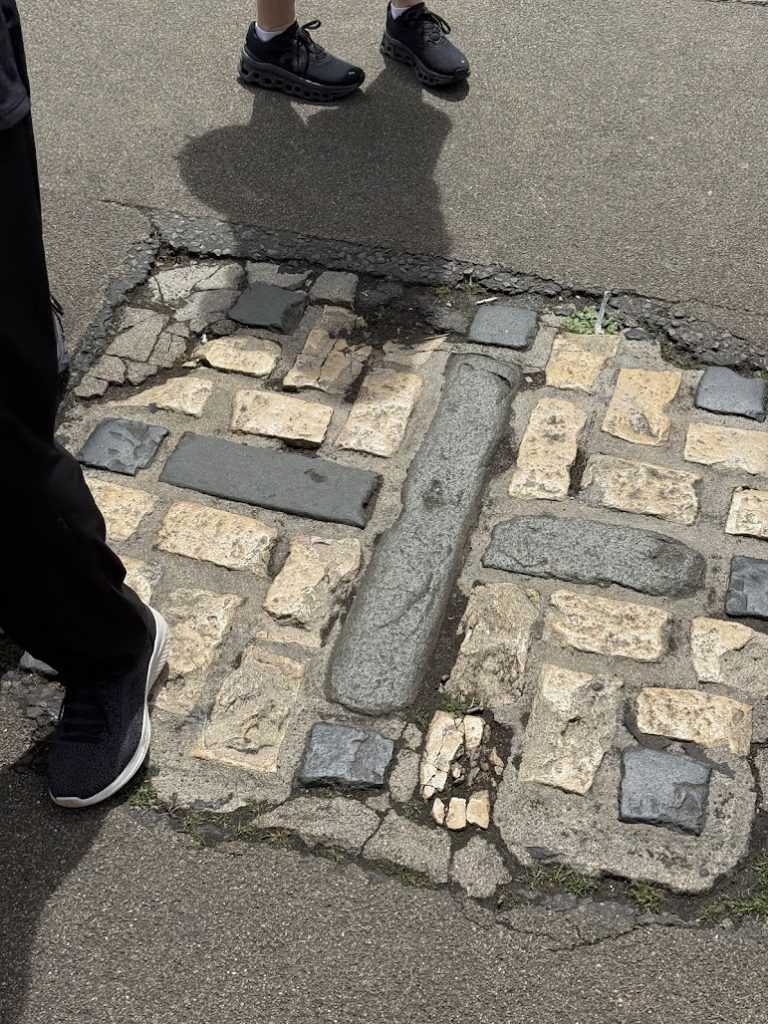
The “Martyrs’ Cross” itself is not a large standing monument but rather a simple cross set into the pavement at the intersection of Broad Street and St. Giles’ in Oxford. It marks the approximate location where Latimer and Ridley were burned at the stake in 1555, followed by Cranmer in 1556. This understated marker contrasts with the nearby Victorian-era Martyrs’ Memorial, a more elaborate stone structure erected in the nineteenth century to honor the same figures.
The historical background of the Martyrs’ Cross lies in the turbulent years of religious conflict following the English Reformation. Under Mary I of England, efforts were made to restore Roman Catholicism in England and to reverse the reforms introduced under her predecessors. Those who had played leading roles in promoting Protestant doctrine were targeted for trial and punishment. Latimer, Ridley, and Cranmer, having been central figures in shaping the Reformed Church of England, were among the most prominent victims of this policy.
The executions carried out at this site were intended to serve as a warning to others. Burning at the stake was a public and severe form of punishment for heresy, meant to demonstrate the consequences of rejecting established doctrine. Yet, rather than silencing dissent, these events had the opposite effect. The courage and composure shown by the martyrs, particularly the famous words attributed to Latimer as the fire was lit, left a deep impression on witnesses and later generations.
Over time, the site of their execution became a place of remembrance. The Martyrs’ Cross, though simple, serves as a powerful symbol of the sacrifices made during this period of religious upheaval. Its placement in a busy street ensures that the memory of these events remains woven into the daily life of the city, rather than confined to a distant or secluded location.
The legacy of the Martyrs’ Cross is closely tied to the broader story of religious freedom and conscience. The deaths of Latimer, Ridley, and Cranmer were later recorded in works such as John Foxe’s Book of Martyrs, which helped to shape Protestant identity in England. Their willingness to stand by their convictions, even in the face of death, has been remembered as an example of steadfast faith and moral courage.
Today, visitors to Oxford often pause at the Martyrs’ Cross to reflect on the events it commemorates. While it lacks the grandeur of larger monuments, its simplicity gives it a particular weight and dignity. It invites quiet contemplation rather than spectacle, encouraging those who pass by to consider the cost of the freedoms they now enjoy.
In its modest form, the Martyrs’ Cross continues to bear witness to a defining chapter in English history. It stands as a reminder that deeply held beliefs have often come at a great price and that the legacy of those who endured such trials continues to shape the present.
♦ _____ ♦
“Be of good cheer, Master Ridley, and play the man, for we shall this day light such a candle in England as I trust by God’s grace shall never be put out!”

Martyrdom of Bishop Ridley and Latimer
The three were tried at University Church of St Mary the Virgin, the official church of the University of Oxford on the High Street, Oxford. The men were imprisoned at the former Bocardo Prison near the extant St Michael at the North Gate church (at the north gate of the city walls) in Cornmarket Street. The door of their cell is on display in the tower of the church.[1]
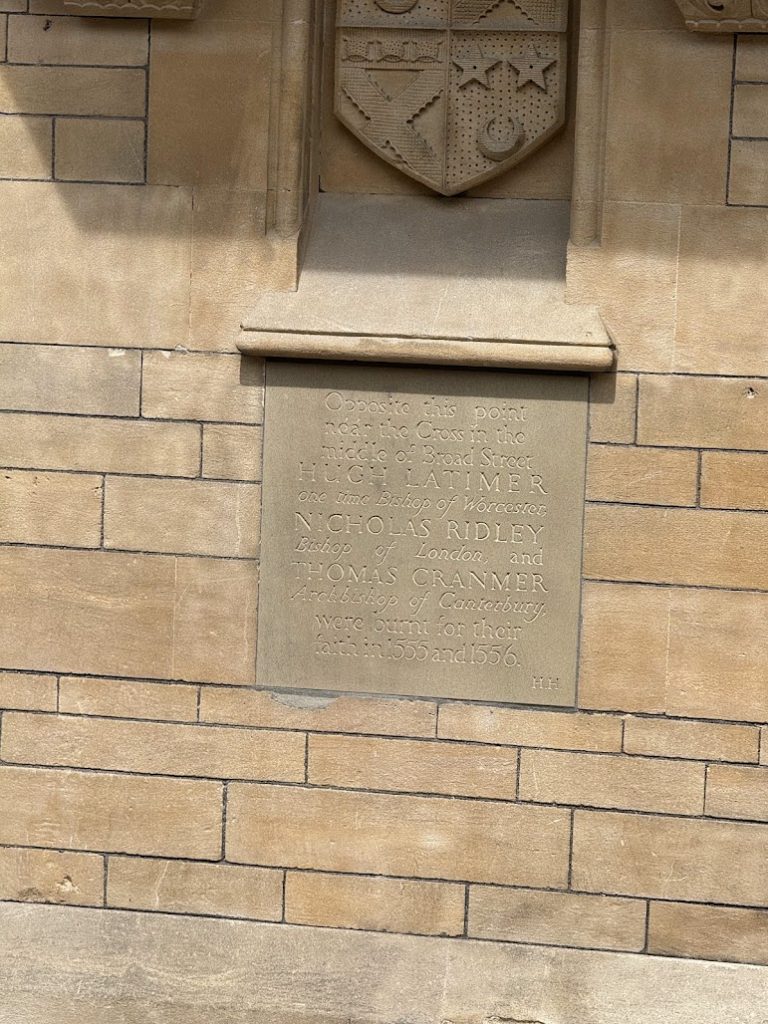
The men were burnt at the stake just outside the city walls to the north, where Broad Street is now located. Latimer and Ridley were burnt on 16 October 1555 for denying the Roman Catholic dogma of Transubstantiation. Cranmer was burnt five months later on 21 March 1556.[2]
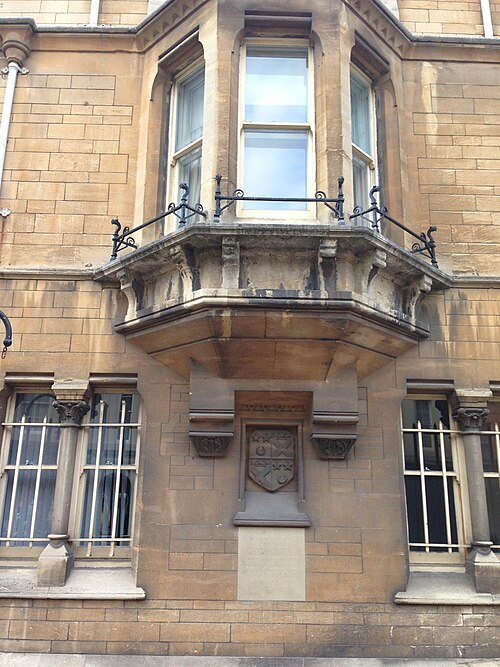
A small area paved with granite setts forming a cross in the centre of the road outside the front of Balliol College marks the site.[2][3] The Victorian spire-like Martyrs’ Memorial, at the south end of St Giles’ nearby, commemorates the events.

Martyrdom of Thomas Cranmer
As the flames drew around him, [Thomas Cranmer] fulfilled his promise by placing his right hand into the heart of the fire, calling it “that unworthy hand”. His dying words were, “Lord Jesus, receive my spirit. I see the heavens open and Jesus standing at the right hand of God.”[108]
_____
Image Source/Credit (in order):
• Photo by the author
• Set in Stone Project, CC BY-SA 4.0 <https://creativecommons.org/licenses/by-sa/4.0>, via Wikimedia Commons
• Tony Holding, CC BY-SA 3.0 <https://creativecommons.org/licenses/by-sa/3.0>, via Wikimedia Commons