
Erwin Lutzer in the Saxon Tower:
I’m here in a very important room in Oxford, England. When Mary Tudor became the Queen, that was in 1553, she believed it was her responsibility to turn the clock back and to make England into a Catholic country again. To do this, she martyred a number of people, and the most famous three of them were imprisoned in some rooms just above me. The three prisoners, Nicholas Ridley, Hugh Latimer, the two of them, they were burned at the stake. And then seven months later, a man by the name of Thomas Cramner was also burned. we must recognize the importance of martyrdom, the willingness of these three men to suffer for the gospel of Jesus Christ. It’s important for us to understand who these men were, what their names were, and why it is that they were willing to give their lives for the gospel. And to answer this question, would we be as willing to die as a martyr as they were?
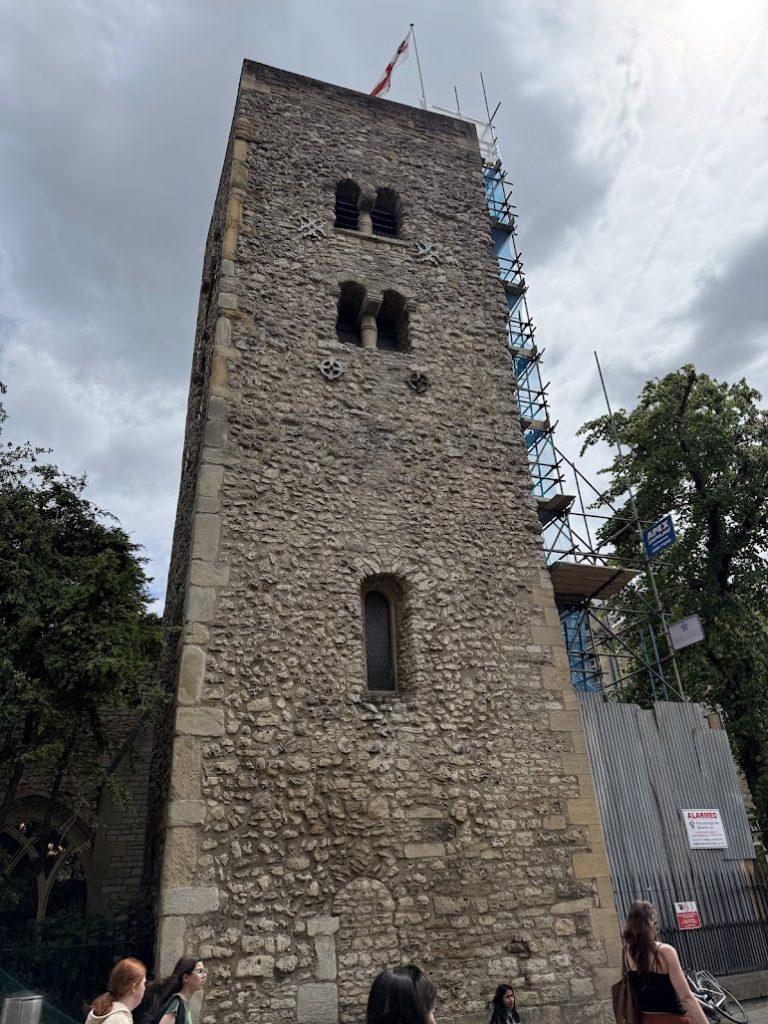
The Saxon Tower of St Michael at the North Gate in Oxford is one of the oldest surviving structures in the city and holds a quiet but significant place in the history of the English Reformation. Dating from around the year 1040, this sturdy stone tower is a rare example of late Saxon architecture, standing as a witness to centuries of change in both church and state. Among its many historical associations, it is traditionally linked with the imprisonment of three leading Protestant figures: Nicholas Ridley, Hugh Latimer, and Thomas Cranmer.
Originally part of a church dedicated to St. Michael at the North Gate, the tower once stood beside one of the main entrances to the walled city of Oxford. Its solid construction and elevated position made it suitable not only for ecclesiastical use but also for defensive and civic purposes. Over time, as Oxford developed into an important center of learning and religious life, the building took on additional functions, including serving as a place of confinement.
During the reign of Mary I of England, the city of Oxford became a focal point for the prosecution of Protestant leaders. After their arrest, Ridley, Latimer, and Cranmer were brought to Oxford to face charges of heresy. While historical records indicate that they were held in various locations throughout the city, including Bocardo Prison near the North Gate, local tradition has long associated the Saxon Tower with their confinement or with the broader complex in which they were detained.
Nicholas Ridley, the former Bishop of London, and Hugh Latimer, Bishop of Worcester, were imprisoned for many months as they awaited trial. Both men were examined repeatedly and urged to recant their Protestant beliefs, particularly their rejection of the doctrine of transubstantiation. Despite the pressure, they remained steadfast. Thomas Cranmer, Archbishop of Canterbury and the principal architect of the English Reformation, was likewise held in Oxford under strict conditions, facing a prolonged and complex series of interrogations.
The proximity of the Saxon Tower to the site of their eventual execution adds to its historical resonance. In October 1555, Ridley and Latimer were burned at the stake in Oxford, followed by Cranmer in March 1556. These events, which took place during a time of intense religious conflict, left a lasting mark on the city and on the course of English history.
Today, the Saxon Tower remains a striking reminder of Oxford’s deep past. Visitors who climb its narrow steps can view the city from above, taking in landmarks that have stood for centuries. Yet beyond its architectural interest, the tower carries a deeper significance as a symbol of endurance and memory.
The legacy of the Saxon Tower lies in its connection to a period when questions of faith were matters of life and death. Whether or not it served directly as the primary prison for Ridley, Latimer, and Cranmer, it stands within the historical landscape of their suffering and witness. It represents a time when conviction was tested under severe trial and when the cost of holding to one’s beliefs could be extraordinarily high.
In its quiet strength, the Saxon Tower continues to bear witness to these events. It invites reflection on the courage of those who endured imprisonment and death, and it preserves the memory of a defining chapter in the history of the English Reformation.
♦ _____ ♦
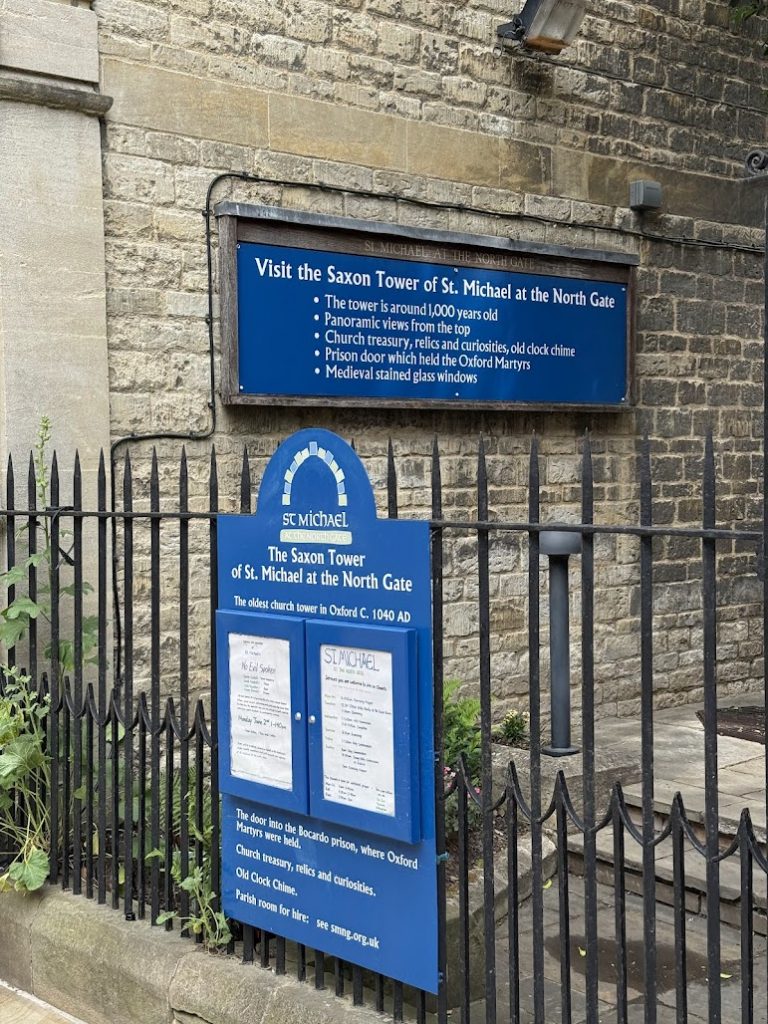
Location of the jailing of Nicholas Ridley, Hugh Latimer, and Thomas Cranmer.
Wikipedia:
The Oxford Martyrs were imprisoned in the Bocardo Prison by the church before they were burnt at the stake in what is now Broad Street nearby, then immediately outside the city walls, in 1555 and 1556. Their cell door can be seen on display in the church’s tower.
_____
Image Source/Credit (in order):
• I, Sailko, CC BY-SA 3.0 <https://creativecommons.org/licenses/by-sa/3.0>, via Wikimedia Commons
• Photo by the author
Related
Sorry, no records were found. Please adjust your search criteria and try again.
Sorry, unable to load the Maps API.