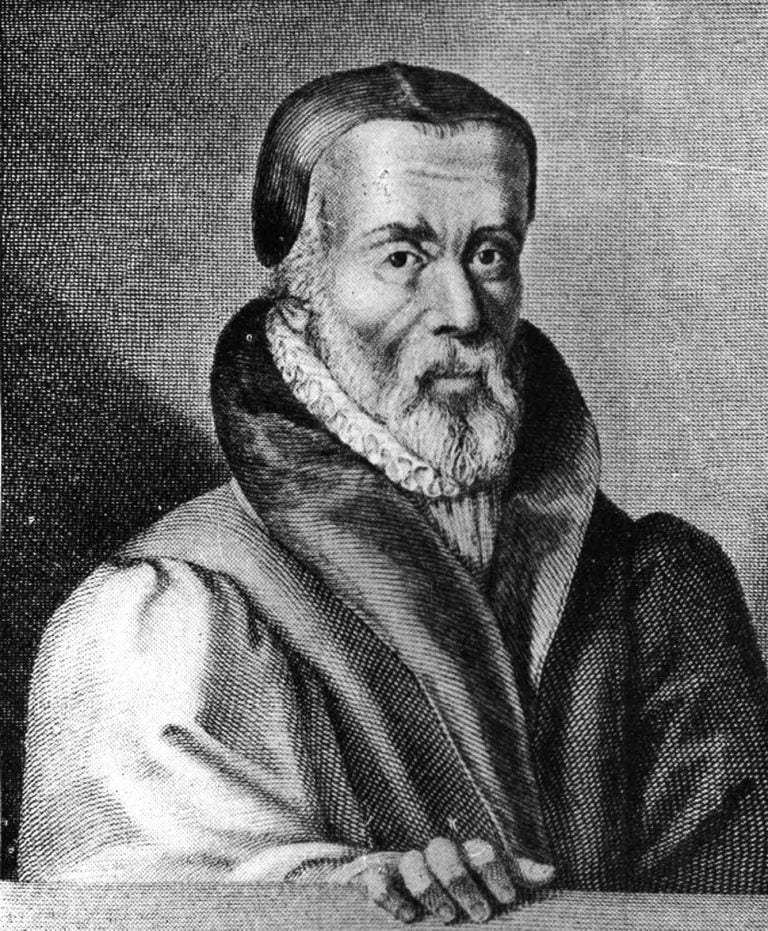
The William Tyndale Stained Glass Window stands as a vivid tribute to one of the most influential figures in the history of the English Bible, William Tyndale. Located in London, a city deeply connected to the religious transformations of the sixteenth century, the window commemorates Tyndale’s life, his work in translating Scripture into English, and the enduring impact of his sacrifice.
William Tyndale (c. 1494–1536) was a scholar and reformer whose greatest contribution was his translation of the Bible into English from the original Hebrew and Greek texts. At a time when access to Scripture was largely restricted to Latin, Tyndale believed that ordinary people should be able to read the Bible in their own language. His famous declaration—that he would cause even a plowboy to know more of the Scriptures than learned clergy—captures the conviction that guided his life’s work.
The stained glass window dedicated to Tyndale reflects both his mission and his martyrdom. Through the use of color, light, and symbolic imagery, the window tells the story of a man who risked—and ultimately gave—his life to make the Bible accessible. Common elements in such depictions include scenes of translation, the printing of English Scriptures, and representations of persecution. The artistry of stained glass allows these themes to be conveyed in a way that is both visually striking and spiritually meaningful.
London is a fitting setting for this memorial. During Tyndale’s lifetime, the city was a center of political and religious authority, as well as a hub for printing and intellectual exchange. Although Tyndale himself spent much of his later life in exile on the European continent to avoid persecution, his work had a profound influence in England. Copies of his English New Testament were smuggled into the country, where they circulated widely despite official opposition.
The window serves as a reminder of the cost associated with Tyndale’s work. His translation efforts were condemned by authorities, and he was eventually arrested, tried, and executed. His final words, traditionally recorded as a prayer that the king’s eyes would be opened, are often remembered as a testament to his faith and dedication. In time, his hope was realized, as English translations of the Bible gained acceptance and became central to religious life in England.
The legacy of Tyndale’s translation work cannot be overstated. Much of his phrasing and structure found their way into later English Bibles, including the King James Bible. His influence on the English language itself is also significant, as many familiar biblical expressions can be traced back to his work. The stained glass window, therefore, honors not only a historical figure but also a lasting contribution to literature, faith, and culture.
As a work of art, the window invites contemplation. The interplay of light and color transforms the space in which it stands, creating an atmosphere that encourages reflection on the themes it represents. Visitors who encounter the window are reminded of the power of conviction and the importance of making truth accessible to all.
Today, the William Tyndale Stained Glass Window continues to draw the attention of those interested in church history, the development of the English Bible, and the broader story of the Protestant Reformation. It stands as both a memorial and a teaching tool, connecting the past with the present.
In conclusion, the William Tyndale Stained Glass Window in London serves as a lasting tribute to a man whose work changed the course of history. Through its artistry and symbolism, it preserves the memory of Tyndale’s courage and commitment, reminding viewers of the enduring value of faith, perseverance, and the pursuit of truth.
♦ _____ ♦
From Hertford:
The window was made in 1911 by the glazier James Powell at the Whitefriars Glassworks in the City of London to commemorate the centenary of the British and Foreign Bible Society. When the Bible Society moved out of London in 1985 they gave the window to the college. Its restoration and installation in the Chapel by the glazier David Worsley and the architect Robert Adam were made possible by a bequest from The Hon. Roland Michener (late Honorary Fellow) and by donations from the Drapers’ Company, the Hertford Society, and many old members of the College. It was dedicated by the then Bishop of Oxford, the Rt Revd Richard Harries, on 24 April 1994.
_____
Image Source/Credit:
• Foxe’s Book of Martyrs, Public domain, via Wikimedia Commons
Related

Sorry, no records were found. Please adjust your search criteria and try again.
Sorry, unable to load the Maps API.