
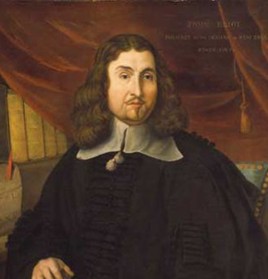
John Eliot occupies a distinctive place in early American history as one of the first European missionaries to devote his life to evangelizing Indigenous peoples in New England. Known often as the “Apostle to the Indians,” Eliot’s work combined religious conviction, linguistic scholarship, and a deep—though historically complex—commitment to cross-cultural engagement. His life and legacy are closely tied to the early colonial period of Massachusetts, where he spent decades laboring among Native communities.
Born in 1604 in Widford, Hertfordshire, England, Eliot was educated at Cambridge University, where he was shaped by Puritan theology. In 1631, he emigrated to New England, joining the wave of Puritan settlers seeking religious freedom and reform. He eventually became pastor of the church in Roxbury, Massachusetts, a position he would hold for more than fifty years. While faithfully serving his congregation, Eliot developed a growing conviction that the Christian gospel should also be shared with the Indigenous peoples of the region.
In the mid-seventeenth century, Eliot began what would become his life’s defining mission: learning the language of the Massachusett (Algonquian-speaking) people. At a time when few Europeans attempted serious linguistic study of Native languages, Eliot undertook the task with remarkable dedication. He worked closely with Native speakers, compiling vocabulary, grammar, and syntax until he was able to translate complex theological texts. His most significant linguistic achievement was the translation of the Bible into the Massachusett language, published in 1663 as the first complete Bible printed in what is now the United States.
Eliot’s missionary efforts were not limited to translation. He also established “praying towns,” settlements intended for Native converts who adopted Christianity and, to varying degrees, European customs. These communities were designed to integrate religious instruction with agriculture, literacy, and governance modeled on English Puritan ideals. While Eliot saw these towns as expressions of spiritual transformation and social order, modern historians recognize them as part of a broader and often coercive colonial system that reshaped Indigenous life.
The most well-known praying town was Natick, founded in 1651. There, Eliot and Native Christian leaders worked to build a self-sustaining community grounded in Christian worship and communal discipline. Native teachers and preachers played a central role in instruction, and Eliot increasingly relied on Indigenous collaborators to carry forward the work. This partnership highlights an important aspect of his mission: although initiated by Eliot, the movement depended significantly on Native agency and leadership.
Eliot’s legacy is closely connected to the broader context of Puritan missionary activity during a period of intense conflict and change. The outbreak of King Philip’s War (1675–1676), a devastating conflict between Native nations and English settlers, deeply affected Eliot’s work. Some Christian Native communities were caught in the violence, and trust between groups was severely strained. Eliot himself continued his ministry during and after the war, though the conditions for missionary work became increasingly difficult.
Despite these challenges, Eliot persisted in his efforts well into old age. He continued preaching, translating, and advising Native Christian communities until his death in 1690. By the end of his life, his mission had produced a substantial body of translated literature, including catechisms, instructional texts, and portions of Scripture, all aimed at supporting Native Christian life.
The impact of Eliot’s work is complex and remains a subject of historical debate. On one hand, he is recognized for his extraordinary linguistic achievement and his sincere commitment to communicating his faith across cultural boundaries. His Bible translation remains a landmark in the history of American printing and Native language documentation. On the other hand, his mission was deeply embedded in the colonial framework of seventeenth-century New England, which often sought to reshape Indigenous societies according to European norms.
In later centuries, Eliot’s reputation evolved alongside changing perspectives on colonization and Indigenous history. Some historians have emphasized his respect for Native language and his reliance on Indigenous teachers, while others critique the broader implications of “praying town” systems as instruments of cultural transformation and control. Both perspectives contribute to a fuller understanding of his legacy.
Today, John Eliot is remembered as a figure who embodied both the religious zeal and the cultural complexities of early colonial America. His life reflects a combination of deep personal conviction, scholarly diligence, and participation in a historical moment marked by both encounter and conflict. His influence endures not only in religious history but also in the study of Native languages and the early printed record of North America.
In sum, Eliot’s life and legacy cannot be reduced to a single narrative. He was a missionary, translator, pastor, and cultural intermediary whose work shaped early New England in lasting ways. His impact continues to be studied as part of the broader story of how faith, language, and colonial history intersected in the formation of American society.
_____
Image Source/Credit:
• Roxbury Latin School, Public domain, via Wikimedia Commons
Related
Sorry, no records were found. Please adjust your search criteria and try again.
Sorry, unable to load the Maps API.