
The First Baptist Church of Boston stands as one of the oldest Baptist congregations in the United States, with a history that reaches back to 1665. Its story reflects both the struggle for religious liberty in colonial New England and the enduring influence of Baptist convictions on American life.
The church was founded during a time when the Massachusetts Bay Colony enforced strict Puritan religious conformity. Baptists, who rejected infant baptism in favor of believer’s baptism, were viewed as dissenters. Early members of the Boston congregation faced persecution, imprisonment, and public punishment. One of the earliest figures associated with the Baptist movement in the region, Obadiah Holmes, was famously whipped in 1651 for his beliefs, an event that underscored the harsh intolerance of the period.
Despite opposition, the congregation formally organized in 1665. Its first pastor, Thomas Gould, and many early members endured fines and imprisonment for practicing their faith. At one point, colonial authorities even nailed shut the doors of their meetinghouse in an attempt to halt their gatherings. Undeterred, the congregation continued meeting in secret homes and, at times, disguised their worship as ordinary social activity.
Over time, conditions gradually improved. By the late 17th century, the church established a meetinghouse in Boston’s North End. In the 18th century, under the long pastorate of Samuel Stillman (1764–1807), the congregation flourished. Stillman became a prominent voice during the American Revolution, reportedly preaching against British occupation while maintaining regular services.
The church’s influence extended beyond Boston. In 1682, members helped establish a Baptist congregation that eventually relocated to Charleston, South Carolina, becoming one of the earliest Baptist churches in the South. This expansion highlights the role of the Boston church in spreading Baptist principles throughout early America.
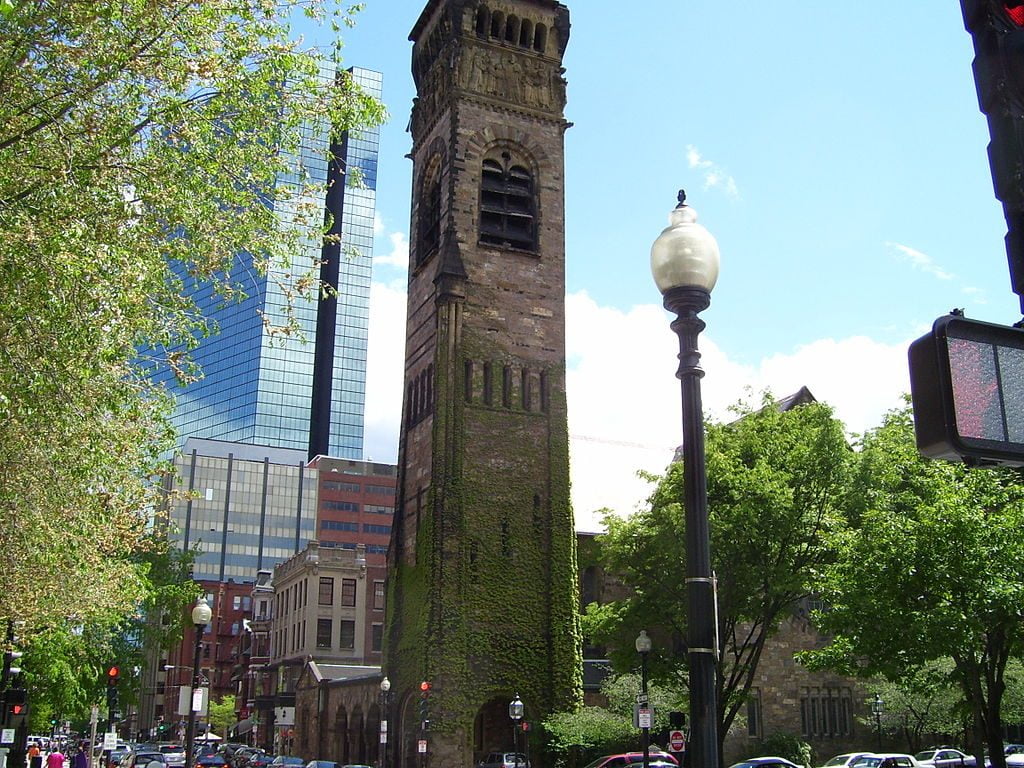
During the 19th century, the congregation moved several times as Boston grew and changed. It relocated to Beacon Hill in 1854, where its steeple became a prominent feature of the city skyline. Later, in 1881, the church purchased its current building in Boston’s Back Bay. This structure, originally built in 1872 and designed by renowned architect Henry Hobson Richardson, is an architectural landmark. Its distinctive Romanesque style and sculptural details—created by Frédéric Auguste Bartholdi—link the church to broader currents in American art and design.
The impact of the First Baptist Church of Boston extends beyond architecture and longevity. From its earliest days, it stood as a witness to the principle of religious freedom, challenging the dominance of established churches in colonial society. Its persistence helped lay groundwork for the broader acceptance of religious diversity in America.
In addition, the church has played a role in shaping Baptist identity in the United States. Through preaching, church planting, and theological leadership, it contributed to the spread of Baptist beliefs emphasizing individual conscience, believer’s baptism, and congregational governance.
Today, the First Baptist Church of Boston remains an active congregation affiliated with the American Baptist Churches USA. Its long history serves as a reminder of the cost of religious conviction and the gradual emergence of liberty of conscience as a defining American value.
_____
Image Source/Credit:
• Original uploaded by Swampyank (Transfered by archinform), CC BY-SA 3.0 <https://creativecommons.org/licenses/by-sa/3.0>, via Wikimedia Commons
Related
Sorry, no records were found. Please adjust your search criteria and try again.
Sorry, unable to load the Maps API.