Phillips Brooks wrote “O Little Town of Bethlehem” – but as David Larsen pointed out, “like his preaching, even the hymn lacks strong Christological affirmation.”
Larsen quotes from his successor’s biography of Brooks:
His mother had in the earlier years of his ministry feared for his faith, and she had prayed mightily that he might remain true. She warned him against a certain volume of sermons, “They tear the view of Christ’s vicarious suffering all to pieces. I hope you do not own the book, but if you do, I want you to burn it with Frederick [his brother] present to witness and exult over it.” No, my dear child; remember, you have promised to preach Christ and Him crucified in the true meaning of the words, and I charge you to stand firm.
Instead, Brooks “produced a bland religion of reassurance” and “emasculated Christianity.”
_____
Hymn History: O Little Town of Bethlehem
Author: Phillips Brooks
“The world has grown weary through the years, but at Christmas it is young.”
(Phillips Brooks)
The Origin of the Hymn “O Little Town of Bethlehem”
The beloved Christmas carol “O Little Town of Bethlehem” was born out of personal experience, pastoral reflection, and the devotional spirit of nineteenth-century American Protestantism. Its author, Phillips Brooks, wrote the text in 1868 after visiting the Holy Land. The hymn’s quiet reverence and thoughtful imagery reflect both the physical setting that inspired it and the theological depth of the man who penned it.
Phillips Brooks (1835–1893) was an Episcopal clergyman known for his powerful preaching and dignified presence. Educated at Harvard and Virginia Theological Seminary, he served prominent congregations in Philadelphia and later in Boston, eventually becoming Bishop of Massachusetts. Brooks combined intellectual strength with pastoral warmth, and his sermons often emphasized the living presence of Christ in the life of the believer.
In 1865, shortly after the end of the American Civil War, Brooks traveled to the Holy Land. On Christmas Eve of that year, he attended a worship service at the Church of the Nativity in Bethlehem. Later, he rode on horseback across the fields traditionally associated with the shepherds who first heard the angelic announcement of Christ’s birth. The experience left a lasting impression. Years afterward, he recalled the stillness of that night and the sense of sacred history surrounding the small Judean town.
Three years later, while serving as rector of Holy Trinity Church in Philadelphia, Brooks sought a new hymn for the children’s Christmas service. Drawing on his memories of Bethlehem, he wrote “O Little Town of Bethlehem” for the occasion. The text was completed in 1868 and first sung by the Sunday school children that year.
The opening stanza sets the tone:
O little town of Bethlehem,
How still we see thee lie;
Above thy deep and dreamless sleep
The silent stars go by.
Brooks emphasizes stillness and quiet. Unlike some Christmas hymns that celebrate with exuberant proclamation, this carol invites contemplation. Bethlehem is portrayed as peaceful and unnoticed, even as the most significant event in human history unfolds within it. The contrast between the town’s outward calm and the cosmic importance of Christ’s birth runs throughout the hymn.
The second stanza highlights the Incarnation:
For Christ is born of Mary;
And, gathered all above,
While mortals sleep, the angels keep
Their watch of wondering love.
Here Brooks weaves together earth and heaven. Humanity sleeps, largely unaware, while angels observe with awe. The birth of Christ is both humble and glorious. This blending of simplicity and majesty reflects Brooks’s broader theological outlook: God enters the ordinary world in extraordinary grace.
Perhaps the most beloved lines appear in the third stanza:
How silently, how silently
The wondrous gift is given!
So God imparts to human hearts
The blessings of His heaven.
Brooks moves from historical narration to spiritual application. The quietness of Bethlehem becomes a symbol of how God works within the human heart. The “wondrous gift” is not only the infant in the manger but also the grace offered to believers. The hymn suggests that divine action is often gentle rather than dramatic, personal rather than public.
The final stanza turns into prayer:
O holy Child of Bethlehem,
Descend to us, we pray;
Cast out our sin and enter in,
Be born in us today.
This petition reflects the evangelical emphasis common in American Protestantism of the period. The birth of Christ is not merely a past event to be remembered; it is a present reality to be embraced. The singer asks that Christ dwell within the heart, bringing forgiveness and renewal.
The music most commonly associated with the hymn was composed by Lewis H. Redner, who served as organist at Holy Trinity Church. According to tradition, Redner struggled to find an appropriate melody until shortly before the Christmas service, when inspiration came in the night. The tune he produced, known as ST. LOUIS, is gentle and flowing, matching the reflective character of the text.
In Britain and other parts of the world, the hymn is often sung to a different melody, FOREST GREEN, adapted by Ralph Vaughan Williams from an English folk tune. This alternative setting gives the carol a slightly different tone but preserves its contemplative spirit.
“O Little Town of Bethlehem” quickly gained popularity beyond its original parish setting. Its combination of poetic imagery, theological depth, and singable melody secured its place in Christmas services across denominations. It speaks not only of a distant historical event but of God’s ongoing work in the world.
More than a century and a half after its first performance, the hymn continues to draw worshipers into quiet reflection. In its measured lines, Phillips Brooks captured both the humility of Christ’s birth and the profound hope it brings. The little town may have seemed unnoticed beneath the silent stars, but from it came a light that has never ceased to shine.
_____
Image Source/Credit:
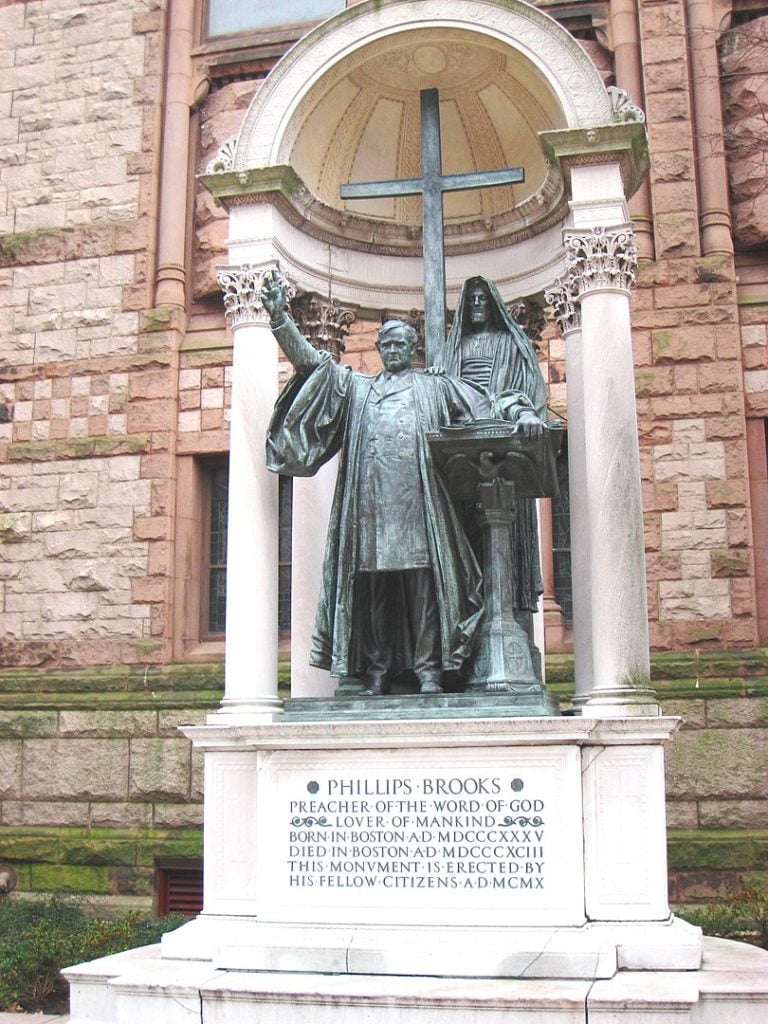
• Sculptor Augustus Saint-Gaudens (1848-1907). Daderot took this photograph., Public domain, via Wikimedia Commons
Related
Sorry, no records were found. Please adjust your search criteria and try again.
Sorry, unable to load the Maps API.